



On April 1, 2026, NASA launched Artemis II, the first crewed flight of the Artemis program and the first time humans have traveled beyond low Earth orbit since Apollo 17 in 1972.
The mission carries four astronauts on a roughly 10-day journey around the Moon aboard the Orion spacecraft, named Integrity by the crew.
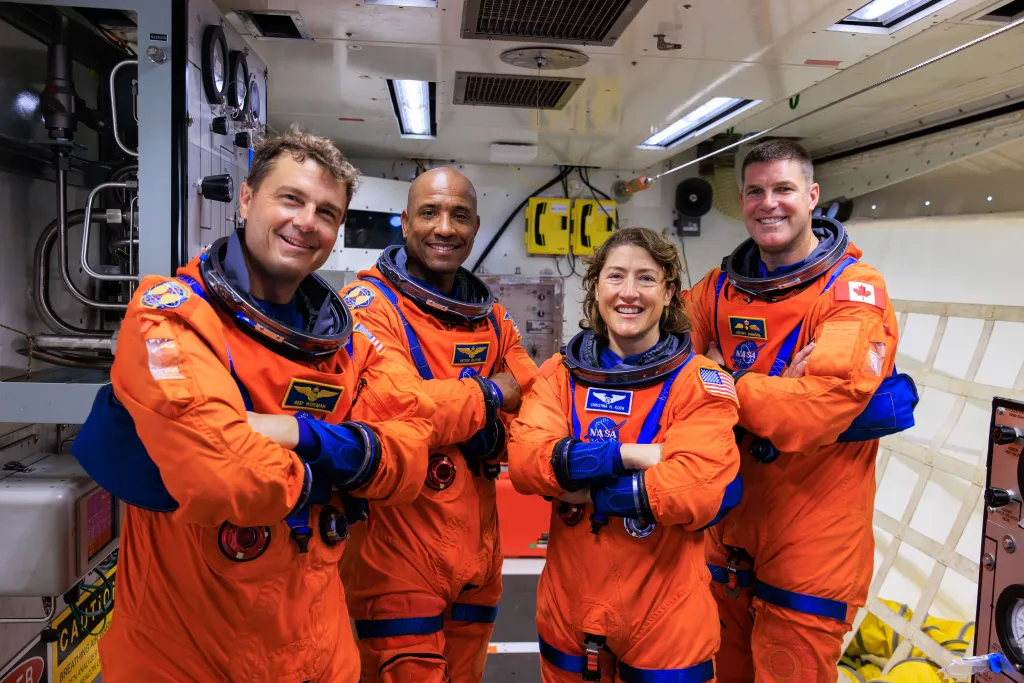
The Artemis II Crew and What They Represent
Commander Reid Wiseman, pilot Victor Glover, mission specialist Christina Koch, and Canadian Space Agency astronaut Jeremy Hansen lifted off from Kennedy Space Center’s Launch Complex 39B. Glover, Koch, and Hansen have already made history as the first Black person, the first woman, and the first non-U.S. citizen to travel to the lunar vicinity respectively. While the mission wasn’t built around that symbolism, the symbolism still matters.
A Rocket That Had to Work the First Time With Crew
At liftoff, the twin solid rocket boosters ignited first, delivering more than 75% of the thrust needed to lift the 5.75-million-pound rocket off the pad. Their combined power, along with the four RS-25 engines already at full thrust, generated 8.8 million pounds of force.
The SLS had only flown once before, on the uncrewed Artemis I mission in 2022. This was its first launch with people on board. Engineers had to replace one of the core stage’s RS-25 engines, E2063, with E2061 in April 2025 after detecting a leak in the oxygen valve hydraulics.
During a wet dress rehearsal in early February 2026, a liquid hydrogen leak was detected during the simulated countdown, forcing NASA to postpone the intended launch to April. A second wet dress rehearsal on February 19 went successfully, but a helium flow issue in the upper stage then triggered a rollback to the Vehicle Assembly Building, pushing the mission to April.
The SLS had only flown once before, on the uncrewed Artemis I mission in 2022. This was its first launch with people on board. Engineers had to replace one of the core stage’s RS-25 engines, E2063, with E2061 in April 2025 after detecting a leak in the oxygen valve hydraulics.
During a wet dress rehearsal in early February 2026, a liquid hydrogen leak was detected during the simulated countdown, forcing NASA to postpone the intended launch to April. A second wet dress rehearsal on February 19 went successfully, but a helium flow issue in the upper stage then triggered a rollback to the Vehicle Assembly Building, pushing the mission to April.
The Heat Shield Problem That Almost Grounded the Mission
The most contested issue in the months before launch was the Orion heat shield. Post-flight inspections of Artemis I revealed that the heat shield did not allow enough of the gases generated inside the Avcoat ablative material to escape, which caused some of the material to crack and break off during reentry. Avcoat is designed to wear away as temperatures approach 5,000 degrees Fahrenheit on return from the Moon, so some erosion is expected. The pattern seen after Artemis I was not.
NASA delayed the Artemis II launch and announced that it had identified the root cause which was that gases generated inside the heat shield’s outer layer could not vent and dissipate as expected, allowing pressure to build and cracking to occur. Rather than replace the shield entirely, NASA decided to modify the reentry trajectory to reduce heat exposure.
In January 2026, NASA’s administrator assembled heat-shield engineers, the chair of an independent review team, and senior human spaceflight officials to meet with outside experts. The analysis concluded that Orion’s thick composite base, which contains a titanium framework, could keep the crew safe even if the Avcoat blocks outside it were entirely stripped away. Not everyone was satisfied.
Leaving Earth Behind
The critical engine burn happened at 7:49 p.m. EDT on April 2, the day after launch, and lasted 5 minutes and 55 seconds. This was the translunar injection burn, needed to send the crew out of Earth orbit and toward the Moon. NASA had the crew stay close to home for a day to test the capsule’s life-support systems before clearing them for lunar departure. The burn was confirmed as successful by teams on the ground.
The Orion capsule will zoom 4,000 miles beyond the Moon before turning back, giving the crew unprecedented views of the lunar far side. The crew will also break the all-time human distance record from Earth, set by the Apollo 13 crew in 1970.
What Artemis II Is Actually Testing
Artemis II is not a landing mission. Its primary purpose is to test the Orion spacecraft’s life support systems for the first time with humans aboard, laying the groundwork for future crewed Artemis missions.
The mission will also demonstrate the Orion Artemis II Optical Communications System, which uses a 4-inch telescope and two gimbals to establish a laser communication link with ground stations in California and New Mexico, targeting downlink rates of up to 260 megabits per second.
Splashdown is scheduled off the coast of San Diego, with recovery teams retrieving the crew using helicopters and delivering them to the USS John P. Murtha for post-mission medical evaluations. The heat shield will face its real test on that return. Whatever condition it arrives in will determine more about the future of the Artemis program than almost anything else that happens on this mission.
