


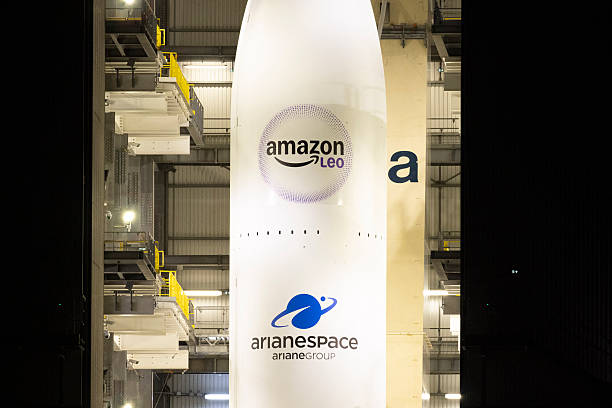
Launching thousands of satellites takes years. Buying a company that already has satellites in orbit, government permissions to operate them, and an established customer base takes considerably less time. That shortcut is what Amazon is paying roughly $11.57 billion for, after recently signing a merger agreement with satellite company Globalstar. The deal is expected to close in 2027, pending regulatory approval.
Amazon wants to use Globalstar’s satellites and radio frequency licenses to add a direct-to-direct feature to its satellite internet service, Amazon Leo. Direct-to-device allows satellites to connect directly to smartphones without needing a separate router or terminal. This means a person in a remote area with no cell tower nearby could still send a message or make a call using just their phone.
What Is Amazon Actually Acquiring?
Amazon is buying all of Globalstar’s satellite operations, physical infrastructure, and the radio frequency spectrum licenses that Globalstar holds. These licenses are government-issued permissions that allow a company to transmit signals on specific radio frequencies. Without them, Amazon cannot legally run direct-to-device services at a global scale.
The e-commerce and tech giant also structured the acquisition as a cash-and-stock offer, giving Globalstar shareholders the choice to receive either $90 per share in cash or the equivalent value in Amazon stock. At this price, the deal gives Amazon all of Globalstar’s satellite operations, physical infrastructure, and the radio frequency spectrum licenses that Globalstar holds.
Globalstar currently has more than 24 satellites in orbit and has agreements to acquire more than 50 additional satellites. Amazon’s plan is to run Globalstar’s satellites alongside its existing, over 200 Amazon Leo broadband satellites as one combined network.
Where Amazon Leo Stands Today
Formerly dubbed “Project Kuiper,” Amazon built Amazon Leo by putting 200 satellites into orbit over the last seven years and plans to add several thousand more in the coming years. The service is scheduled to launch commercially in mid-2026, with paying customers from enterprises and governments already lined up.
However, the gap between Amazon Leo and its main rival is still wide. SpaceX’s Starlink had over 10,000 satellites in orbit as of April 2026 and had reached 10 million subscribers in February 2026.
Amazon will be using the Globalstar acquisition to move faster, specifically in the direct-to-device market where Globalstar already has years of operational experience and the required government approvals to operate globally.
The Apple Connection
Globalstar’s existing business is also closely tied to Apple, as it currently powers satellite features on the iPhone 14 and later models, as well as the Apple Watch Ultra 3. This allows users to text emergency services, share their location, and request roadside assistance when they have no cell signal.
Apple holds a 20% stake in Globalstar from a $1.5 billion investment it made in 2024, which made Apple a significant stakeholder in the acquisition negotiations.
As part of the overall agreement, Amazon and Apple signed a separate deal for Amazon Leo to take over the provision of these satellite services for current and future iPhone and Apple Watch models. For existing iPhone users, nothing changes immediately. Globalstar’s network will continue operating as it does now, and iPhone satellite features will keep working without any disruption.
What Comes Next
Amazon Leo is also slated to deploy its own direct-to-device satellite system from 2028, which would integrate with its current broadband and satellite systems. The company’s long-term goal is a network capable of supporting hundreds of millions of customer endpoints globally across consumer, enterprise, government, and IoT segments.
Amazon’s total space infrastructure investment now exceeds $21 billion when combining the original Project Kuiper budget with the Globalstar acquisition. The Globalstar deal still needs to clear regulatory hurdles before it becomes final and must also meet specific satellite deployment milestones for the full transaction value to hold.
But if it closes as expected, Amazon will enter 2027 with considerably more orbital infrastructure, licensed spectrum, and an established consumer partnership through Apple than it holds today.
