


In defense technology, government contracts are often the foundation that private investment builds on. The government lays the groundwork and then venture capital follows. That pattern just played out with True Anomaly.
Four days after the U.S. Space Force named it among 12 companies selected to develop space-based interceptors for the Golden Dome program, the Colorado-based startup announced a $650 million Series D funding round, pushing its valuation to $2.2 billion.
What True Anomaly Builds
The company builds three things. The first is Jackal, a multirole autonomous orbital vehicle roughly the size of a small refrigerator, designed to be mission-configurable for inter-satellite operations. The second is Mosaic, a software platform that translates commander intent into autonomous action for mission planning, analytics, and tactical decision-making. The third, which was added following its Golden Dome selection, is space-based interceptors designed to engage missile threats in boost, midcourse, and glide phases of flight.
True Anomaly opened for business in 2022 to exclusively focus on defense and national security space efforts. It has no commercial satellite business, no telecommunications revenue, and no launch division. Everything it builds is for military use.
How True Anomaly Fits Into Golden Dome
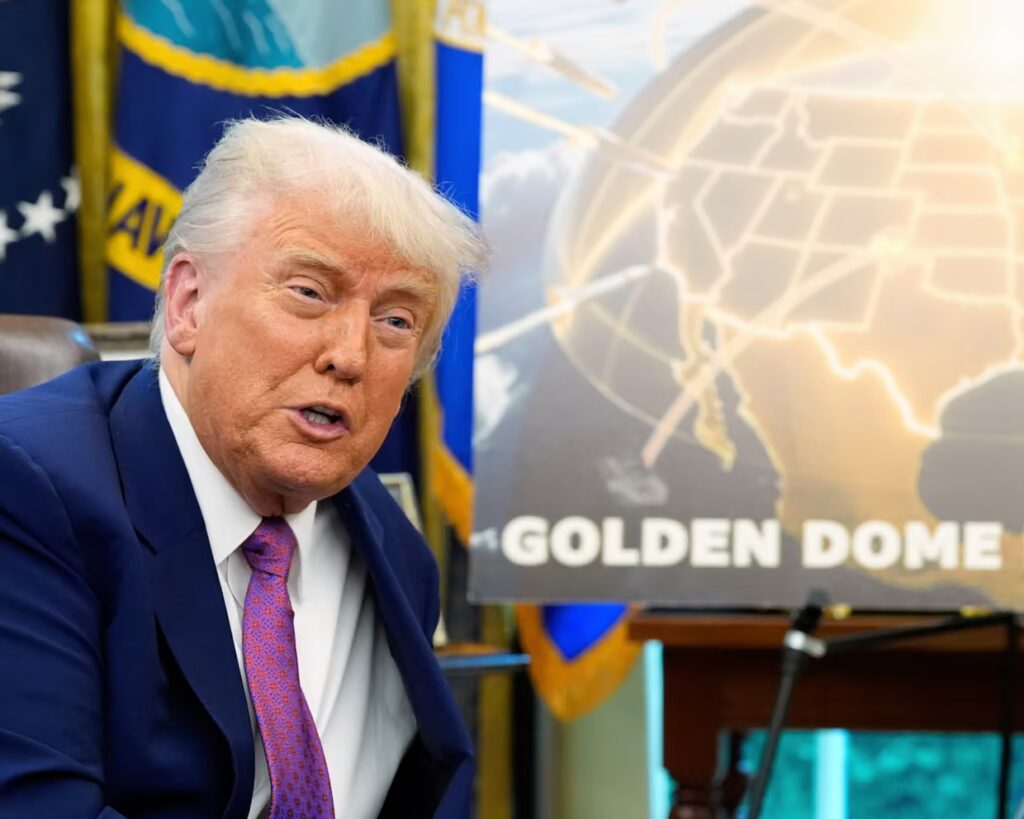
Golden Dome is a proposed multilayered missile defense shield designed to intercept a wide range of threats, from cruise missiles and drones to intercontinental ballistic missiles and hypersonic weapons. Unlike traditional ground-based systems, the Golden Dome will leverage a network of satellites and space-based interceptors to detect and neutralize incoming threats, including those launched from space.
The space-based interceptor (SBI) component envisions a proliferated constellation in low Earth orbit capable of engaging threats in their boost phase, the most vulnerable point in a missile’s trajectory but the hardest to reach from the ground. Targeting missiles at that stage, while they are still gaining speed and emitting heat, gives interceptors the clearest window to act before a missile can deploy decoys or maneuver.
The 12 companies selected for SBI prototype development span the full spectrum of American defense, including Lockheed Martin, Northrop Grumman, Raytheon, General Dynamics, Booz Allen Hamilton, SpaceX, Anduril Industries, GITAI USA, Quindar, Sci-Tec, Turion Space, and True Anomaly.
What the $650 Million Covers
True Anomaly plans to use the funding for new product launches and a major factory expansion, with plans to grow from 140,000 square feet to 2 million square feet over the next four years.
On the hiring front, the company has grown from around 150 employees in 2025 to approximately 300 today, with a stated goal of reaching 500 by the end of 2026.
The Adversaries True Anomaly Is Building Against
True Anomaly has been clear about what is driving the urgency behind the raise. In its announcement, the company said the funding reflects “the urgency of the moment the United States and its Allies face in ensuring freedom of action in space,” adding that the window to establish space superiority is open but narrowing rapidly. The company goes ahead to identify China and Russia as the primary adversaries the U.S. must compete with to achieve space superiority in orbit.
CEO and Co-founder Even Rogers, speaking to CNBC, confirmed that position directly, saying, “Space is a war-fighting domain, and our adversaries are building space war-fighting capabilities at a scale that we’ve never seen.”
For a company that has raised $1 billion in four years, built its entire business around a single mission, and now holds a U.S. Space Force contract to manufacture interceptors for the most expensive missile defense program in American history, the $650 million investment is also a sign that private capital believes the threat is real and the work is worth funding.
