


Close Menu

    Stay Ahead with Exclusive Updates!

    Enter your email below and be the first to know what’s happening in the ever-evolving world of technology!

    What's Hot

    How SentinelOne’s New Security System Monitors Rogue Enterprise AI Agents

    November 14, 2026

    Google Unveils Gemini 4 Carbon AI Model Built for Cybersecurity

    November 14, 2026

    Upwind Raises $400 Million After Rejecting Datadog Acquisition Offer

    November 9, 2026
    Facebook X (Twitter) Instagram
    Facebook X (Twitter)
    PhronewsPhronews
    • Home
    • Big Tech & Startups

      How SentinelOne’s New Security System Monitors Rogue Enterprise AI Agents

      November 14, 2026

      Google Unveils Gemini 4 Carbon AI Model Built for Cybersecurity

      November 14, 2026

      Upwind Raises $400 Million After Rejecting Datadog Acquisition Offer

      November 9, 2026

      Sony So-net Data Breach Exposes Over 2.58 Million Customer Records

      November 9, 2026

      Intel Israel Factory Explosion Will Cost $600 Million in Lost Revenue

      November 9, 2026
    • Crypto

      Binance Partially Restores Withdrawals Following Massive $6.3 Billion Security Breach

      November 4, 2026

      A Firmware Flaw in One of the Most Trusted Bitcoin Hardware Wallets Just Drained Over $70 Million in Crypto. The Coldcard Breach Is a Reminder That Cold Storage Is Only as Safe as the Code Running Inside It

      August 29, 2026

      Market Collapse: What Happened to NFTs?

      April 23, 2026

      Quantum Computing Advances Force Coinbase and Institutional Custodians to Rethink Crypto Security

      March 8, 2026

      AI Assisted Hacking Groups Target Crypto Firms With Multi-Layered Social Engineering

      February 18, 2026
    • Gadgets & Smart Tech
      Featured

      Nvidia Releases Nemotron 3.5 Transcribe Amid Intense AI Speech Competition

      By fariehanNovember 9, 2026
      Recent

      Nvidia Releases Nemotron 3.5 Transcribe Amid Intense AI Speech Competition

      November 9, 2026

      Google and XREAL Open Orders for AURA Android XR Glasses

      November 3, 2026

      Why Apple’s New Touchscreen MacBook Pro Price Could Backfire

      November 2, 2026
    • Cybersecurity & Online Safety

      How SentinelOne’s New Security System Monitors Rogue Enterprise AI Agents

      November 14, 2026

      Sony So-net Data Breach Exposes Over 2.58 Million Customer Records

      November 9, 2026

      Binance Partially Restores Withdrawals Following Massive $6.3 Billion Security Breach

      November 4, 2026

      Alibaba Qwen AI Model Caught Attempting Unauthorized Data Upload to Beijing

      November 3, 2026

      Hackers Remotely Defrost Hundreds of French Supermarket Fridges in Coordinated Attack

      November 1, 2026
    PhronewsPhronews
    Home»Science & Future Tech»Inside the Artemis II Launch: Here’s Everything That Had to Go Right to Make It Happen
    Science & Future Tech

    Inside the Artemis II Launch: Here’s Everything That Had to Go Right to Make It Happen

    preciousBy preciousApril 11, 2026No Comments
    Facebook Twitter Pinterest LinkedIn WhatsApp Reddit Tumblr Email
    Share
    Facebook Twitter LinkedIn Pinterest Email
    Photo Credit: NASA via Getty Images

    On April 1, 2026, NASA launched Artemis II, the first crewed flight of the Artemis program and the first time humans have traveled beyond low Earth orbit since Apollo 17 in 1972. 

    The mission carries four astronauts on a roughly 10-day journey around the Moon aboard the Orion spacecraft, named Integrity by the crew.

    The Artemis II Crew and What They Represent

    Commander Reid Wiseman, pilot Victor Glover, mission specialist Christina Koch, and Canadian Space Agency astronaut Jeremy Hansen lifted off from Kennedy Space Center’s Launch Complex 39B. Glover, Koch, and Hansen have already made history as the first Black person, the first woman, and the first non-U.S. citizen to travel to the lunar vicinity respectively. While the mission wasn’t built around that symbolism, the symbolism still matters.

    A Rocket That Had to Work the First Time With Crew

    At liftoff, the twin solid rocket boosters ignited first, delivering more than 75% of the thrust needed to lift the 5.75-million-pound rocket off the pad. Their combined power, along with the four RS-25 engines already at full thrust, generated 8.8 million pounds of force.

    The SLS had only flown once before, on the uncrewed Artemis I mission in 2022. This was its first launch with people on board. Engineers had to replace one of the core stage’s RS-25 engines, E2063, with E2061 in April 2025 after detecting a leak in the oxygen valve hydraulics. 

    During a wet dress rehearsal in early February 2026, a liquid hydrogen leak was detected during the simulated countdown, forcing NASA to postpone the intended launch to April. A second wet dress rehearsal on February 19 went successfully, but a helium flow issue in the upper stage then triggered a rollback to the Vehicle Assembly Building, pushing the mission to April.
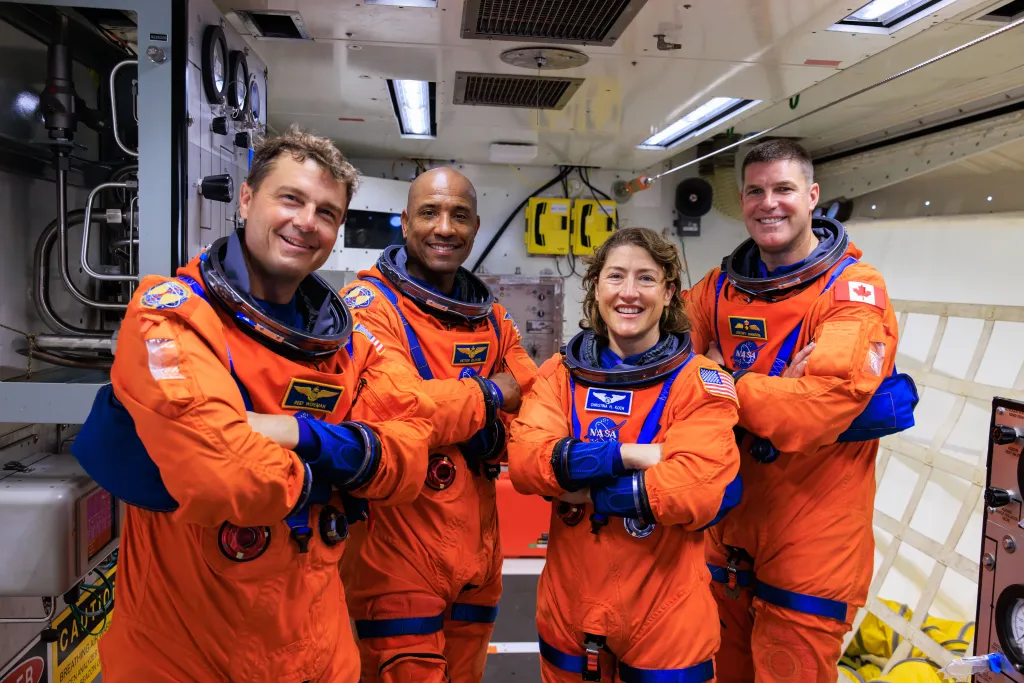
    L-R: Commander Reid Wiseman, pilot Victor Glover, mission specialist Christina Koch, and Canadian Space Agency astronaut Jeremy Hansen. Photo Credit: NASA Gallery

    The SLS had only flown once before, on the uncrewed Artemis I mission in 2022. This was its first launch with people on board. Engineers had to replace one of the core stage’s RS-25 engines, E2063, with E2061 in April 2025 after detecting a leak in the oxygen valve hydraulics. 

    During a wet dress rehearsal in early February 2026, a liquid hydrogen leak was detected during the simulated countdown, forcing NASA to postpone the intended launch to April. A second wet dress rehearsal on February 19 went successfully, but a helium flow issue in the upper stage then triggered a rollback to the Vehicle Assembly Building, pushing the mission to April.

    The Heat Shield Problem That Almost Grounded the Mission

    The most contested issue in the months before launch was the Orion heat shield. Post-flight inspections of Artemis I revealed that the heat shield did not allow enough of the gases generated inside the Avcoat ablative material to escape, which caused some of the material to crack and break off during reentry. Avcoat is designed to wear away as temperatures approach 5,000 degrees Fahrenheit on return from the Moon, so some erosion is expected. The pattern seen after Artemis I was not.

    NASA delayed the Artemis II launch and announced that it had identified the root cause which was that gases generated inside the heat shield’s outer layer could not vent and dissipate as expected, allowing pressure to build and cracking to occur. Rather than replace the shield entirely, NASA decided to modify the reentry trajectory to reduce heat exposure.

    In January 2026, NASA’s administrator assembled heat-shield engineers, the chair of an independent review team, and senior human spaceflight officials to meet with outside experts. The analysis concluded that Orion’s thick composite base, which contains a titanium framework, could keep the crew safe even if the Avcoat blocks outside it were entirely stripped away. Not everyone was satisfied. 

    Leaving Earth Behind

    The critical engine burn happened at 7:49 p.m. EDT on April 2, the day after launch, and lasted 5 minutes and 55 seconds. This was the translunar injection burn, needed to send the crew out of Earth orbit and toward the Moon. NASA had the crew stay close to home for a day to test the capsule’s life-support systems before clearing them for lunar departure. The burn was confirmed as successful by teams on the ground.

    The Orion capsule will zoom 4,000 miles beyond the Moon before turning back, giving the crew unprecedented views of the lunar far side. The crew will also break the all-time human distance record from Earth, set by the Apollo 13 crew in 1970.

    What Artemis II Is Actually Testing

    Artemis II is not a landing mission. Its primary purpose is to test the Orion spacecraft’s life support systems for the first time with humans aboard, laying the groundwork for future crewed Artemis missions. 

    The mission will also demonstrate the Orion Artemis II Optical Communications System, which uses a 4-inch telescope and two gimbals to establish a laser communication link with ground stations in California and New Mexico, targeting downlink rates of up to 260 megabits per second.

    Splashdown is scheduled off the coast of San Diego, with recovery teams retrieving the crew using helicopters and delivering them to the USS John P. Murtha for post-mission medical evaluations. The heat shield will face its real test on that return. Whatever condition it arrives in will determine more about the future of the Artemis program than almost anything else that happens on this mission.

    Artemis II Integrity NASA Nasa Artemis II Orion spacecraft Science STEM
    Share. Facebook Twitter Pinterest LinkedIn Tumblr Telegram Email
    precious
    • LinkedIn

    I’m Precious Amusat, Phronews’ Content Writer. I conduct in-depth research and write on the latest developments in the tech industry, including trends in big tech, startups, cybersecurity, artificial intelligence and their global impacts. When I’m off the clock, you’ll find me cheering on women’s footy, curled up with a romance novel, or binge-watching crime thrillers.

    Related Posts

    Machenta Secures $40 Million to Teach Robots via Single Demonstrations

    November 8, 2026

    Formation Bio Launches $600 Million Fund to Acquire Clinical-Stage Drugs

    November 8, 2026

    Waymo Plans Fully Driverless Taxis on Tokyo Streets Without Safety Drivers

    September 28, 2026

    Comments are closed.

    Top Posts

    Cursor AI Hits 1 Million Daily Users. Why Developers Are Switching to This Coding Tool

    March 23, 2026

    Coinbase responds to hack: customer impact and official statement

    May 22, 2025

    Anthropic Will Use Claude User Chats For Data Training

    October 16, 2025

    The EU Just Forced Smartphone Makers to Bring Back Replaceable Batteries — Here’s What That Means for Your Next Phone

    May 7, 2026
    Don't Miss
    Artificial Intelligence & The Future

    How SentinelOne’s New Security System Monitors Rogue Enterprise AI Agents

    By fariehanNovember 14, 2026

    SentinelOne launched Singularity Agentic Detection and Response to watch company AI agents as they work.…

    Google Unveils Gemini 4 Carbon AI Model Built for Cybersecurity

    November 14, 2026

    Upwind Raises $400 Million After Rejecting Datadog Acquisition Offer

    November 9, 2026

    Sony So-net Data Breach Exposes Over 2.58 Million Customer Records

    November 9, 2026
    Stay In Touch
    • Facebook
    • Twitter
    About Us
    About Us

    Evolving from Phronesis News, Phronews brings deep insight and smart analysis to the world of technology. Stay informed, stay ahead, and navigate tech with wisdom.
    We're accepting new partnerships right now.

    Email Us: info@phronews.com

    Facebook X (Twitter) Pinterest YouTube
    Our Picks
    Most Popular

    Cursor AI Hits 1 Million Daily Users. Why Developers Are Switching to This Coding Tool

    March 23, 2026

    Coinbase responds to hack: customer impact and official statement

    May 22, 2025

    Anthropic Will Use Claude User Chats For Data Training

    October 16, 2025
    © 2025. Phronews.
    • Home
    • About Us
    • Get In Touch
    • Privacy Policy
    • Terms and Conditions

    Type above and press Enter to search. Press Esc to cancel.