


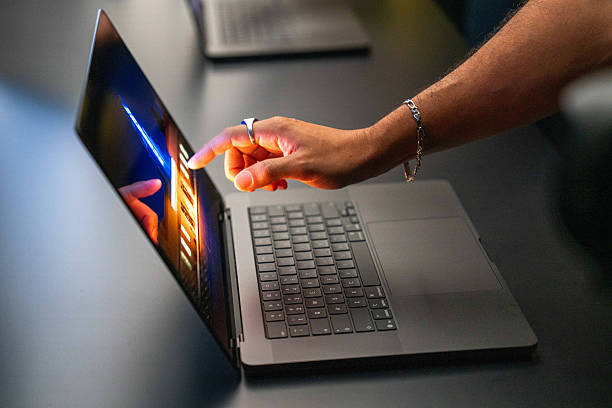
Touchscreen displays have become a familiar feature across the laptop market, as it gives users another way to interact with their devices without relying entirely on a keyboard or trackpad.
For Apple, however, finally bringing the feature to its Mac computers after many years comes with a price that could make the transition difficult for some buyers.
The iPhone-maker introduced its new MacBook Pro with PROLED XDR Display on October 28, bringing touchscreen capabilities, tandem OLED technology, and its M5 Pro and M5 Max processors to the laptop lineup. But the 14-inch model starts at $2,899, while the 16-inch version costs $3,399, both costing $400 more than their previous non-touchscreen counterparts.
This raises questions about how much customers will be willing to pay for the new features.
Apple’s First Touchscreen MacBook Comes at a Higher Price
The new MacBook Pro stands as a major change in Apple’s approach to laptop design. For years, the company maintained that the Mac experience was best suited to keyboard and trackpad controls, even as manufacturers such as Lenovo, HP, and Dell continued introducing touchscreen laptops.
But its position has now changed. The new models can now allow users scroll through webpages, zoom into photographs, move presentation slides, and interact directly with creative applications. Apple is also targeting professionals who work with 3D models, graphic design, and music production.
The laptops feature a tandem OLED display that delivers up to 2,000 nits of peak brightness, a 10,000,000:1 contrast ratio, and a 120Hz refresh rate. Apple has also introduced a redesigned hinge to keep the screen stable during touch interactions, alongside thinner bezels and a lighter body.
However, the starting prices represent a 16% increase for the 14-inch M5 Pro model and a 13% increase for the 16-inch version compared with the previous models.
The $400 Difference Could Be Difficult to Justify
One issue Apple may face is convincing existing MacBook Pro users that the additional features are worth the higher price. The new laptops retain the M5 Pro and M5 Max processors, which means users may not feel justified to spend $400 more over a new laptop that doesn’t come with a new processor generation.
But there are still some new improvements. The OLED display offers significant improvements in brightness, contrast and colour reproduction, which could appeal to photographers, video editors, and designers who depend on accurate visuals. Touch controls could also make certain creative tasks easier, particularly when working directly with images, designs, and 3D objects.
However, customers who primarily use their MacBooks for software development, writing, browsing and other productivity tasks may have less reason to pay extra for a touchscreen.
Apple is also continuing to sell its existing non-touchscreen MacBook Pro models, giving customers a lower-priced option if they do not need the new display and touch features.
Can Apple Convince Buyers to Pay More for Touchscreen?
While Apple’s new touchscreen MacBook Pro arrives with display improvements and new ways for professionals to interact with their work, the company still needs to demonstrate that these features provide enough practical value to justify the higher prices.
And with the existing non-touchscreen models remaining available, customers have the option to avoid the additional cost.
How buyers respond to the new pricing could determine whether Apple’s move into the touchscreen laptops market becomes a successful expansion of the MacBook Pro lineup or an expensive upgrade that appeals to a small group of professionals.
