


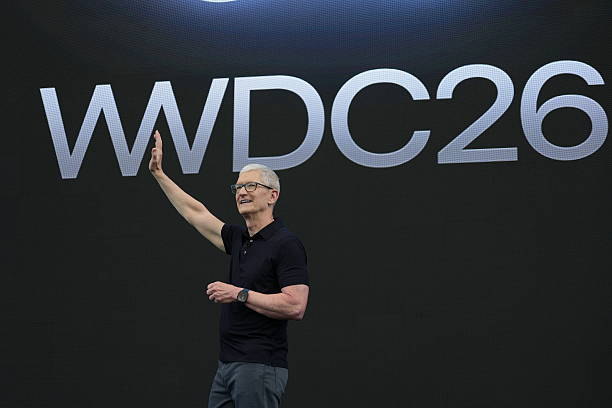
Two years after promising a smarter Siri and failing to deliver it, Apple showed up at WWDC 2026 with a rebuilt Siri powered by a custom Google Gemini model.
The rebuilt Siri runs on a custom Google Gemini model and arrives as a standalone app on iPhone, iPad, and Mac, capable of holding conversations, chaining commands across apps, reading on-screen content, and drawing on personal data like emails, messages, and photos.
The keynote was also Tim Cook’s final as Apple CEO before hardware chief John Ternus takes over on September 1.
A Three-Tier Architecture Built for Privacy
The rebuilt Siri uses a three-tier routing system that determines where each query is processed based on its complexity. Simple requests stay entirely on-device, handled by Apple’s own smaller neural models, while moderately complex requests escalate to Apple’s Private Cloud Compute servers. The heaviest reasoning tasks route to Google Cloud, running on Nvidia Blackwell B200 GPUs.
At each step, Apple anonymizes and tokenizes queries so neither Apple nor Google can link requests to individual users. Software chief Craig Federighi made the privacy stance explicit during the keynote, stating that data is only used to execute a user’s request and that outside experts can verify this at any time.
There’s also the cloud deal that carries weight, as reports put the arrangement at roughly $1 billion a year, spanning multiple years, with Apple licensing a custom 1.2-trillion-parameter Gemini model as the engine behind Siri’s cloud intelligence.
Users Now Choose Their AI
The more consequential shift for the broader AI industry is what iOS 27 does with choice. iOS 27 Extensions will let users set a third-party AI model, such as Claude or ChatGPT, as their default assistant, surfacing the option through the Apple Intelligence and Siri section of Settings.
iPhone users will be able to select which services they want to use inside Siri through Extensions options coming to iOS 27, iPadOS 27, and macOS 27. This shifts Apple from the bilateral deal model it used with OpenAI since iOS 18.2 in 2024 to an open Extensions system that any qualifying AI chatbot provider can join, fundamentally changing the competitive dynamics of the mobile AI market. As such, OpenAI’s once-exclusive position on the iPhone no longer holds.
Siri Gets a New Shape
Beyond the backend changes, the assistant itself looks and works differently. The new Siri operates as a full chatbot with a dedicated app, a system-wide “Search or Ask” gesture, and integration into the Dynamic Island on iPhone 16 and newer. Users can type or talk, multi-step commands work, and Siri can compose emails, pull personal context, and read what is on screen.
Apple promised a smarter, context-aware Siri at WWDC 2024 and did not deliver it for nearly two years. In May 2026, the company sought approval for a $250 million class-action settlement over those undelivered features. This WWDC 2026 delivery was, in practical terms, the feature set Apple had been sued for failing to ship.
There are limits to the rollout. Siri AI will not be available on iPhone or iPad in the European Union at launch due to the Digital Markets Act, and it will not launch in China while Apple works through regulatory requirements.
