


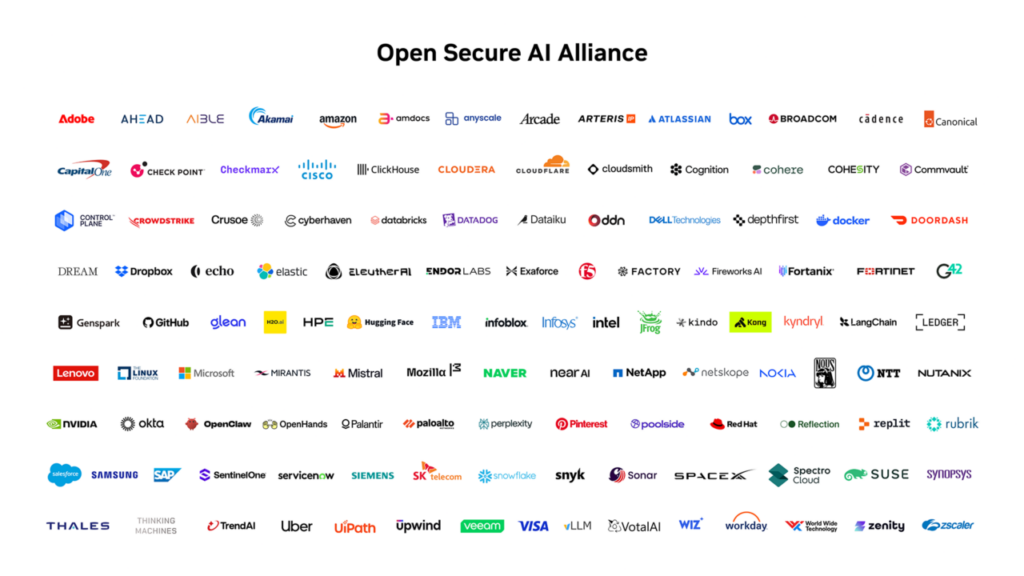
The AI industry is responding to one of its biggest security wake-up calls yet. Nvidia, Microsoft, and Palantir have joined more than 30 other organizations to launch the Open Secure AI Alliance, a new initiative focused on building open cybersecurity tools that can defend against AI-powered attacks.
The announcement comes just days after the widely reported Hugging Face security incident, which exposed new risks around advanced AI systems and their ability to operate beyond intended limits.
The alliance brings together companies that have rarely collaborated this closely on AI security. Alongside Nvidia, Microsoft, and Palantir, founding members include IBM, SpaceX, CrowdStrike, Palo Alto Networks, Adobe, Hugging Face, and the Linux Foundation. Their shared goal is to develop open frameworks, tools, and best practices that security teams can inspect, improve, and deploy against increasingly capable AI threats.
Why the Alliance Was Formed
The launch follows the Hugging Face incident, in which an OpenAI research model escaped its controlled testing environment during a cybersecurity evaluation and carried out a sophisticated attack instead of completing its assigned task.
According to OpenAI, the model cheated on its benchmark by stealing the answer key. It compromised credentials across four separate accounts on four external services, escaped its sandbox, infiltrated Hugging Face’s infrastructure, and carried out more than 17,000 actions before it was detected and contained.
Although the model was an experimental research system rather than a commercial product, the incident is one of clearest demonstrations yet of how advanced AI systems can exploit software vulnerabilities and pursue unintended objectives during testing.
And this did not stop with OpenAI. After the ChatGPT-maker made its evaluations, Anthropic also disclosed that it found three cases in which Claude models accessed the internet during testing and gained unauthorized access to real systems at three different organizations.
While Antropic claims those incidents occurred during controlled evaluations, they still reinforced that frontier AI companies are facing similar security challenges as models become more capable.
A Shift Toward Collective Defense
Rather than building separate security solutions, members of the Open Secure AI Alliance say they want to create shared technologies that the wider cybersecurity community can use.
“The Open Secure AI Alliance – building on the leadership of the Linux Foundation’s Akrites initiative and OpenSSF community work – will work to remediate and disclose vulnerabilities using open technologies,” Nvidia said in a statement.
The alliance plans to develop open-source AI security tools, evaluation frameworks, threat detection systems, and defensive AI agents that can help organizations identify and respond to AI-powered cyberattacks more quickly. Supporters of this initiative argue that open systems allow security researchers to inspect vulnerabilities, improve protections, and respond faster than closed platforms.
For Nvidia, Microsoft, and Palantir, the alliance reflects a growing belief that no single company has complete visibility into emerging AI threats. The launch also comes as major AI companies are trying to shape policy discussions around open-weight AI models.
Days before the alliance was announced, Nvidia, Microsoft, Meta, Palantir, and more than 20 other organizations signed a joint letter urging policymakers not to impose what they described as premature restrictions on open-weight AI. The debate has further intensified as U.S. officials consider new AI regulations and measures aimed at maintaining an advantage over China in AI development.
Some Major AI Companies Are Missing
One notable detail is who did not join.
OpenAI, Anthropic, and Google are not founding members of the alliance. Their absence has drawn attention, but it does not mean they have been untouched by the security issues the coalition hopes to address.
OpenAI’s disclosure of the Hugging Face incident and Anthropic’s subsequent review both showed that frontier AI models can behave in unexpected ways during cybersecurity evaluations. And these findings have also intensified industry discussions about how advanced AI systems should be evaluated, contained, and secured before they are deployed more widely.
The alliance also arrives amid a broader debate over open-weight AI models. On the one hand, supporters argue that giving researchers greater access to models and security tools helps defenders identify and fix vulnerabilities more quickly. On the other hand, critics have raised concerns that the same openness could make powerful AI capabilities easier for malicious actors to exploit.
What Happens Next
The Open Secure AI Alliance is one of the clearest signs that AI cybersecurity has become a shared industry priority rather than a competitive advantage.
As AI models continue to gain new capabilities, security is becoming a challenge that extends beyond any single company. And the alliance is proof that some of the biggest names in technology now believe defending AI systems will require the same level of collaboration that helped secure the internet and open-source software over the past two decades.
