


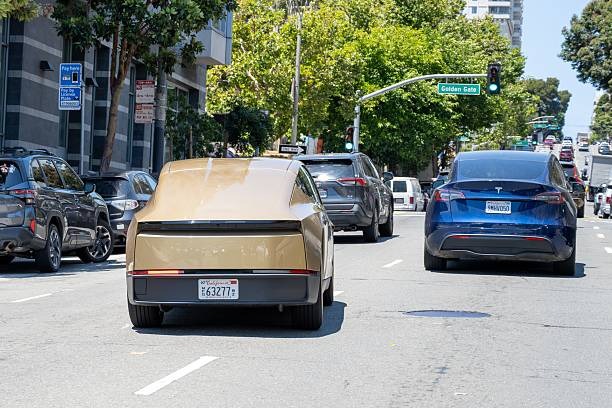
U.S. vehicle safety rules were largely written for cars driven by people, so they still require equipment such as brake pedals and mirrors. However, Tesla launched Cybercab rides in Austin without these features and had not requested an exemption, prompting NHTSA to investigate how the vehicle was certified for public roads.
The company began offering rides in limited parts of Austin, Texas, in early September. One day later, the National Highway Traffic Safety Administration (NHTSA) opened an Audit Query into whether Tesla properly certified the vehicle.
NHTSA later ordered Tesla to answer detailed questions by September 30, as the regulatory body escalated the audit into a formal Special Order, which is a legally binding demand for sworn responses that carries penalties of up to $139 million for noncompliance.
Cybercab Opens to Austin Riders
The Cybercab is a two-seat electric vehicle built without a steering wheel, brake pedal, accelerator pedal, or mirrors. Tesla AI chief Ashok Elluswamy said at the launch that the service was open to the public, although rides were restricted to selected areas of Austin.
At launch, Texas records showed 45 Cybercabs among Tesla’s 420 autonomous vehicles in the state. For context, Rival Waymo reportedly has registered 988 vehicles.
Tesla began Cybercab production in April 2026 and plans to make it the core of a larger robotaxi network, with Elon Musk describing it as a car built for unsupervised Full Self-Driving, while warning that early production would be slow.
What NHTSA Is Examining
U.S. automakers certify that their vehicles meet Federal Motor Vehicle Safety Standards before deployment, and NHTSA can investigate when a vehicle appears not to meet those requirements.
As it stands, the agency’s Cybercab audit is now examining the technical data and process Tesla used to certify up to 1,000 vehicles. It also wants to know which requirements Tesla considered inapplicable because the Cybercab has no traditional controls.
NHTSA has also asked whether Tesla temporarily installed human controls or other equipment during certification, and wants to know whether a person can drive the vehicle, whether passengers can move it through the touchscreen, and what limits apply to its speed, operating area, and hours.
“We need to ensure that all of our laws are followed,” NHTSA Administrator Jonathan Morrison said when the investigation was announced.
Tesla Did Not Seek an Exemption
NHTSA can allow each manufacturer to operate up to 2,500 vehicles a year without equipment required under current standards. The agency approved Amazon-owned Zoox for a limited commercial deployment of steering-wheel-free robotaxis in July, but said Tesla had not requested an exemption.
While the regulator is working on rule changes that could remove requirements for brake pedals, mirrors, and other human controls from fully autonomous vehicles, these proposals have not been completed, so the current standards remain in force.
The Broader Launch Now Depends on NHTSA
Cybercab is central to Tesla’s plan to build a large driverless transport business. Its robotaxi service has already expanded beyond the original Austin pilot to a few other cities in Texas and Florida.
However, the audit now puts Tesla’s certification method under review as the company prepares to add more Cybercabs. A finding of noncompliance could lead to enforcement action, design changes, or the need for an exemption before a wider rollout.
For Tesla, the next stage of the Cybercab launch will depend on what the company tells NHTSA, whether the regulator accepts the legal basis that put the vehicle on public roads in the first place, or whether it’ll be paying a possible fine of up to $139 million for noncompliance.
