


As companies invest in AI systems, building the data centres needed to run them has become a major challenge. These facilities require specialised computing equipment, power distribution, and cooling systems that must work together to support increasingly demanding workloads.
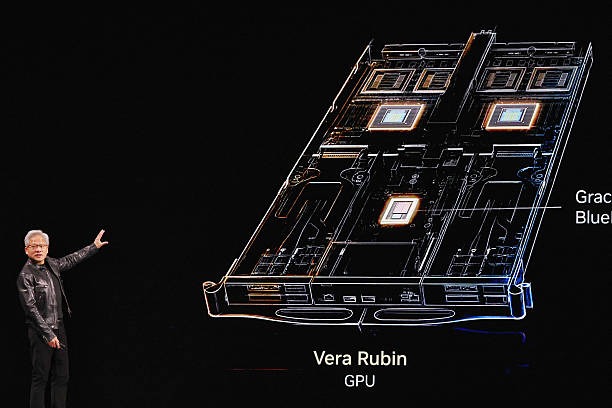
Nvidia is now opening part of that infrastructure design to other manufacturers, giving them a common blueprint for building systems around its next-generation Vera Rubin platform.
The company announced in early October that it had contributed its Vera Rubin rack and compute tray designs to the Open Compute Project (OCP), an industry group that promotes shared hardware designs.
The contribution, made through Nvidia’s modular MGX architecture, is intended to help equipment manufacturers develop and deploy AI infrastructure without having to work from separate, proprietary specifications.
Why Nvidia Is Sharing Its Designs
The decision addresses a practical challenge in expanding AI infrastructure, where manufacturers need to coordinate the design and production of servers, power systems, and cooling equipment before large data centre installations can be deployed.
Speaking during a press briefing, Joe DeLaere, Nvidia’s product lead for AI infrastructure solutions, said the main bottleneck in building AI factories was how quickly manufacturers could produce and deploy the equipment. He explained that publishing the specifications would allow equipment makers and component developers to begin manufacturing and building supply chains without waiting for individual customers to provide their own designs.
Foxconn, Quanta, Wiwynn, and Supermicro are among the system builders that can use the designs to produce compatible racks faster, as can neocloud providers.
This approach could make it easier for more manufacturers to supply compatible infrastructure, as it also extends Nvidia’s existing MGX strategy, which allows hardware partners to build different systems around a shared modular architecture.
What the Vera Rubin Rack Designs Include
The contribution introduces version 1.2 of Nvidia’s MGX rack specification, with changes to power delivery, cooling, and equipment layout.
One of the key features is a liquid-cooled busbar rated at 5,000 amps, designed to distribute electricity across high-power computing systems. The updated specification also includes fanless, liquid-cooled compute trays, standard 19-inch equipment support, and connections that allow cooling systems to link with rack components more easily.
The architecture supports rack deployments of up to 250 kilowatts and includes configurable input and output bays. These features are designed to simplify equipment assembly, maintenance, and integration across different systems.
Nvidia has also contributed a separate rack design specification for its Vera CPU. The system is designed for workloads such as tool calling, orchestration, and sandboxed execution, which are important for AI agents that interact with applications and services.
According to the chip giant, the Vera CPU rack has already started shipping. At the OCP Global Summit, it open-sourced four components of DSX, its software for managing AI factories.
What This Means for AI Infrastructure
Opening the designs gives manufacturers a common starting point for developing compatible equipment. And it could also help them prepare components earlier, potentially reducing delays caused by designing systems around different customer specifications.
Nvidia’s Vera Rubin platform was already moving into production before this announcement. In May 2026, the company said manufacturers including Dell Technologies, HPE, Lenovo and Supermicro were developing Vera Rubin-based systems.
As such, the latest contribution expands the shared infrastructure available to these manufacturers.
However, making the designs available does not guarantee that deployments will become faster or cheaper. And the outcomes will depend on how manufacturers adopt the specifications and bring compatible equipment to market.
Nvidia is not the only chipmaker offering open rack designs. At the same summit, AMD introduced an open rack design of its own and Intel showed Xeon-based racks for agentic AI workloads.
For Nvidia, the move supports a wider network of hardware suppliers while keeping its computing platform at the centre of the systems they build. For the AI industry, the availability of shared rack designs could help manufacturers coordinate production and expand the supply of equipment needed to run large AI workloads.
