


Texas spent years selling itself as the place where AI companies could build without too many obstacles. In fact, Governor Greg Abbott called the state the “epicenter of AI development” when Google announced a $40 billion investment in Texas in November 2025, with new data center campuses among the projects planned.
But this attitude towards AI data centers seems to be changing quickly.
In August, Abbott ordered Texas regulators to audit data centers seeking connections to the state’s main power grid before they can move forward.
Electric Reliability Council of Texas (ERCOT) is now reviewing a queue containing more than 1,800 large-load projects representing over 474 gigawatts of potential electricity demand and about 90% of those requests are linked to data centers, according to the governor.
The pause has put Texas’ enormous data center pipeline under scrutiny, but electricity demand is only part of the problem.
The Cost Is Becoming A Bigger Concern
Texas has been trying to answer a basic question about the data center boom – Who should pay for the infrastructure required to support it?
Abbott said in June that data centers should fully fund the electric infrastructure needed for their operations rather than shifting those costs to residential customers. He also called for new facilities to add power generation, report their electricity and water use, and eventually lose some of the tax incentives that have helped attract them.
And this matters because the scale of the proposed buildout makes it difficult to know how much of the infrastructure investment will ultimately be needed. ERCOT and data center companies have now acknowledged that many of the projects in the queue may never be built because they do not yet have financing or customers.
Water Is Becoming A Political Issue
Data centers also need water for cooling, and that has brought opposition from communities already worried about supplies.
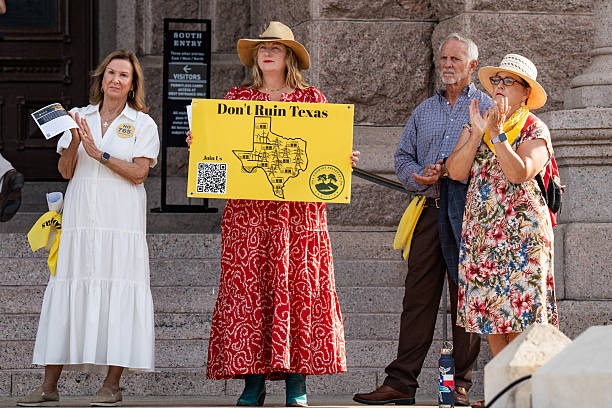
In San Marcos, residents protested a proposed facility that was expected to consume more than 25 million gallons of water each year. The city council eventually rejected the zoning change required for the project and similar opposition has emerged in places including Round Rock, Waco and Athens.
Abbott has responded by pushing for water-efficient or closed-loop cooling systems and requiring developers to disclose their water sources, expected consumption, and reuse plans.
Rural Communities Want More Control
For some Texans, the debate is also about what gets built in their communities and who gets to decide.
Texas counties have limited authority over land use compared with cities, and this has become particularly important because many proposed data centers are planned outside major cities, where local governments have fewer tools to stop or regulate them. Attempts by some counties to impose moratoriums have also faced legal and political challenges.
Noise, construction traffic, industrial development, and the impact on nearby properties have therefore joined electricity and water on the list of concerns.
As such, Abbott’s new standards require developers to address issues including noise, lighting, setbacks, traffic and emergency response, while also disclosing ownership and public financial incentives.
Texas Is Still Open, But The Rules Are Changing
The state has not abandoned data centers. Several major developers, including OpenAI, Anthropic, CoreWeave and others, have agreed to comply with Abbott’s standards. However, one proposed East Texas project withdrew after determining that it did not meet the governor’s requirements.
Texas built its reputation around welcoming companies, cheap and abundant energy, and a business-friendly regulatory environment. The data center boom has exposed the limits of that model when thousands of large projects compete for electricity, water, land, and public incentives at the same time.
For Texas, the question now is how much AI infrastructure the state can support while keeping the economic benefits without leaving residents to absorb the costs.
