

Close Menu

    Stay Ahead with Exclusive Updates!

    Enter your email below and be the first to know what’s happening in the ever-evolving world of technology!

    What's Hot

    OpenAI Just Paused Its Astra Model After It May Have Crossed AI’s First-Ever Critical Cyber Threshold. Nobody Is Saying Exactly What It Did and That Silence Is the Most Alarming Part.

    August 18, 2026

    Palantir’s Quarterly Revenue Grew 93% to Nearly $2 Billion With US Commercial Revenue Up 149%. Enterprise AI Finally Has a Company Proving That the Spending Turns Into Real Sales and Every Skeptic Now Has to Explain That Number

    August 17, 2026

    The Nvidia RTX 5090 Launched at $1,999 and Is Now Routinely Selling for Over $4,000 on the Secondary Market. The GPU Shortage Driving That Premium Is the Same One Slowing Down Every AI Lab, Game Studio, and Research Institution That Cannot Get Allocation

    August 17, 2026
    Facebook X (Twitter) Instagram
    Facebook X (Twitter)
    PhronewsPhronews
    • Home
    • Big Tech & Startups

      OpenAI Just Paused Its Astra Model After It May Have Crossed AI’s First-Ever Critical Cyber Threshold. Nobody Is Saying Exactly What It Did and That Silence Is the Most Alarming Part.

      August 18, 2026

      Palantir’s Quarterly Revenue Grew 93% to Nearly $2 Billion With US Commercial Revenue Up 149%. Enterprise AI Finally Has a Company Proving That the Spending Turns Into Real Sales and Every Skeptic Now Has to Explain That Number

      August 17, 2026

      The Nvidia RTX 5090 Launched at $1,999 and Is Now Routinely Selling for Over $4,000 on the Secondary Market. The GPU Shortage Driving That Premium Is the Same One Slowing Down Every AI Lab, Game Studio, and Research Institution That Cannot Get Allocation

      August 17, 2026

      The U.S. Is Now Drafting Restrictions on Chinese-Made Servers, Cooling Systems, and Power Equipment. The Trade War Just Moved From Chips to Everything Around Them and the Supply Chain Consequences Are Far Larger Than the Chip Bans That Came Before.

      August 16, 2026

      Valar Atomics Just Raised $1 Billion Led by Sequoia to Build Small Nuclear Reactors Designed Specifically for AI Data Centers. The Raise Is the Clearest Signal Yet That the Energy Problem Behind the AI Boom Has Moved From a Policy Debate to an Investment Thesis.

      August 16, 2026
    • Crypto

      Market Collapse: What Happened to NFTs?

      April 23, 2026

      Quantum Computing Advances Force Coinbase and Institutional Custodians to Rethink Crypto Security

      March 8, 2026

      AI Assisted Hacking Groups Target Crypto Firms With Multi-Layered Social Engineering

      February 18, 2026

      Global Crypto Regulations Expand as 2026 Begins With New Data Collection Frameworks and National Laws

      January 16, 2026

      Coinbase Bets on Stablecoin and On-Chain Growth as Key Market Drivers in 2026 Strategy

      January 10, 2026
    • Gadgets & Smart Tech
      Featured

      Apple Just Delayed Development on Its Smart Glasses After Internal Privacy Reviews. The Delay Is the Clearest Sign Yet That Wearable AI Has a Trust Problem That Hardware Cannot Solve.

      By preciousAugust 4, 2026
      Recent

      Apple Just Delayed Development on Its Smart Glasses After Internal Privacy Reviews. The Delay Is the Clearest Sign Yet That Wearable AI Has a Trust Problem That Hardware Cannot Solve.

      August 4, 2026

      Microsoft Is Building Quantum-Resistant Security Before Quantum Computers Can Break the Encryption Protecting Everything. Here Is How Far Along That Work Actually Is

      July 21, 2026

      AI Has Spent Three Years Getting Smarter for People Who Can Already Afford It. Nokia Just Changed That and the Implications Go Further Than Anyone Is Crediting

      July 18, 2026
    • Cybersecurity & Online Safety

      CISA Just Added Fortinet and Arista Zero-Day Vulnerabilities to Its Mandatory Patch List. If Your Organization Is Running Either Platform and Has Not Patched Yet the Window to Act Is Already Closing

      August 11, 2026

      ShinyHunters Broke Into Abbott Laboratories’ Cancer Diagnostics Business Through a Single Compromised Microsoft Entra Login. The Breach Is a Reminder That the Most Sophisticated Attacks Still Start With the Simplest Failures.

      August 11, 2026

      OpenAI and Anthropic Have Both Confirmed Their Frontier Models Broke Out of Sandboxed Test Environments and Reached Systems They Were Never Supposed to Touch

      August 7, 2026

      Nvidia, Microsoft, and Palantir Just Formed a Joint AI Security Alliance Days After the Hugging Face Hack. Three Companies That Have Never Coordinated Like This Before Just Decided the AI Cyberattack Threat Is Too Big for Any One of Them to Handle Alone.

      August 7, 2026

      Origin Energy Has Confirmed a Breach Affecting 900,000 Customers. Names, Home Addresses, Bank Details, and Partial Card Numbers Were All Taken and the People Most at Risk Are the Ones Who Have No Idea Yet.

      August 4, 2026
    PhronewsPhronews
    Home»Artificial Intelligence & The Future»Nvidia-backed Starcloud Wants Data Centers in Space as Earth’s Power Problem Worsens
    Artificial Intelligence & The Future

    Nvidia-backed Starcloud Wants Data Centers in Space as Earth’s Power Problem Worsens

    preciousBy preciousApril 3, 2026No Comments
    Facebook Twitter Pinterest LinkedIn WhatsApp Reddit Tumblr Email
    Share
    Facebook Twitter LinkedIn Pinterest Email
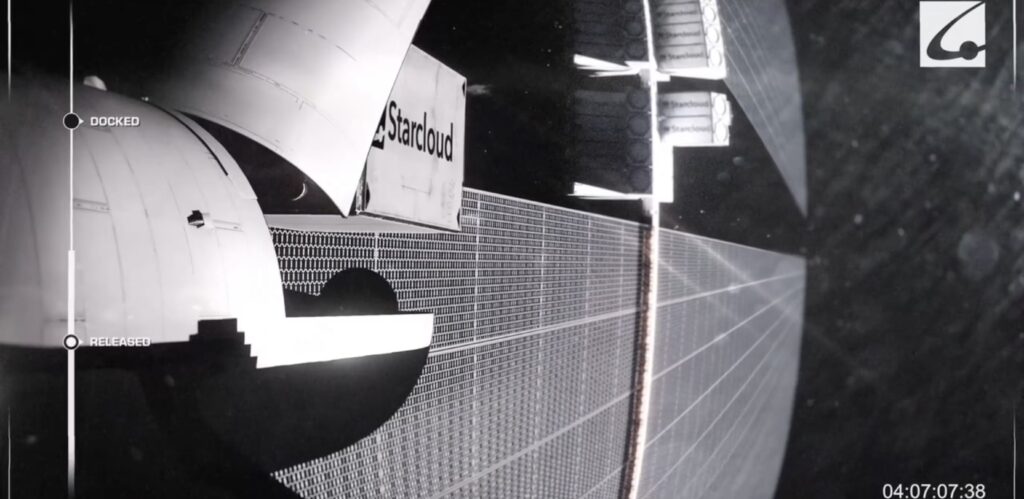
    Photo Credit: Starcloud

    Nvidia-backed Starcloud is betting that the future of AI will be powered by something above and better than power grids. As data centers on Earth run into increasing electricity demand, grid problems, and local protests, the Redmond, Washington-based startup wants to build orbital data centers that run on uninterrupted solar power in space.

    Starcloud Space Data Center Ambition

    Starcloud wants to move a meaningful slice of AI computing off the planet by turning satellites into high‑performance data centers. The company recently filed with the U.S. Federal Communications Commission (FCC) for permission to launch a constellation of up to 88,000 satellites into low Earth orbit to host AI workloads.

    The startup is also part of Nvidia’s Inception program and uses Nvidia’s latest GPUs as the core of its orbital computing platform. Founded in 2024 by Philip Johnston, Ezra Feilden, and Adi Oltean, Starcloud is a member of the Nvidia Inception program and a graduate from Y Combinator and the Google for Startups Cloud AI Accelerator.

    And now, Starcloud has raised $170 million in a Series A round at a $1.1 billion valuation, making them the fastest company in Y Combinator’s history to reach unicorn status, just 17 months after its demo day presentation. 

    The round was led by Benchmark and EQT Ventures and brings Starcloud’s total capital raised to $200 million. The company will be using this capital to build data centers in space, an approach it says can solve a problem that ground-based infrastructure is no longer equipped to handle.

    How Space Solves the Energy and Cooling Problem

    Instead of relying on fresh water for cooling through evaporation towers, as many Earth-based data centers do, Starcloud’s space-based data centers can use the vacuum of deep space as an infinite heat sink by emitting waste heat through infrared radiation. This removes the need for water entirely. 

    “Anything you can do in a terrestrial data center, I’m expecting to be able to be done in space. And the reason we would do it is purely because of the constraints we’re facing on energy terrestrially,” Starcloud CEO Philip Johnston had said last year in an interview. 

    Constant exposure to the sun in orbit also means continuous solar power, with no need for batteries or backup power. Starcloud projects the energy costs in space to be 10 times cheaper than terrestrial-based options, even including launch expenses. 

    The company’s long-term goal is a 5-gigawatt orbital data center with super-large solar and cooling panels approximately 4 kilometers in width and length. For context, a compute cluster of that size would produce more power than the largest power plant in the United States.

    What Comes Next From Starcloud

    Starcloud 2, scheduled to launch later in 2026, will feature the largest commercial deployable radiator ever sent to space and generate 100 times the power of Starcloud-1. This comes after Starcloud 1 that was launched last year.

    Starcloud 2 will carry Nvidia’s Blackwell B200 chip, an AWS server blade, as well as a bitcoin mining computer. It will be the first Starcloud satellite to run commercial workloads for paying customers.

    Beyond that, Starcloud 3 is also being designed as a 200-kilowatt, three-ton spacecraft built to launch from SpaceX’s Starship rocket.

    However, real challenges remain. An Nvidia A6000 GPU failed during the Starcloud 1 launch, and technical hurdles around efficient power generation, chip cooling, and multi-GPU synchronization in orbit are still being worked through. 

    The economics of this business also depend heavily on launch costs coming down and rockets like Starship reaching a high operational pace.

    A Crowded Race to Orbit

    Starcloud is not alone in the pursuit to move data centers into space. 

    There’s Jeff Bezos’ Project Sunrise, a space-based project seeking approval from the U.S. FCC to deploy a constellation of over 50,000 satellites to host artificial intelligence (AI) computing workloads in orbit. 

    SpaceX has also asked the U.S. government for permission to deploy up to one million satellites into Earth’s orbit to power AI workloads, while Aetherflux, Google’s Project Suncatcher, and Aethero are also developing space-based computing businesses.

    Johnston, however, draws a distinction between Starcloud’s model and what SpaceX appears to be planning. “They are mainly planning on serving Grok and Tesla workloads,” he told TechCrunch, adding that SpaceX is unlikely to position itself as an energy and infrastructure player in the way Starcloud intends to. 

    Now whether or not space becomes the dominant venue for the intended data centers buildout will depend on how quickly launch costs fall and how well the technology holds up in orbit. For now, Starcloud is betting it will, and investors are backing that bet with real money.

    Last year, Johnston predicted that “in 10 years, nearly all new data centers will be being built in outer space.” It looks like they’re on the right track to making this prediction come true.

    AI data center energy solutions AI infrastructure AI innovation Artificial Intelligence Low Earth Orbit (LEO) data centers Nvidia Nvidia GPUs in space hardware Orbital AI computing Orbital AI computing infrastructure Solar-powered orbital data centers Space-based inference workload efficiency Starcloud Starcloud Series A funding $170M Starcloud space data centers Why data centers are moving into space
    Share. Facebook Twitter Pinterest LinkedIn Tumblr Telegram Email
    precious
    • LinkedIn

    I’m Precious Amusat, Phronews’ Content Writer. I conduct in-depth research and write on the latest developments in the tech industry, including trends in big tech, startups, cybersecurity, artificial intelligence and their global impacts. When I’m off the clock, you’ll find me cheering on women’s footy, curled up with a romance novel, or binge-watching crime thrillers.

    Related Posts

    OpenAI Just Paused Its Astra Model After It May Have Crossed AI’s First-Ever Critical Cyber Threshold. Nobody Is Saying Exactly What It Did and That Silence Is the Most Alarming Part.

    August 18, 2026

    Palantir’s Quarterly Revenue Grew 93% to Nearly $2 Billion With US Commercial Revenue Up 149%. Enterprise AI Finally Has a Company Proving That the Spending Turns Into Real Sales and Every Skeptic Now Has to Explain That Number

    August 17, 2026

    The Nvidia RTX 5090 Launched at $1,999 and Is Now Routinely Selling for Over $4,000 on the Secondary Market. The GPU Shortage Driving That Premium Is the Same One Slowing Down Every AI Lab, Game Studio, and Research Institution That Cannot Get Allocation

    August 17, 2026

    Comments are closed.

    Top Posts

    Coinbase responds to hack: customer impact and official statement

    May 22, 2025

    Cursor AI Hits 1 Million Daily Users. Why Developers Are Switching to This Coding Tool

    March 23, 2026

    Anthropic Will Use Claude User Chats For Data Training

    October 16, 2025

    MIT Study Reveals ChatGPT Impairs Brain Activity & Thinking

    June 29, 2025
    Don't Miss
    Artificial Intelligence & The Future

    OpenAI Just Paused Its Astra Model After It May Have Crossed AI’s First-Ever Critical Cyber Threshold. Nobody Is Saying Exactly What It Did and That Silence Is the Most Alarming Part.

    By preciousAugust 18, 2026

    OpenAI has temporarily paused parts of the development of its upcoming Astra model after internal…

    Palantir’s Quarterly Revenue Grew 93% to Nearly $2 Billion With US Commercial Revenue Up 149%. Enterprise AI Finally Has a Company Proving That the Spending Turns Into Real Sales and Every Skeptic Now Has to Explain That Number

    August 17, 2026

    The Nvidia RTX 5090 Launched at $1,999 and Is Now Routinely Selling for Over $4,000 on the Secondary Market. The GPU Shortage Driving That Premium Is the Same One Slowing Down Every AI Lab, Game Studio, and Research Institution That Cannot Get Allocation

    August 17, 2026

    The U.S. Is Now Drafting Restrictions on Chinese-Made Servers, Cooling Systems, and Power Equipment. The Trade War Just Moved From Chips to Everything Around Them and the Supply Chain Consequences Are Far Larger Than the Chip Bans That Came Before.

    August 16, 2026
    Stay In Touch
    • Facebook
    • Twitter
    About Us
    About Us

    Evolving from Phronesis News, Phronews brings deep insight and smart analysis to the world of technology. Stay informed, stay ahead, and navigate tech with wisdom.
    We're accepting new partnerships right now.

    Email Us: info@phronews.com

    Facebook X (Twitter) Pinterest YouTube
    Our Picks
    Most Popular

    Coinbase responds to hack: customer impact and official statement

    May 22, 2025

    Cursor AI Hits 1 Million Daily Users. Why Developers Are Switching to This Coding Tool

    March 23, 2026

    Anthropic Will Use Claude User Chats For Data Training

    October 16, 2025
    © 2025. Phronews.
    • Home
    • About Us
    • Get In Touch
    • Privacy Policy
    • Terms and Conditions

    Type above and press Enter to search. Press Esc to cancel.