

Close Menu

    Stay Ahead with Exclusive Updates!

    Enter your email below and be the first to know what’s happening in the ever-evolving world of technology!

    What's Hot

    Grid-Responsive AI: How Nvidia Plans to Turn Data Centers Into Power Assets with Emerald AI

    April 16, 2026

    Cyber Retaliation: How Iran-Linked Hackers Paralyzed Medical Giant Stryker

    April 16, 2026

    The Trillion-Dollar Exit: Why a SpaceX IPO Would Reshape the Space Economy

    April 15, 2026
    Facebook X (Twitter) Instagram
    Facebook X (Twitter)
    PhronewsPhronews
    • Home
    • Big Tech & Startups

      The Trillion-Dollar Exit: Why a SpaceX IPO Would Reshape the Space Economy

      April 15, 2026

      The Sacramento Blueprint: How California is Writing the U.S. AI Rulebook

      April 14, 2026

      Silicon Sovereignty: Microsoft’s $10B Play to Secure Japan’s AI Future

      April 14, 2026

      The Rule-Breaker: Why DeepSeek V4 is China’s Defiant Bid for AI Supremacy

      April 13, 2026

      Scheduling Monopoly? Why Nvidia’s SchedMD Deal Alarms Open-Source Devs

      April 13, 2026
    • Crypto

      Quantum Computing Advances Force Coinbase and Institutional Custodians to Rethink Crypto Security

      March 8, 2026

      AI Assisted Hacking Groups Target Crypto Firms With Multi-Layered Social Engineering

      February 18, 2026

      Global Crypto Regulations Expand as 2026 Begins With New Data Collection Frameworks and National Laws

      January 16, 2026

      Coinbase Bets on Stablecoin and On-Chain Growth as Key Market Drivers in 2026 Strategy

      January 10, 2026

      Tether Faces Ongoing Transparency Questions and Reserve Scrutiny Amid Massive Bitcoin Accumulation

      January 5, 2026
    • Gadgets & Smart Tech
      Featured

      AirPods Max 2: USB-C, Live Translation, and the H2 Upgrade

      By preciousMarch 26, 2026
      Recent

      AirPods Max 2: USB-C, Live Translation, and the H2 Upgrade

      March 26, 2026

      How ABB and Nvidia are Perfecting Industrial Robotics using AI Simulation

      March 20, 2026

      Neura Robotics Reaches €4B Valuation With Tether Backing

      March 12, 2026
    • Cybersecurity & Online Safety

      Cyber Retaliation: How Iran-Linked Hackers Paralyzed Medical Giant Stryker

      April 16, 2026

      Your Company Could Be Iran’s Next Target: What U.S. Tech Firms Need to Do Right Now

      April 6, 2026

      Google Is Warning Us About The Encryption Protecting Your Data Today. It May Not Survive Quantum Computing

      April 5, 2026

      Accenture and Anthropic Team Up on AI-powered Cybersecurity

      April 4, 2026

      Your BVN, Passport, and Bank Account May Already Be on the Dark Web. What Every Nigerian Must Do Right Now After the Banking Breaches

      April 4, 2026
    PhronewsPhronews
    Home»Artificial Intelligence & The Future»Nvidia-Backed FieldAI Raises $405M to Build “brains” for Humanoid Robots
    Artificial Intelligence & The Future

    Nvidia-Backed FieldAI Raises $405M to Build “brains” for Humanoid Robots

    oluchiBy oluchiSeptember 7, 2025Updated:September 11, 2025No Comments
    Facebook Twitter Pinterest LinkedIn WhatsApp Reddit Tumblr Email
    Share
    Facebook Twitter LinkedIn Pinterest Email
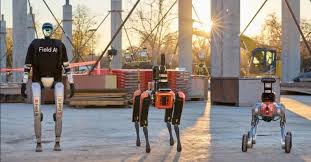
    Three robots positioned in front of a building, symbolizing FieldAI's cutting-edge developments in robotic autonomy
    Image Generated from Tech Funding News

    Marking one of the most exciting funding rounds of 2025, FieldAI, a rising star in robotics and AI, raised $405M from two consecutive funding rounds. The Nvidia-backed start-up aims to create universal robot brains to bring about a future where robots might walk, work, and interact alongside our day-to-day life.

    Meet FieldAI.

    Although officially founded in 2023, FieldAI has been in operation since 2016. Ali Agha, former NASA JPL Principal Investigator and group leader for the Robotics Ariel Mobility group, founded the company. Additionally, he spearheaded a team that significantly contributed to the first Mars helicopter mission.

    The early works of the team that would go on to form FieldAI started in 2016 with the NASA BRAILLE Project. 

    Their goal was to develop a first-of-its-kind AI-robot autonomy that could explore lava tube caves without any satellite information or prior map. This was the start of physical (physics-first) AI for the now known FieldAI.

    From 2018 to 2020, the team successfully solved the DARPA SubT Challenge. This prestigious robotics competition actively challenges robotic autonomy in underground environments. 

    The goal of the challenge was to create robots that could navigate, map, and search complex subterranean spaces without human control or maps. The team, which operated under the name COSTAR, participated in the “systems track” aspect of the competition.

    Their participation led to the development of multi-robot coordination, complex navigation in subterranean spaces, and autonomous exploration. This led to the team winning the “Urban Circuit” of the DARPA challenge 2020 in 2020.

    The victory in turn led to the validation of their technology. And placed the team as a leading force in the field of subterranean and autonomous robotics.

    In 2021, the team transitioned from subterranean environments to large off-road vehicles in above-ground, complex terrains. This led to their participation in the DARPA RACER (Robotics for Automated Combat Effectors) program. 

    The team’s goal was to apply their “physics-first” AI and autonomy solutions to heavy machinery and passenger-sized vehicles. In 2022, the team set a record by being the first to clear all eight courses of the challenge on their first try.

    In 2023, the team established FieldAI, with the goal of revolutionizing physical AI, which is FieldAI’s trademark technology.

    The $405M Funding Boost

    After securing two consecutive unknown-series funding rounds in August, FieldAI amassed a total of over $405 million. The first round raised $91M and the second $314,000, making it an oversubscribed funding round.

    Due to the rapid customer adoption of FieldAI’s technology and multiple expansion contracts, the funding rounds were very successful. FieldAI has the track record and accolades to back up the efficiency and reliability of its technology. This led to prominent tech and business figures participating in the funding rounds.

    Some notable figures include Bezos Expeditions, BHP Ventures, Canaan Partners, Emerson Collective, Intel Capital, Khosla Ventures, NVentures (Nvidia’s venture capital arm), Prysm, and Temasek. Previous investors in FieldAI include Samsung and Gates Frontier.

    The Goal Behind the Funding 

    FieldAI is in the works of developing a single software “brain” capable of powering robots across different niches/environments. Robots from FieldAI are already operational across various industries in Japan, Europe, and the US.

    With the core foundation of “physics first” AI, FieldAI has designed Field Foundation Models (FFMs), robots built for embodied intelligence. By leveraging this model robots can safely and reliably handle untrained scenarios (similar to the BRAILLE Project).

    Robots with FFMS can safely and dynamically adapt to new and unexpected conditions without requiring reprogramming. This allows them to execute complex tasks reliably in unstructured environments.

    According to FieldAI, the acquired funds will be used to:

    • Accelerate the company’s global growth
    • Expand its talent pool through strategic hiring
    • Invest in improving its products across locomotion and manipulation.

    What This Means for the Future

    “Our team has spent years in the field, driving major breakthroughs in ‘field robotics’ and safety-crucial robotic AI in complex environments,” said Ali Agha, CEO of FieldAI.

    “With FFMS, we are enabling robotic operations to scale seamlessly across diverse environments with varying risk profiles, moving beyond the constraints of traditional solutions,” he further stated.

    FieldAI has always been about breaking limitations to modern-day robotics. The birth of FFMS could lead to the dawn of a futuristic age of thinking robots that can function independently of human control and programming.

    As the race to develop intelligent machines intensifies, FieldAI has just positioned itself at the heart of the robotics revolution, with Nvidia as its ally.

    ai and automation AI brains for robots ai funding news AI industry growth ai investment trends ai robotics ai startup success autonomous robots autonomous vehicles ai bezos expeditions braille project darpa racer program darpa subt challenge embodied ai embodied intelligence ffms Field $405M funding field foundation models FieldAI future of robotics global robotics expansion humanoid robots intel capital intelligent machines khosla ventures mars helicopter mission multi robot coordination nasa robotics nv ventures Nvidia nvidia backed startup Nvidia-backed FieldAI physics first ai robotics for complex terrains robotics funding robotics funding 2025 robotics innovation robotics revolution samsung frontier subterranean robotics temasek ventures universal robot brain venture capital robotics
    Share. Facebook Twitter Pinterest LinkedIn Tumblr Telegram Email
    oluchi
    • X (Twitter)
    • LinkedIn

    I am a content writer with over three years of experience. I specialize in creating clear, engaging, and value-driven content across diverse niches, and I’m now focused on the tech and business space. My strong research skills, paired with a natural storytelling ability, enable me to break down complex topics into compelling, reader-friendly articles. As an avid reader and music lover, I bring creativity, insight, and a sharp eye for detail to every piece I write.

    Related Posts

    Grid-Responsive AI: How Nvidia Plans to Turn Data Centers Into Power Assets with Emerald AI

    April 16, 2026

    The Trillion-Dollar Exit: Why a SpaceX IPO Would Reshape the Space Economy

    April 15, 2026

    The Sacramento Blueprint: How California is Writing the U.S. AI Rulebook

    April 14, 2026

    Comments are closed.

    Top Posts

    Coinbase responds to hack: customer impact and official statement

    May 22, 2025

    MIT Study Reveals ChatGPT Impairs Brain Activity & Thinking

    June 29, 2025

    From Ally to Adversary: What Elon Musk’s Feud with Trump Means for the EV Industry

    June 6, 2025

    Anthropic Will Use Claude User Chats For Data Training

    October 16, 2025
    Don't Miss
    Uncategorized

    Grid-Responsive AI: How Nvidia Plans to Turn Data Centers Into Power Assets with Emerald AI

    By preciousApril 16, 2026

    Data centers are power-hungry by design, but Nvidia wants them to work in the opposite…

    Cyber Retaliation: How Iran-Linked Hackers Paralyzed Medical Giant Stryker

    April 16, 2026

    The Trillion-Dollar Exit: Why a SpaceX IPO Would Reshape the Space Economy

    April 15, 2026

    The Sacramento Blueprint: How California is Writing the U.S. AI Rulebook

    April 14, 2026
    Stay In Touch
    • Facebook
    • Twitter
    About Us
    About Us

    Evolving from Phronesis News, Phronews brings deep insight and smart analysis to the world of technology. Stay informed, stay ahead, and navigate tech with wisdom.
    We're accepting new partnerships right now.

    Email Us: info@phronews.com

    Facebook X (Twitter) Pinterest YouTube
    Our Picks
    Most Popular

    Coinbase responds to hack: customer impact and official statement

    May 22, 2025

    MIT Study Reveals ChatGPT Impairs Brain Activity & Thinking

    June 29, 2025

    From Ally to Adversary: What Elon Musk’s Feud with Trump Means for the EV Industry

    June 6, 2025
    © 2025. Phronews.
    • Home
    • About Us
    • Get In Touch
    • Privacy Policy
    • Terms and Conditions

    Type above and press Enter to search. Press Esc to cancel.