


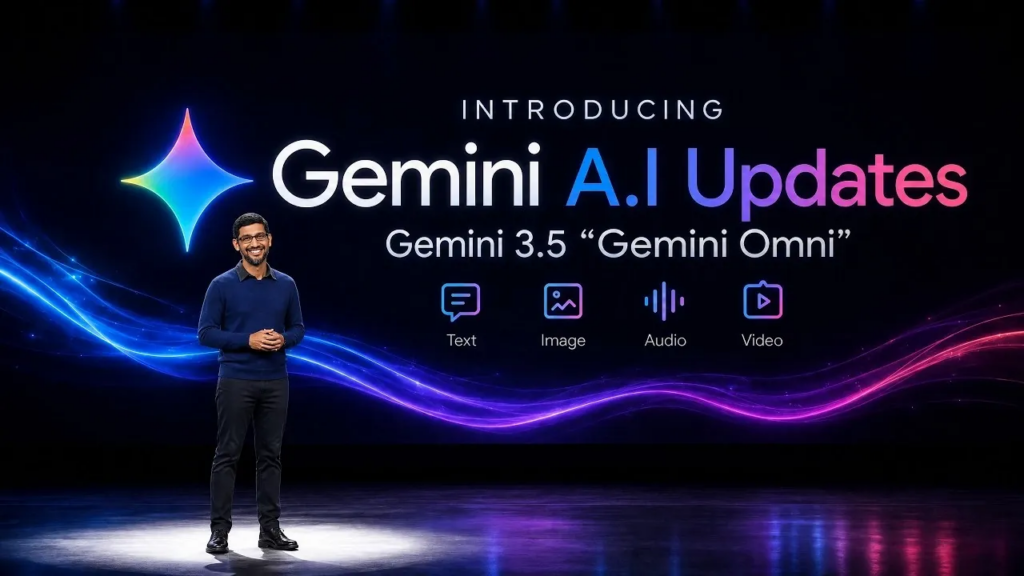
Google Gemini Omni Flash marks Google’s biggest step yet toward real-time AI video creation and editing. Instead of relying on separate tools for generation and revision, the model lets users create, adjust, and refine videos within a single conversation. As a result, the creative process becomes faster, more flexible, and easier to manage.
Google introduced Gemini Omni Flash alongside its latest Gemini model updates. The model processes text, images, audio, and video together instead of treating each format separately.
Consequently, users can move from an idea to a polished video without constantly switching between tools. More importantly, the release reflects Google’s broader effort to make AI content creation feel more natural for developers, businesses, and everyday creators.
What Is Google Gemini Omni Flash and How Does It Work?
Google Gemini Omni Flash combines multimodal reasoning with real-time video generation. Rather than relying on text prompts alone, the model understands several input formats within one workflow.
For example, a user can upload an image, describe a scene, and request matching audio. The model uses each input to generate a video that reflects the complete request. Afterwards, users can continue improving the result through follow-up instructions instead of beginning a new project.
In addition, Google released Gemini Omni Flash through its developer platform. Therefore, developers can build applications that incorporate AI video generation directly into their products and services.
Real-Time Editing Speeds Up Video Production
Editing often consumes more time than generating a video. Traditional AI platforms frequently require users to repeat prompts or regenerate clips whenever they want meaningful changes.
Google Gemini Omni Flash streamlines that process. Users can adjust lighting, backgrounds, camera movement, characters, or visual style while working on the same project. Meanwhile, the model preserves the broader context of the conversation, making revisions quicker and more consistent.
Consequently, creative teams can test multiple ideas in less time. Instead of waiting through repeated generation cycles, they can focus on improving the final result. Likewise, marketers and educators can update existing content without rebuilding every scene.
Why Google Is Positioning Gemini Omni Flash Differently
Several companies already offer AI video generators. However, Google places equal emphasis on editing and generation instead of treating them as separate capabilities.
The company also integrates Gemini Omni Flash into the wider Gemini ecosystem through its API. As a result, developers gain access to video features alongside Google’s broader multimodal AI capabilities. This approach encourages organizations to build complete AI workflows rather than relying on disconnected creative tools.
Furthermore, Google positions the model as a foundation for future applications instead of a standalone video editor. That strategy could help developers deliver richer AI experiences across different products.
Who Can Benefit From the New Model?
Developers can use Gemini Omni Flash to build interactive video applications with fewer technical barriers. At the same time, content creators can accelerate production by refining projects more efficiently.
Businesses also stand to benefit. Marketing teams can create promotional content faster, while training departments can update instructional videos with less manual work. Similarly, educators can develop visual learning materials without mastering complex editing software.
Because the model supports multiple input formats, different industries can adapt it to a wide range of creative tasks.
What Google Gemini Omni Flash Means for AI Video Tools
Google Gemini Omni Flash highlights a growing shift in AI video development. Companies no longer compete only on video quality. Instead, they increasingly compete on how quickly and naturally people can produce creative work.
Although the preview still has practical limitations, Google’s latest release points toward more collaborative AI workflows. Therefore, future video tools will likely emphasize continuous refinement, broader multimodal capabilities, and faster production from concept to final edit.
