


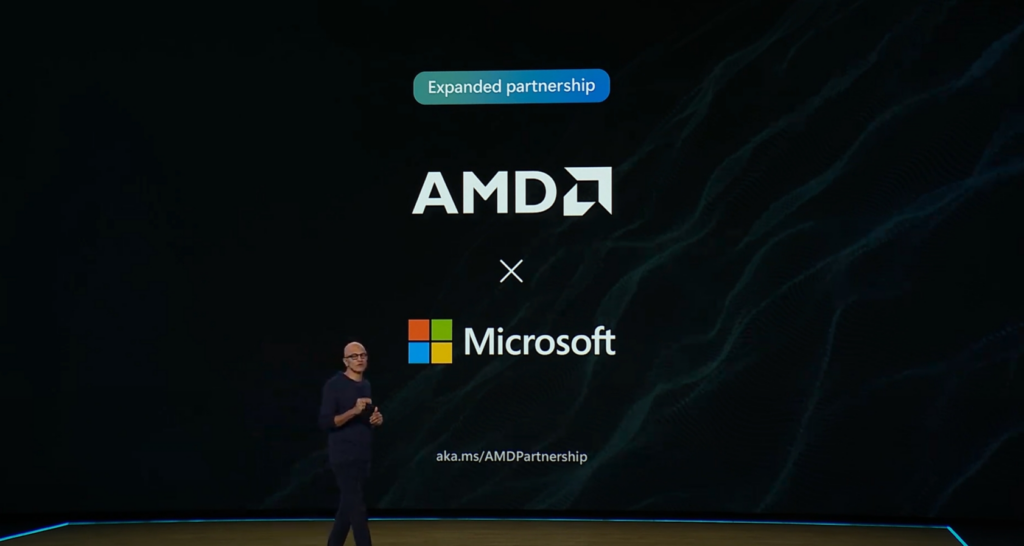
AI infrastructure continues evolving as AMD and Microsoft expand their Azure partnership. The agreement brings AMD’s Helios rack-scale platform to Azure, marking a significant step in enterprise AI computing.
AMD and Microsoft Expand Their AI Infrastructure Partnership
AMD and Microsoft have expanded their long-term partnership to strengthen AI infrastructure across Azure. Microsoft will deploy AMD’s upcoming Instinct MI455X accelerators, sixth-generation EPYC Venice processors, Pensando networking technology, and the Helios rack-scale platform for Azure AI and high-performance computing services.
Furthermore, Helios combines processors, accelerators, networking, and software into one rack-scale architecture. With this, Azure customers will gain access to AI infrastructure designed for demanding enterprise AI, scientific computing, and engineering workloads. AMD also confirmed that the platform uses the ROCm software ecosystem, allowing developers to build and optimize AI applications on an open software stack within Azure.
Instead of delivering individual components, AMD now provides AI infrastructure as a complete platform. As a result, Microsoft can deploy tightly integrated systems that support large-scale cloud operations more efficiently.
Growing Enterprise AI Demand Drives the Expansion
Microsoft continues investing in AI infrastructure because enterprise demand keeps growing. Organizations increasingly require greater computing capacity for AI training, inference, simulation, and high-performance computing. Therefore, Azure needs additional infrastructure choices as customer workloads become more demanding.
Meanwhile, AMD aims to expand its presence in enterprise AI infrastructure. Rather than competing only with individual accelerators, the company now delivers complete rack-scale systems for hyperscale cloud environments.
Additionally, both companies emphasize customer choice. Azure users can select AI infrastructure that matches different performance, software, and cost requirements while maintaining access to Microsoft’s cloud services.
AI Infrastructure Moves Beyond Individual Chips
The expanded partnership reflects a broader change across the cloud industry. AI infrastructure now depends on complete platforms instead of isolated chips. Because of this, cloud providers increasingly combine processors, accelerators, networking, and software into unified systems that simplify large-scale deployments.
Moreover, Microsoft’s decision validates AMD’s strategy of delivering integrated AI infrastructure for enterprise customers. Industry analysts also believe Helios positions AMD to compete directly with Nvidia’s latest rack-scale AI platforms.
At the same time, Azure customers receive another option for advanced enterprise AI workloads. Greater infrastructure choice can improve deployment flexibility while supporting rising demand across multiple industries.
Helios Sets the Stage for Future AI Infrastructure
AMD expects Helios deployments to begin during the second half of 2026. Microsoft will gradually integrate the new AI infrastructure into Azure AI and high-performance computing services as production increases.
Meanwhile, AMD plans to expand Helios beyond Microsoft as additional hyperscale customers adopt the platform. Larger deployments are also expected throughout 2027 as enterprise AI demand continues rising.
Ultimately, the expanded partnership signals where AI infrastructure is heading. Cloud providers increasingly prioritize integrated rack-scale platforms that combine computing, networking, and software into unified systems. Consequently, AMD and Microsoft have positioned Helios to support the next phase of enterprise AI infrastructure on Azure.
