


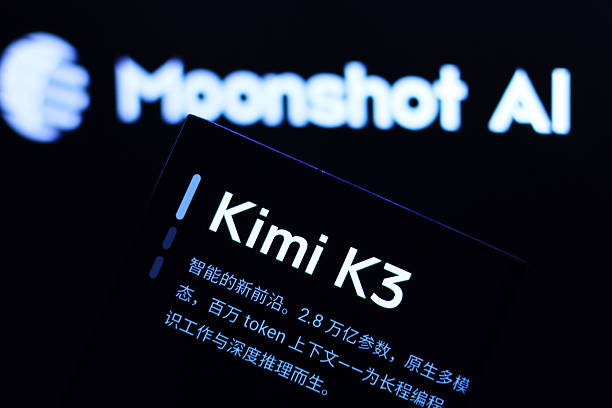
China’s AI race has produced another surprise, with Moonshot AI unveiling Kimi K3, a 2.8 trillion parameter open-weight language model that is now the largest of its kind ever released.
Early benchmark results show the model competing with, and in some coding tests, outperforming some of the most advanced systems from OpenAI and Anthropic.
The launch has quickly drawn global attention because Kimi K3 is not just another large language model. It is an open-weight model, meaning developers can download, study, fine tune, and build on it once the full model weights become available.
This makes it one of the biggest open AI releases the industry has seen at a time when many leading U.S. companies continue to keep their most capable models closed.
Kimi K3 Pushes Open AI to a New Scale
Moonshot AI said Kimi K3 contains 2.8 trillion total parameters and uses a Mixture of Experts architecture that activates only a small number of experts during inference. This approach allows the model to deliver high performance without requiring all of its parameters to run for every request.
The company also said the model supports a one million token context window, allowing it to process very large documents and codebases in a single session.
The release follows months of rapid progress from Chinese AI companies including DeepSeek, Alibaba, and Zhipu AI (Z AI). Each has narrowed the performance gap with leading U.S. developers despite ongoing restrictions on the country’s access to advanced AI chips.
Strong Coding Performance Grabs Attention
The biggest talking point has been Kimi K3’s coding ability.
According to Moonshot AI and independent benchmark tracking, Kimi K3 reached the top of the Frontend Code Arena leaderboard, scoring ahead of OpenAI’s GPT-5.6 Sol and Anthropic’s Claude Fable 5. The model also ranked among the leading AI systems on broader intelligence and agentic task evaluations, placing close to the strongest closed models currently available.
It is important to note that these results do not mean Kimi K3 outperforms GPT-5.6 across every category. Independent evaluations show OpenAI’s flagship still leads on several broad reasoning and general intelligence benchmarks. Kimi K3’s biggest strengths so far appear in coding, software engineering, and certain agent-focused tasks.
Demand Surged Almost Immediately
Interest in the model was so high that Moonshot AI temporarily stopped accepting new subscriptions for Kimi K3 shortly after launch. The company said it was dealing with unprecedented demand that had placed heavy pressure on its computing infrastructure while it focused on maintaining service for existing users.
Industry analysts say Kimi K3 also signals that China’s AI ecosystem is becoming increasingly competitive in open models. Rather than focusing only on matching proprietary systems, Chinese developers are releasing powerful models that businesses and researchers can build upon directly.
Why the Launch Matters
Kimi K3 is another reminder that the global AI race is no longer defined by Silicon Valley alone. Chinese companies are releasing models that increasingly compete with the world’s best on performance while expanding access through open releases.
Whether Kimi K3 maintains its early benchmark lead will depend on broader independent testing in the coming weeks. But even so, its arrival has already shifted the conversation. The largest open-weight AI model in history now comes from China, and it has shown that open models are closing the gap with the industry’s most advanced proprietary systems.
