


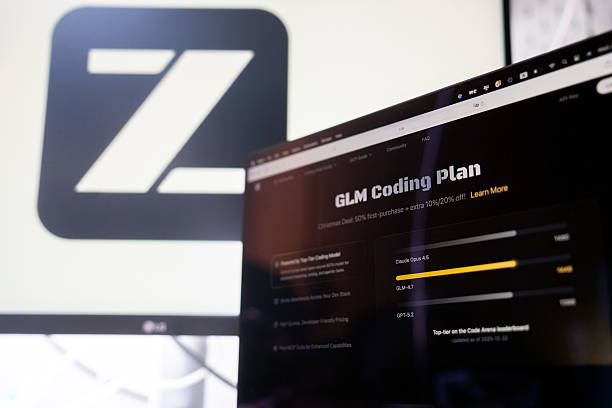
The AI race has largely been focused on OpenAI, Anthropic and Google over the past year. But a Chinese model released last month is quietly changing the conversation by showing that developers may no longer need to pay premium prices for top-tier coding performance.
GLM-5.2, developed by Chinese AI company Z.ai, formerly known as Zhipu AI, is emerging as one of the strongest open-weight language models available today.
Independent benchmark comparisons and early industry testing show it competing closely with Anthropic’s Claude Opus 4.8 on several coding tasks while costing a fraction of the price.
Strong Coding Performance at a Much Lower Cost
Claude Opus 4.8 remains one of the industry’s leading coding models and still leads GLM-5.2 across many software engineering benchmarks. However, the gap has become much smaller than many expected.
According to benchmark comparisons released after GLM-5.2’s launch, the model trails Opus 4.8 by less than a point on FrontierSWE and by just one point on MCP Atlas, two important evaluations for advanced coding agents. It also outperforms Opus 4.8 on selected benchmarks including AIME 2026, IMOAnswerBench and one Terminal Bench 2.1 configuration.
Perhaps even more significant is the price. GLM-5.2 costs about $1.40 per million input tokens and $4.40 per million output tokens. Claude Opus 4.8 charges roughly $5 for input tokens and $25 for output tokens. That makes GLM-5.2 around four to six times cheaper depending on the workload.
Open-Weights Change the Equation
Price is only part of the story. Unlike Claude Opus 4.8, GLM-5.2 is released with MIT licensed open weights. This means developers can download, modify, and self host the model instead of relying only on a commercial API.
For startups and enterprise teams, this creates far more flexibility. They can run the model on their own infrastructure or through cloud providers while reducing long term operating costs and avoiding vendor lock in.
This combination of competitive performance, low cost, and open deployment is what makes GLM-5.2 stand out from most recent AI releases.
Early Testing Supports the Benchmark Results
While benchmarks rarely tell a part of the story of a model, early real world testing also produces encouraging results.
In one experiment shared by researchers using identical coding agent setups, GLM-5.2 and Claude Opus solved exactly 25 out of 45 Terminal Bench tasks. They agreed on 43 of the 45 results, suggesting the models performed very similarly under the same conditions while GLM-5.2 completed the work at significantly lower cost.
These findings do not mean GLM-5.2 has overtaken Anthropic’s flagship model, as Claude Opus 4.8 still performs better on several demanding software engineering benchmarks, particularly long running agent workflows.
Why This Matters
The bigger story is not that another AI model has appeared; it is that an open weight model from China has narrowed the performance gap with one of the world’s best proprietary coding systems while dramatically lowering the cost of access.
This shift could reshape how startups, researchers, and software companies choose AI models over the coming months. Reuters reports that GLM-5.2 has already gained attention among developers because it combines strong coding ability with affordable pricing, even as security and geopolitical concerns continue to limit adoption in some regulated industries.
For much of the AI boom, the strongest models have also been the most expensive and tightly controlled. GLM-5.2 challenges that pattern, making it one of the most important open weight releases of the year, even if it has not yet received the same attention as its Western rivals.
This model’s release also brings back memories of DeepSeek’s breakthrough in January 2025. Like DeepSeek, GLM-5.2 is showing that Chinese AI companies can narrow the performance gap with leading Western models while charging far less.
