


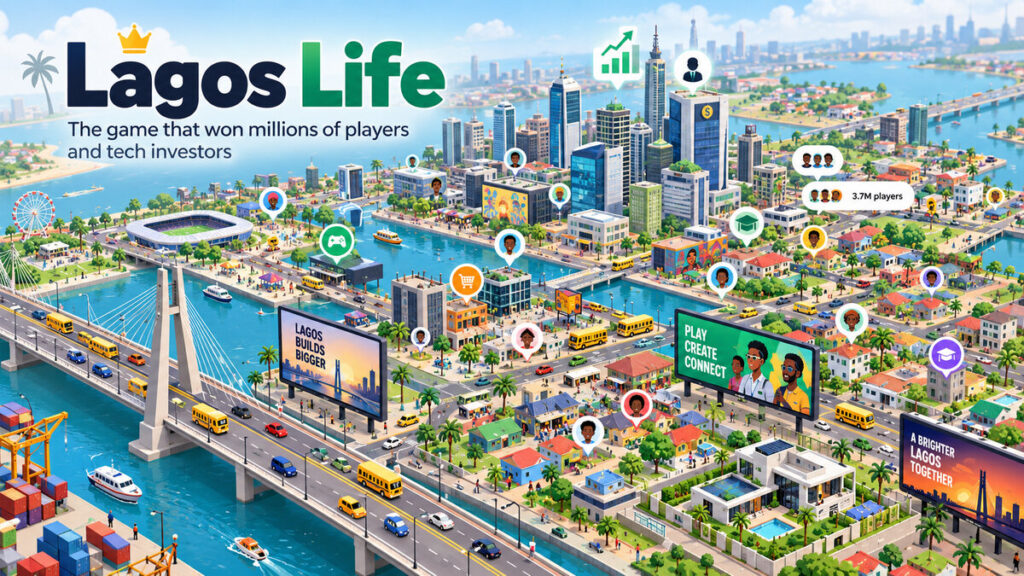
Renting a house, taking a danfo, and finding a side hustle are familiar parts of life in Lagos. It’s no wonder they are among the experiences drawing millions of people to Lagos Life, a Nigerian-made browser game that allows users to build virtual lives and interact with one another.
Since launching on October 1, 2026, the game has reportedly surpassed 10 million players in just 11 days. Its creator, Shalom Rayhamen, announced the milestone on October 11, also adding a record of 49.2 million visits. However, these figures come from the game’s own live dashboard and have not been independently verified.
And this attention has, no doubt, reached investors. On October 9, Vatar, the company behind Lagos Life, secured $500,000 in angel funding at a reported $10 million valuation, with the investment round closing within a mere 24 hours.
From an Overnight Project to Millions of Players
Rayhamen, a Nigerian software developer based in the United Kingdom, said she built the first version of Lagos Life overnight, using AI tools to assist with development, before releasing it on Nigeria’s Independence Day.
She drew inspiration from The Sims 3, which she enjoyed growing up, and Lagos Run, a browser game based on driving a danfo through Lagos.
According to Rayhamen, its early growth came largely through word of mouth and social media, without spending on marketing.
Why Lagos Life Keeps Players Engaged
One of the game’s distinctive features is how it determines a player’s financial background from the beginning. Players are randomly assigned to start as either a “Nepo Baby” or a “LAPO Baby.”
A Nepo Baby enjoys privileges such as a furnished apartment in Lekki, a car, a bank job and starting money, while a LAPO Baby begins with a loan to repay and must find employment to cover living expenses. These different starting points reflect familiar Nigerian experiences of inherited wealth, financial struggles, and the effort required to build a better life.
As such, Lagos Life offers a chance to Nigerians who are enamored by building a life they want but in a game. It allows players to create characters, earn virtual naira through jobs or side hustles such as DJing and tutoring, as well as rent homes. And its housing ranges from face-me-I-face-you rooms, where weekly rent goes for about ₦2,400, to Banana Island mansions. Travel options include danfos, keke, and flights to Abuja and Port Harcourt for now.
Beyond earning money, players can compete in Whot, Ludo and Ayo Olopon, record skits, visit friends, create families and develop romantic relationships through the game’s social features.
The game also includes banks, hospitals, insurance, police stations, and courts, where players can reportedly file cases and hire lawyers. Other features also include Meetumo and Lagos Forbes, where players can see upcoming real-life events with the former and the latter ranks players by virtual wealth and character scores track fitness, hygiene, and energy.
Ultimately, this means money shapes what players can afford, making the game more interesting.
However, Rayhamen acknowledged that some users exploited a glitch to generate huge amounts of virtual money, prompting her team to restrict suspicious balances and work towards restoring balance.
How Lagos Life Turned Its Popularity Into Investment
Vatar’s investors include Flutterwave CEO Olugbenga Agboola, through his fund Resilience17, Mono co-founder Abdulhamid Hassan, and Terra Industries co-founder Nathan Nwachuku. Technology investor Oo Nwoye also participated, according to Techpoint Africa.
These investors are betting that this game will bring as much revenue as possible, especially because it promises to do that in several ways. For one, the game allows businesses to pay for virtual billboards and advertising space, while musicians can promote their songs in its virtual clubs. This immediately presents an opportunity for people in the entertainment space to reach new audiences.
Rayhamen said the company had earned or secured contracts worth more than $170,000 since launch.
What’s Next for Lagos Life?
Vatar plans to use its new funding to develop the platform and introduce more virtual worlds.
Rayhamen has also announced plans to allow outside developers to connect their games to Lagos Life, enabling players to use their existing accounts and virtual money across different games. However, no launch date has been announced for this feature.
For now, Lagos Life has demonstrated how quickly a game built around familiar Nigerian experiences can attract an audience and investor attention.
But its next challenge will be keeping those players interested and building a sustainable business as Vatar expands beyond its first viral game.
