






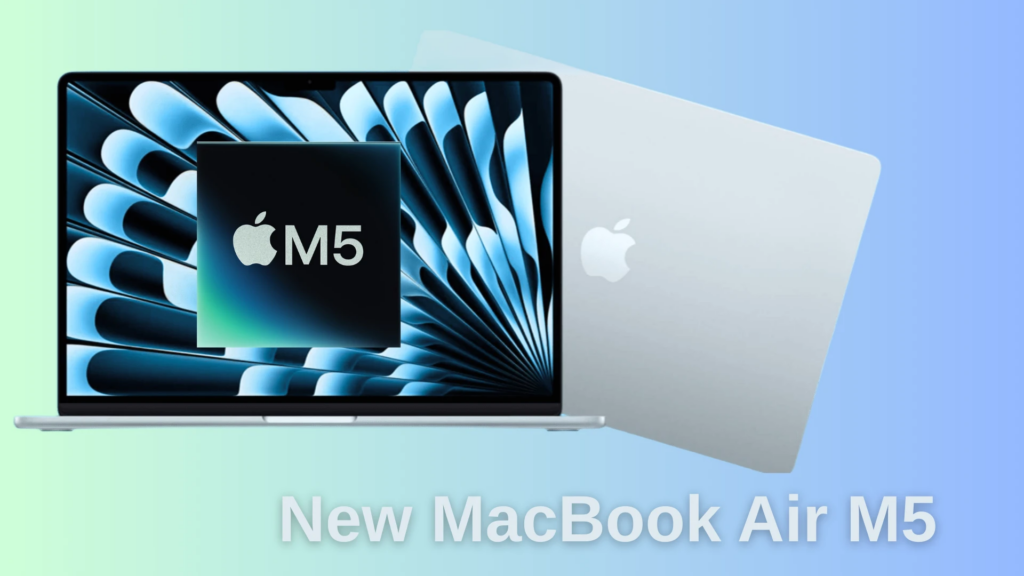
Apple recently gave its most popular MacBook model the biggest AI upgrade in history. The new MacBook Air M5 promises 4x faster AI performance over the M4 and 9.5x faster than the M1.
This is all pretty impressive by today’s standards but it also begs the question; does a speed boost in a fanless laptop finally close the gap with the pro? Or is Apple just selling a number?
What’s New in the MacBook M5 Air
First, let’s find out what these upgrades are. The MacBook Air M5 ships with a 10-core CPU, a next-gen GPU with a Neural Accelerator embedded in each core, 512GB of base storage (double the M4’s 256GB), Wi-Fi 7, Bluetooth 6 and up to 18 hours of battery life all wrapped inside the same thin, fanless aluminium frame.
Also, the prices start at $1099 for the 13-inch and $1299 for the 15-inch, a $100 boost from the previous year.
Looking at the specs, it’s a clear upgrade but the AI speed boost is what makes it stand out even more.
The 4x AI Claim – What It Actually Means
As previously stated, Apple’s M5 chip embeds a dedicated Neural Accelerator inside each GPU core. Before this, AI workloads relied on one centralised Neural Engine. Now, each GPU core independently accelerates AI tasks and the result is over 4x GPU compute performance for AI compared to the M4.
On top of that, memory bandwidth jumps from 120GB/s on the M4 to 153GB/s, a 28% increase. That extra headroom directly enables larger on-device AI models to run without needing to offload data to the cloud.
In practice, tools like Apple Intelligence, LM Studio, and Draw Things all run noticeably faster. AI-enhanced video tools like Topaz Video AI clock in at roughly 1.9x faster than on the M4. Writing tools, image generation, and smart replies are also instantaneous. Most importantly, all of it stays on-device so your data never leaves your machine.
The upgrades are great but whether it changes anything for you depends on how you use your machine.
MacBook Air M5 vs MacBook Pro
Despite all the upgrades, the MacBook Air M5 has one major setback. It does not have a fan. The fanless design is loved for silent operations but this means the Air M5 will slow down under heavy workloads.
Render a long 4K video, train a large ML model for hours, or run a complex simulation and the Pro will consistently pull ahead because it actively cools itself.
Moreover, MacBook Pro with M5 Pro and MacBook Pro with M5 Max offer Thunderbolt 5, a ProMotion XDR display, scalable GPUs up to 40 cores, and memory bandwidth up to 614GB/s. That’s not a minor gap, that’s a different tier of machine built for sustained professional output.
Additionally, if display quality matters to your workflow, note that the Air still ships with a Liquid Retina LCD, not OLED or ProMotion. Apple is reportedly saving OLED for the MacBook Pro line first, with the Air unlikely to get it before 2027.
Who Should Buy the Air M5?
For students, remote workers, writers, photographers, and anyone using AI-assisted tools casually to daily, the M5 Air is arguably the best laptop at this price point, full stop. The AI performance boost genuinely matters for these users in ways they’ll feel immediately.
That said, if you already own an M3 or M4 Air, upgrading is hard to justify unless on-device AI is central to your workflow. And if you own an M1 or M2 Air, the M5 is clearly the smarter long-term buy over the discounted M4.
Our Take
Ultimately, the MacBook Air M5 delivers a real and substantial AI upgrade. For most people, it completely eliminates the need for a MacBook Pro but “most people” isn’t everyone.
For people that push sustained heavy workloads for hours, the Pro will always be the go-to. For everyone else, the Air M5 is without a doubt the best laptop to buy in 2026.


