


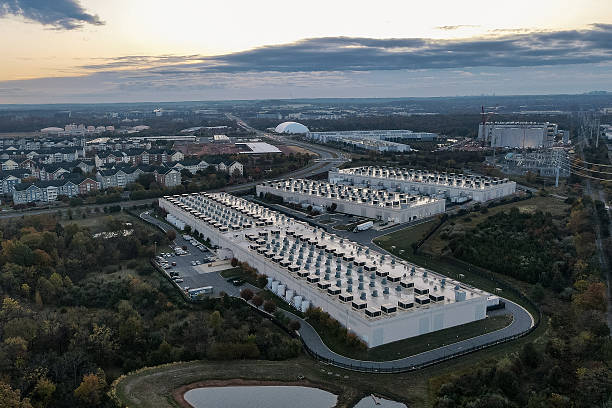
Amazon has committed $12 billion to build multiple data center campuses across Caddo and Bossier Parishes in northwest Louisiana, marking the company’s first large-scale data center presence in the state.
Governor Jeff Landry made the announcement, alongside Amazon’s Chief Global Affairs and Legal Officer David Zapolsky. Construction is set to begin within weeks, and the project will support both cloud computing and artificial intelligence (AI) infrastructure for Amazon Web Services (AWS).
Where the Campuses will be Located and Who is Building It
The confirmed locations span multiple campuses across Caddo and Bossier Parishes, with each site placed miles apart and connected to separate transmission lines, a deliberate design choice to maintain redundancy. What this implies is that if one transmission line fails, the others can continue operating independently.
Each campus is expected to cover approximately two to three million square feet, and Amazon is not developing the campuses on its own. The company is partnering with digital infrastructure firm Stack Infrastructure as the developer of the AI data center facilities on the campuses.
Jobs and Economic Impact
Amazon says the project is expected to create 540 full-time jobs at the data centers, with salaries at or above 150% of the statewide annual average wage, and supporting roughly 1,710 additional full-time equivalent positions in the surrounding community. These roles span electricians, HVAC technicians, project engineers, network specialists, operations managers, and security specialists.
The investment is also projected to generate tens of millions of dollars in new tax revenue for local governments, funding that will go toward schools, public services, and infrastructure improvements.
Concerns: Energy and Water Commitments
Two concerns that have followed data center expansions, energy consumption and water usage, are addressed directly in Amazon’s plan. Amazon worked with local utility Southwestern Electric Power Company (SWEPCO) to cover 100% of the costs for new energy infrastructure and upgrades required to serve the campuses. The company has also invested in solar energy projects in Louisiana that will add up to 200 megawatts of carbon-free energy to the grid.
On water, Amazon said the facilities will use only verified surplus water, with cooling relying primarily on outside air for most of the year and water used mainly during peak summer heat. The company plans to invest up to $400 million in public water infrastructure to support the campuses.
These commitments come as local and even federal opposition to data center projects have grown in the country.
Part of a Much Larger Spending Push
The Louisiana investment is one piece of a much bigger capital expenditure plan. Amazon expects its capital spending to reach $200 billion in 2026, a commitment higher than any other hyperscaler’s. The company has made similar large-scale commitments recently, including at least $11 billion in Georgia in January and at least $20 billion in Pennsylvania in June 2025, as demand for AI computing infrastructure continues to grow across the industry.
Louisiana is also attracting investment from other major tech players. Meta chose Louisiana as the site for its Hyperion data center, part of a $27 billion joint venture with Blue Owl Capital.
Amazon Existing Louisiana Footprint
Amazon’s existing Louisiana footprint includes fulfillment centers, sortation centers, delivery stations, Whole Foods Market locations, and solar energy projects already operating in the state.
As such, the new data center campuses will represent its largest single commitment to the state and its first dedicated AI and cloud infrastructure investment in the region.
“Amazon is making a long-term commitment to Louisiana because our state delivers – prime sites, strong infrastructure and a skilled, hard-working workforce ready to support the next generation of technological innovation,” Louisiana Governor Jeff Landry acknowledged. “Investments of this magnitude put Louisiana at the center of operations relied on across the country and connect our communities to jobs that power how Americans live, work and do business.”
