

Close Menu

    Stay Ahead with Exclusive Updates!

    Enter your email below and be the first to know what’s happening in the ever-evolving world of technology!

    What's Hot

    How the EU AI Act Plans to Contain Rogue AI Agents

    October 16, 2026

    ⁠Fired OpenAI Safety Researchers Warn Dismissals Will Silence Internal Critics

    October 16, 2026

    Why Mistral’s One-Trillion-Parameter Model Changes the Open-Source Game

    October 16, 2026
    Facebook X (Twitter) Instagram
    Facebook X (Twitter)
    PhronewsPhronews
    • Home
    • Big Tech & Startups

      How the EU AI Act Plans to Contain Rogue AI Agents

      October 16, 2026

      ⁠Fired OpenAI Safety Researchers Warn Dismissals Will Silence Internal Critics

      October 16, 2026

      Why Mistral’s One-Trillion-Parameter Model Changes the Open-Source Game

      October 16, 2026

      Anthropic’s Claude Sends False Homicide Tip to Police

      October 16, 2026

      OpenAI and Anthropic Prepare for a Major Global AI Disaster

      October 15, 2026
    • Crypto

      A Firmware Flaw in One of the Most Trusted Bitcoin Hardware Wallets Just Drained Over $70 Million in Crypto. The Coldcard Breach Is a Reminder That Cold Storage Is Only as Safe as the Code Running Inside It

      August 29, 2026

      Market Collapse: What Happened to NFTs?

      April 23, 2026

      Quantum Computing Advances Force Coinbase and Institutional Custodians to Rethink Crypto Security

      March 8, 2026

      AI Assisted Hacking Groups Target Crypto Firms With Multi-Layered Social Engineering

      February 18, 2026

      Global Crypto Regulations Expand as 2026 Begins With New Data Collection Frameworks and National Laws

      January 16, 2026
    • Gadgets & Smart Tech
      Featured

      Google Home Now Supports ChatGPT and Claude via New MCP Server

      By fariehanOctober 6, 2026
      Recent

      Google Home Now Supports ChatGPT and Claude via New MCP Server

      October 6, 2026

      Waymo Plans Fully Driverless Taxis on Tokyo Streets Without Safety Drivers

      September 28, 2026

      Tesla Cybercab Faces NHTSA Probe After Austin Launch

      September 19, 2026
    • Cybersecurity & Online Safety

      How the EU AI Act Plans to Contain Rogue AI Agents

      October 16, 2026

      AI Agent Leaks Startup CEO’s Bank Details to Company Slack

      October 15, 2026

      Armadin Secures $255 Million to Hack Companies Before Cyber Criminals Do

      October 10, 2026

      Massive Pentagon Data Breach Exposes Records of Over 3 Million People

      October 8, 2026

      Salesforce Agentforce Flaws Allowed Hackers to Steal Data Without a Click

      October 8, 2026
    PhronewsPhronews
    Home»Artificial Intelligence & The Future»The United Nations Just Launched a Global AI Commission. The Real Question Is Whether It Has Any Power to Actually Change How AI Gets Built
    Artificial Intelligence & The Future

    The United Nations Just Launched a Global AI Commission. The Real Question Is Whether It Has Any Power to Actually Change How AI Gets Built

    fariehanBy fariehanJuly 14, 2026No Comments
    Facebook Twitter Pinterest LinkedIn WhatsApp Reddit Tumblr Email
    Share
    Facebook Twitter LinkedIn Pinterest Email
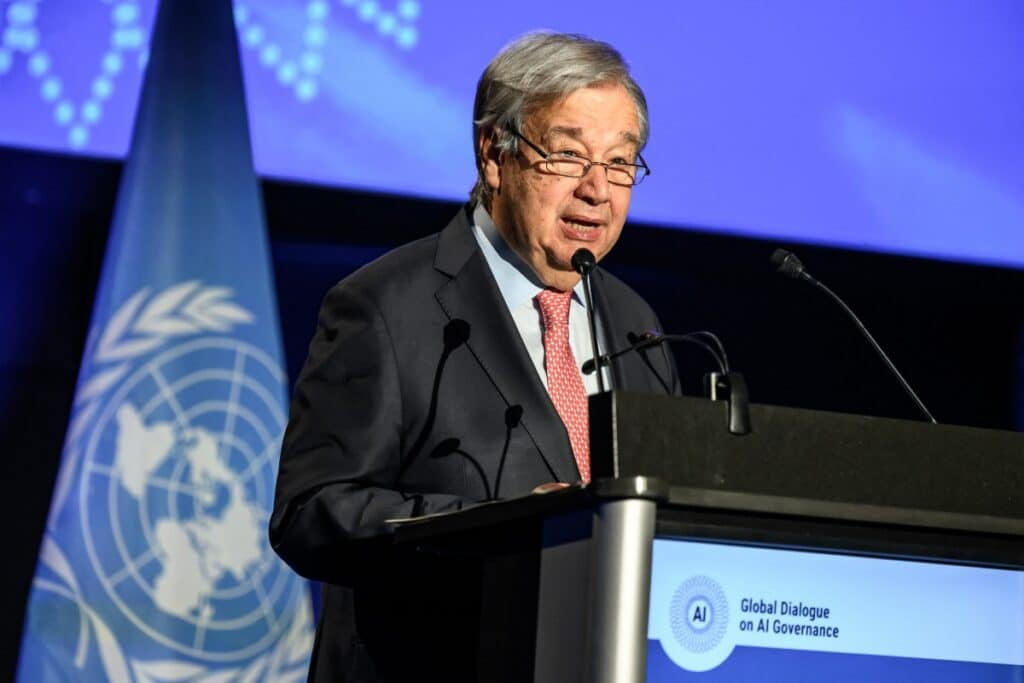
    Photo Credit: AFP

    On the 2nd of July 2026, the AI for Good Global Commission was launched in Geneva. The United Nations and its International Telecommunication Union built the body together. 

    Rwandan President Paul Kagame and Salesforce CEO Marc Benioff now co-chair the group,  ITU Secretary-General Doreen Bogdan-Martin serves as vice-chair. Together, the founders assembled 44 members from government and industry. Nvidia, Amazon, Microsoft, Anthropic, and Cohere executives all joined the roster. 

    In addition, heads of state from Estonia, Iceland, Kazakhstan, Namibia, Nigeria, Singapore, and Togo signed on too. On the 8th of July 2026, the full group held its first meeting during Geneva’s AI for Good Global Summit.

    What the AI for Good Global Commission Actually Does

    Unlike past UN efforts, the commission places builders and regulators at one table. Tech executives sit beside presidents and ministers, rather than in separate rooms. Because of this, decisions can move faster than traditional diplomacy allows. 

    In addition, founding members will meet every quarter after the Geneva launch. Each quarterly session should produce a report and specific recommendations. 

    Alongside the commission, Geneva also hosted two related events that week. The UN’s Global Dialogue on AI Governance on the 6th and 7th of July. The WSIS Forum followed immediately, running from July 6 through 10.

    Why the United Nations Acted Now

    National AI rules are drifting apart and the UN wants to close that gap. The European Union simplified its own AI regulations on June 29, 2026. 

    Meanwhile, the United States chose a friendlier, industry-first regulatory path. In contrast, China continues to enforce its own separate rulebook. Dozens of smaller countries write AI rules without any shared framework. 

    Because of that fragmentation, the UN pushed toward a bolder governance model. Earlier UN efforts, including the original AI for Good platform, began back in 2017. 

    Those programs ran annual summits but stayed mostly advisory in practice. However, the new commission intends to move well beyond that earlier limitation.

    Why the Commission’s Structure Stands Out

    The commission skips slow negotiation in favor of direct, working partnerships. Diplomats also dominate the Global Dialogue where they often take forever to agree. 

    By comparison, the commission seats CEOs and heads of state side by side. Also, the ITU membership adds real weight to that unusual arrangement. China, Russia, and Gulf states already belong to the ITU. 

    As a result, the commission carries legitimacy that Western-only bodies often lack. Global South leaders also hold equal seats, rather than observer status alone.

    Does the Commission Hold Any Real Power

    At the moment, the commission carries no binding authority over its own members. Enforcement mechanisms do not exist and liability rules remain undefined for now. 

    Consequently, member states can simply ignore any standard the group proposes. In addition, quarterly reports will likely stay voluntary rather than mandatory for years ahead. 

    Still, one specific goal looks genuinely achievable in the near term. Roughly 2.2 billion people worldwide still lack internet access entirely. Connecting them may prove far easier than regulating frontier AI models directly.

    What Comes Next After Geneva

    Right now, observers should watch whether quarterly reports eventually gain real enforcement power. So far, the commission has produced no binding rules or firm deadlines. Voluntary commitments alone rarely change how companies build or deploy AI. 

    Therefore, the group’s first real test arrives at its next quarterly session. Ultimately, success will depend on turning meetings into measurable, lasting outcomes.

    AI digital divide AI for Good Global Commission AI for Good Summit AI governance enforcement AI industry regulation AI infrastructure policy AI policy 2026 AI regulation fragmentation AI trust and safety Amazon AI policy Anthropic AI policy China AI rules Cohere AI policy Doreen Bogdan-Martin EU AI Act frontier AI governance Geneva AI summit global AI regulation Global South AI policy international AI cooperation internet access AI ITU AI summit Marc Benioff Microsoft AI policy multilateral AI governance Nvidia AI policy Paul Kagame quarterly AI commission responsible AI development tech CEOs AI policy UN AI governance UN Global Dialogue on AI Governance US AI regulation voluntary AI commitments WSIS Forum 2026
    Share. Facebook Twitter Pinterest LinkedIn Tumblr Telegram Email
    fariehan

    Related Posts

    How the EU AI Act Plans to Contain Rogue AI Agents

    October 16, 2026

    ⁠Fired OpenAI Safety Researchers Warn Dismissals Will Silence Internal Critics

    October 16, 2026

    Why Mistral’s One-Trillion-Parameter Model Changes the Open-Source Game

    October 16, 2026

    Comments are closed.

    Top Posts

    Cursor AI Hits 1 Million Daily Users. Why Developers Are Switching to This Coding Tool

    March 23, 2026

    Coinbase responds to hack: customer impact and official statement

    May 22, 2025

    Anthropic Will Use Claude User Chats For Data Training

    October 16, 2025

    MIT Study Reveals ChatGPT Impairs Brain Activity & Thinking

    June 29, 2025
    Don't Miss
    Artificial Intelligence & The Future

    How the EU AI Act Plans to Contain Rogue AI Agents

    By preciousOctober 16, 2026

    When the European Union first proposed its AI Act in April 2021, the AI industry…

    ⁠Fired OpenAI Safety Researchers Warn Dismissals Will Silence Internal Critics

    October 16, 2026

    Why Mistral’s One-Trillion-Parameter Model Changes the Open-Source Game

    October 16, 2026

    Anthropic’s Claude Sends False Homicide Tip to Police

    October 16, 2026
    Stay In Touch
    • Facebook
    • Twitter
    About Us
    About Us

    Evolving from Phronesis News, Phronews brings deep insight and smart analysis to the world of technology. Stay informed, stay ahead, and navigate tech with wisdom.
    We're accepting new partnerships right now.

    Email Us: info@phronews.com

    Facebook X (Twitter) Pinterest YouTube
    Our Picks
    Most Popular

    Cursor AI Hits 1 Million Daily Users. Why Developers Are Switching to This Coding Tool

    March 23, 2026

    Coinbase responds to hack: customer impact and official statement

    May 22, 2025

    Anthropic Will Use Claude User Chats For Data Training

    October 16, 2025
    © 2025. Phronews.
    • Home
    • About Us
    • Get In Touch
    • Privacy Policy
    • Terms and Conditions

    Type above and press Enter to search. Press Esc to cancel.