


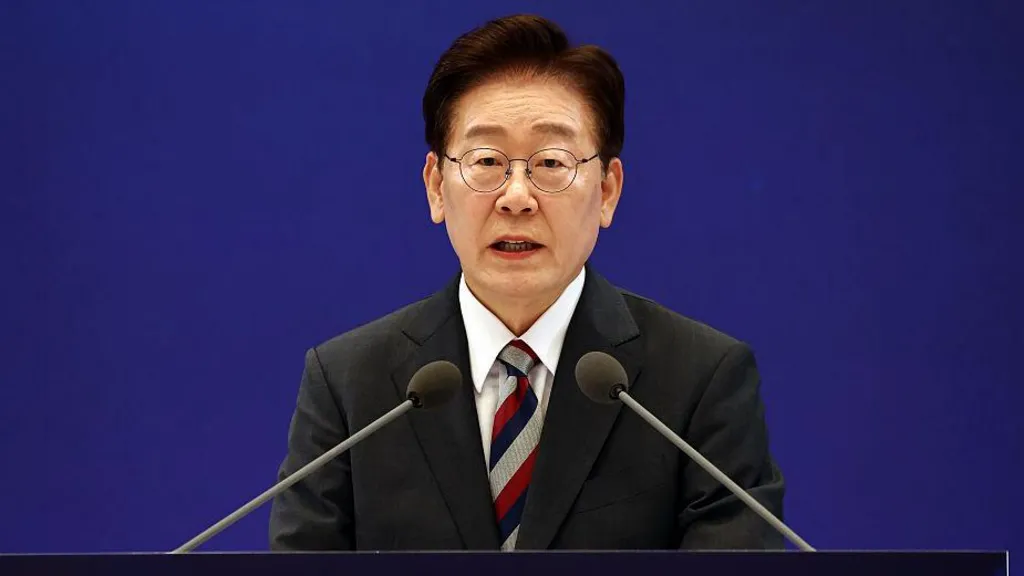
South Korea has unveiled plans for at least $880 billion (£666 billion) in investment to build out its chip manufacturing and artificial intelligence capabilities in the years ahead.
The plan falls under what the government is calling its Three Mega Projects, covering new chip production hubs, data centres and robotics technology. President Lee Jae Myung announced on June 29 the plan is aimed at rejuvenating the economies of areas outside the capital, Seoul.
Why Now
Lee’s announcement comes as regional rivals including Taiwan, China and Japan pour money into chip factories and related technology, with the AI boom driving up global demand for semiconductors.
He also said the country must secure the core elements of AI faster than its rivals, describing semiconductors, physical AI and AI data centres as the three pillars of the plan. He made the announcement at a televised event alongside the leaders of Samsung and SK Hynix, the country’s two largest chipmakers.
A Push Beyond Seoul
President Lee laid out plans to build additional AI infrastructure hubs outside Seoul, where most of the country’s advanced factories are currently concentrated.
He had earlier described the project as a matter of survival for the country, pointing to the decline of rural areas caused by the concentration of industry in the capital. “Now, we must break this long-standing cycle of discrimination and marginalisation,’ he wrote, framing the plan as a matter of fairness as well as long-term, inclusive growth.
Samsung’s Share of the Plan
A large piece of the national commitment comes from Samsung itself. The company has pledged roughly 1,000 trillion won (about $648 billion) over the next 10 years, which analysts are calling the largest single corporate spending commitment in South Korean history. Samsung Electronics chairman Lee Jae-yong and SK Group chairman Chey Tae-won both joined President Lee at the June 29 briefing to lay out how the money would be spent.
A large share is earmarked for a new semiconductor cluster in Gwangju, in the southwest, where Samsung plans to build front-end fabrication plants alongside back-end packaging facilities.
More funds will expand existing chip campuses in Pyeongtaek, Hwaseong, Giheung and Yongin, sites that are reportedly nearing the limits of available power and water.
Samsung Display, Samsung SDI and Samsung Electro-Mechanics are also part of the plan, with money going toward next-generation OLED screens, batteries and semiconductor substrates across the Chungcheong and Yeongnam regions. And a separate portion supports a new AI data centre in South Jeolla province, which officials describe as a step toward a domestically controlled AI system.
Where the Industry Stands
Samsung and SK Group sit near the top of the AI supply chain, with Nvidia counted among the companies that buy their chips. This position has paid off as global spending on AI infrastructure has climbed, spending that includes a combined $650 billion Google, Amazon and Meta plan to put into the technology this year.
SK Hynix has also felt the effect directly, as its valuation crossed $1 trillion in May, a jump investors tied to surging demand for AI data centres, the very kind of demand that companies like Google and Meta are helping drive.
Rising demand for AI chips has led to a global semiconductor shortage, pushing prices higher across the industry. For instance, Apple and Microsoft raised prices on some of their devices last week, citing higher component costs.
Some investors have also grown uneasy about the scale of money flowing into AI, a concern that has already contributed to share price declines in recent days.
