


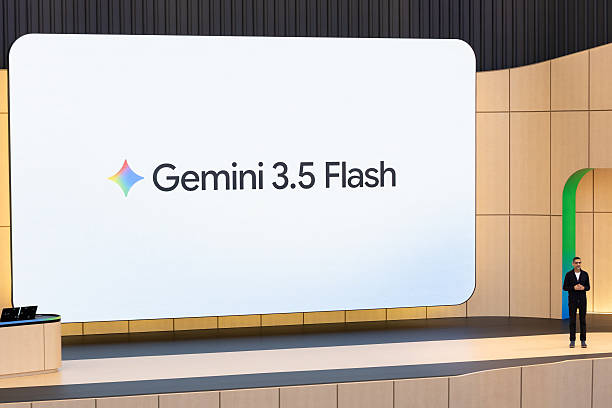
Google used its I/O 2026 developer conference to announce a major shift from AI chatbots to agentic AI systems, which are tools that can act on a user’s behalf across apps, devices, and the web. At the center of that shift was Gemini 3.5 Flash, a new model that Google described as the first in its latest family combining frontier intelligence with action.
Google is calling this the “agentic Gemini era,” and every product announcement at the I/O 2026 event was built around that framing.
A Flash Model That Now Outperforms a Pro
Gemini 3.5 Flash outscores Gemini 3.1 Pro on Terminal-Bench 2.1 at 76.2%, MCP Atlas at 83.6%, and GDPval-AA at 1,656 Elo, while running roughly four times faster in output tokens per second and costing about 25% less. The model is priced at $1.50 per million input tokens and $9.00 per million output tokens, which is roughly 40% cheaper than Gemini 3.1 Pro on both input and output. As of mid-May, it became the default model in the Gemini app, AI Mode in Search, and the Gemini API.
To illustrate what that speed means internally, CEO Sundar Pichai revealed that Google’s token processing on Antigravity 2.0, its agent-first development platform, grew from half a trillion tokens per day in March 2026 to more than three trillion tokens per day by the time of the conference.
What “Agentic” Actually Looks Like
The shift Google described at I/O is not only about faster models. There’s the Gemini Spark, a 24/7 personal AI agent inside the Gemini app that runs on dedicated Google Cloud virtual machines. This means it keeps working when a user’s device is off. It integrates with Gmail, Docs, Sheets, Slides, and Chrome to complete long-horizon research and task management autonomously.
And on the developer side, Antigravity 2.0 is a new standalone desktop application for building and managing AI agents, with support for parallel subagent execution, scheduled background tasks, and ecosystem integrations with AI Studio, Android, and Firebase. Google also announced Android Halo, a new UI surface that lets users watch an agent’s progress from the phone’s status bar without switching apps. It is set to launch later in 2026.
Search Gets Rebuilt Around the Same Idea
AI Mode now runs on Gemini 3.5 Flash, and a new intelligent Search box was introduced that expands as users type, reflecting how people now ask longer and more conversational queries.
New information agents work in the background 24/7 to keep users updated on whatever matters most to them, pulling from blogs, news sites, social posts, and real-time data on many subjects such as finance, shopping, and sports.
The Numbers Behind the Push
Google is now processing more than 3.2 quadrillion tokens per month, a significant jump from 480 trillion tokens per month at I/O 2025. The Gemini app has grown from 400 million to 900 million monthly active users in one year, while AI Overviews now reaches 2.5 billion users monthly.
The infrastructure spending behind all of this is also significant, as Google’s 2026 capital expenditures is between $180 billion to $190 billion, roughly six times what the company spent in 2022.
What Google Did Not Ship
Gemini 3.5 Pro was not released at the event. The I/O audience reportedly groaned when Pichai broke the news, and he told them the model would arrive in June 2026.
With 3.5 Flash already deployed across Google’s biggest products and 3.5 Pro still on the way, the company’s position in the AI arms race has become sharper. The next stage of the competition, at least by Google’s own framing, will not be decided by which model gives the best single answer. It will be decided by which platform can run the most useful tasks in the background, without waiting to be asked.
