


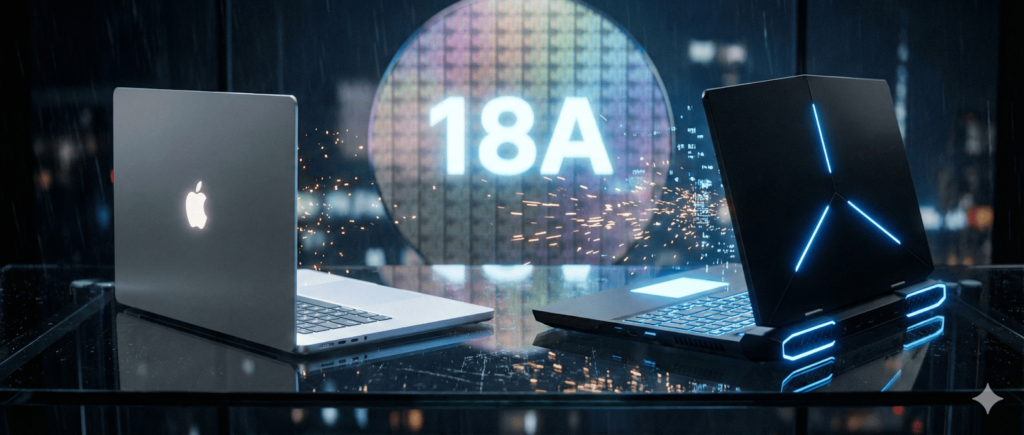
For the past five years, the narrative of the semiconductor industry has been singular and punishing for Intel: Apple simply does it better. Since the debut of the M1 in 2020, the MacBook has served as the gold standard for efficiency and performance, leaving Intel’s x86 architecture to languish as the hot, loud, and slow alternative. However, 2026 marks the end of that unilateral dominance. With the release of the Core Ultra Series 3, codenamed Panther Lake, and the revolutionary 18A process node, Intel has not only stabilized its plummeting trajectory but has arguably retaken the performance crown from the Apple M5. This is the story of how an American icon went from the brink of insolvency to a triumphant, if complex, comeback.
To understand the magnitude of this resurgence, one must appreciate the depth of Intel’s previous collapse. The relationship between Intel and Apple, once a symbiotic alliance, disintegrated due to Intel’s severe stagnation. By 2018, Intel’s inability to shrink its transistors, known as the “10nm delay,” meant its chips ran far too hot for Apple’s sleek designs, culminating in the thermal throttling disasters of the i9 MacBooks. When Apple finally broke away and launched the M1 in 2020, it didn’t just win; it embarrassed the competition. An entry-level, fanless MacBook Air could suddenly outperform Intel’s flagship mobile processors while delivering triple the battery life. Losing Apple cost Intel more than just revenue; it stripped them of their status as the industry pacesetter. By 2024, Intel found itself fighting a losing three-front war against Apple in premium laptops, AMD in data centers, and Qualcomm in AI PCs.
By late 2024 and early 2025, the situation had direly escalated. Intel was no longer merely struggling; it was on the verge of total collapse. The company posted a historic quarterly loss of $16.6 billion, suspended its dividend, and watched its stock price crash by over 60%. CEO Pat Gelsinger’s ambitious “IDM 2.0” strategy which involves spending billions to build new factories had drained the company’s cash reserves just as revenue plummeted. It was here that the U.S. government intervened. In August 2025, viewing Intel as too critical to fail for national security, the Trump Administration stepped in. They converted over $11 billion in grants and funds into a 9.9% direct equity stake in the company. This controversial move, labeled by some as necessary “State Capitalism” to compete with China, effectively nationalized part of Intel’s risk and provided the $37.4 billion in immediate liquidity needed to stop the bleeding.
Stabilized by this influx of sovereign capital, Intel was finally able to complete its “Hail Mary” technology: the 18A process node. This new manufacturing process introduced massive innovations that allowed Intel to catch up to the laws of physics that Apple had mastered. Through RibbonFET, a new transistor design that drastically reduces power leakage, and PowerVia, which routes power through the back of the chip to improve density, Intel boosted performance without melting the chassis. The result is the Core Ultra Series 3, a chip that brings the fight directly to Apple.
In a head-to-head comparison, the question of whether Intel has beaten the M5 is nuanced. For heavy-duty workflows and gaming, Intel has reclaimed the throne. In multi-core testing, the Core Ultra X9 388H destroys the base Apple M5, scoring 1,285 in Cinebench R24 compared to Apple’s 922, a commanding 39% lead. Furthermore, Intel’s new Xe3 “Battlemage” integrated graphics outscored the M5 by nearly 16% in 3DMark tests. For the first time, thin Windows laptops can run the entire Steam library natively, effectively becoming gaming ultrabooks without needing a separate, heavy graphics card. However, Apple still retains the crown for snappiness and efficiency. The M5 architecture holds a significant lead in single-core performance, meaning basic tasks like opening apps or browsing the web may still feel slightly more fluid on a Mac.
Perhaps the most critical battleground for users is battery life, where Intel has finally closed the usability gap. The new Intel-powered laptops, such as the Asus ZenBook Duo (2026), can achieve an incredible 22 hours of video playback. While this is functionally excellent, it reveals a brute-force approach: Intel achieves this parity by using larger 99.0 Wh batteries, whereas the 14-inch MacBook Pro achieves 24 hours with a much smaller 72.4 Wh battery. The verdict is clear: Intel has beaten the anxiety of battery life, but the Apple M5 remains roughly 30-40% more efficient per watt.
Beyond the raw specs, the landscape of the industry has shifted in fascinating ways. As part of the government deal, Intel agreed to match federal contributions to “Trump Accounts” tax-deferred savings for children essentially tying the company’s HR policies to the administration’s political platform. Meanwhile, manufacturing these new chips has proven difficult; yields for Panther Lake are hovering around 60%, meaning Intel is sacrificing profit margins just to win back market share. Interestingly, the roles regarding software stability have flipped. Intel now markets Windows as the safe bet for creatives, highlighting that recent macOS updates have broken compatibility with legacy professional tools. Most ironically, rumors suggest that Apple, facing price hikes from TSMC, is exploring using Intel’s foundries for its entry-level chips by 2028. The company that left Intel might soon be renting Intel’s factories.
Intel has not magically become more efficient than Apple overnight. Instead, they have utilized a combination of sovereign capital and brute-force engineering to create a product that is functionally superior for power users. If you need raw multi-core power and gaming compatibility, the Intel Core Ultra X9 is now the winner. If you want the absolute highest efficiency, the M5 remains king. For the first time in five years, however, the choice is no longer obvious.
