


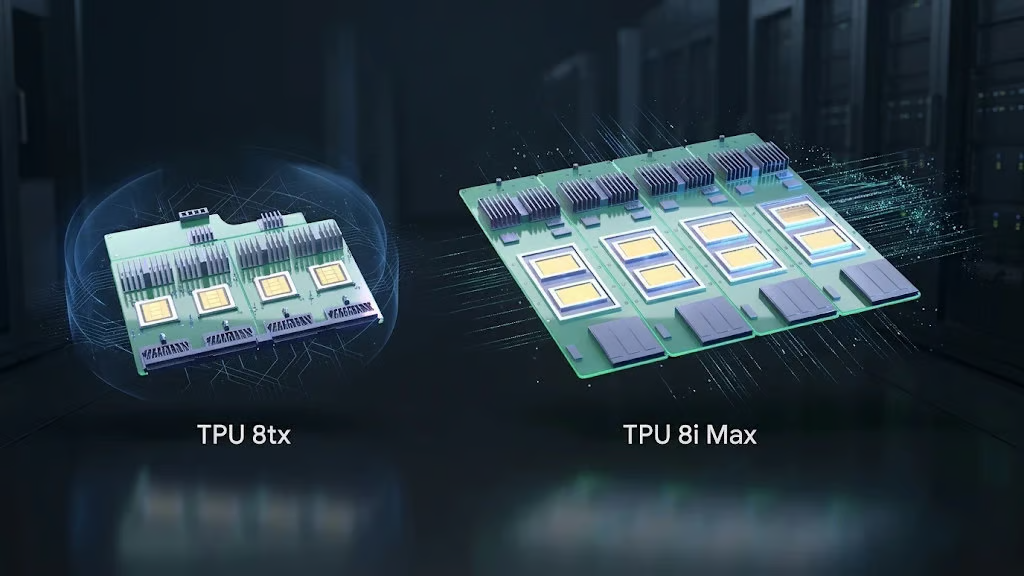
On the 9th of November, Google unveiled two new AI chip systems, TPU 8tx and TPU 8i Max. Google says a new chip needs a multi-year design process, while a new system takes months. As a result, the company shipped four TPU systems in a single year for the first time.
Google Builds Two Systems for Two Jobs
Customer requests drove both designs. Businesses wanted accelerators for massive context windows, and regulated customers wanted specialized encryption.
Memory bandwidth limits performance when dozens of AI agents work together. Therefore, TPU 8i Max doubles the compute, on-chip memory, and bandwidth of a single TPU 8i. Totals reach 768 MB of on-chip memory and 17.2 TB per second of bandwidth. Twice the silicon also fits in the same rack, so data centers gain more computing power per square foot.
However, regulated customers faced a different problem, since computers normally unlock data in memory during processing. As a result, TPU 8tx solves the problem by keeping data and model weights protected and isolated during processing.
In addition, the company reports up to 2x lower latency than TPU 8t, with a near-zero performance penalty. TPU 8tx pairs with fifth-generation AMD EPYC host processors. Google says TPU 8tx also suits small-scale training. Together, the four systems now cover training, low-latency reasoning, confidential computing, and massive context windows.
Inference Growth Favors Specialized Chips
Patrick Moorhead, chief analyst at Moor Insights & Strategy, explained why specialization matters. “With roughly two-thirds of AI compute now going to inference, specializing in inference hardware is the right call.”
In addition, both systems follow the same logic, since each targets one workload. As a result, governments and regulated enterprises can run AI on sensitive records. Teams can also fine-tune models on their private data without moving the data between separate clusters. Customers can now deploy TPUs directly in their own data centers, according to Google.
Beyond hardware, Google open-sourced TorchTPU last month, so PyTorch code and Hugging Face models run natively on TPUs. Meanwhile, new Agent Compute Engine software suspends idle agent sessions automatically, which cuts infrastructure costs.
Nearly 100 customers now use TPUs, including frontier labs, trading firms, retailers, and universities. For example, Caltech moved some cancer research from its own computing system to Google Cloud TPUs.
2027 Availability Leaves Pricing Unanswered
Google gave no availability dates, prices, or regions for either system at launch. The company expects both systems to reach customers in 2027. Until then, Google Cloud’s documented confidential options for regulated customers remain Nvidia GPUs. Buyers therefore cannot compare TPU 8tx costs against Nvidia GPU options.
In addition, capacity adds another limit, since customers have contracted every TPU the company has. Moreover, no independent tests exist, so every performance figure for both systems comes from Google.
However, Google has not published how regulated buyers can verify TPU 8tx’s protections. The company has not said whether TPU 8tx will run in customers’ data centers. Ultimately, independent tests, security details, and prices will decide whether regulated buyers choose TPU 8tx over Nvidia’s confidential GPUs.
