


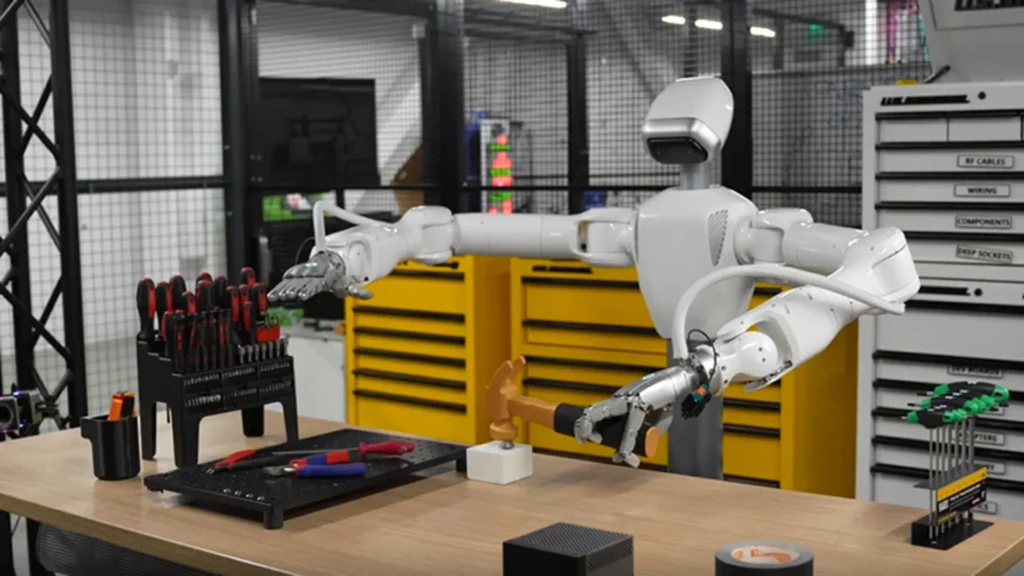
Robots have become increasingly capable of performing physical tasks, from walking and moving objects to assisting with industrial operations. However, teaching them to handle smaller components, connect cables, assemble equipment, and perform other activities that require precise hand movements remains a major challenge, according to Nvidia.
The company is now working to address this challenge with a new AI model designed to improve how robots learn and perform physical tasks. The company introduced GR00T 2 at the Conference on Robot Learning (CoRL) in Austin, Texas, on November 9, announcing that the model uses a new approach called a world action model, which allows robots to learn manipulation skills from human demonstrations, predict how their surroundings will change as they act, and transfer learned skills across different robot designs.
GR00T 2 builds on Nvidia’s work to improve how robots learn from human demonstrations, adapt to unfamiliar tasks, and handle objects that require precise movements.
According to Nvidia, GR00T 2 achieved a 40% average success rate without additional demonstrations across 50 tasks that the target robot had not previously been shown. Providing five demonstrations for each task increased the average success rate to 95%, which shows how quickly it can adapt to new activities with limited additional training.
How GR00T 2 Helps Robots Learn New Tasks
GR00T 2 differs from earlier robot AI models in how it learns to interact with the physical world. Rather than relying only on instructions and observed movements, it predicts future video frames alongside the robot actions needed to produce those changes.
This approach helps the model understand how objects and surroundings respond to physical interactions, allowing it to plan movements based on what it expects to happen next.
Nvidia trained GR00T 2 using a combination of human activity videos, demonstrations collected with handheld robotic grippers, and data from robots performing different tasks. The training dataset includes 402,730 hours of first-person human videos, 10,184 hours of handheld gripper demonstrations covering 2,897 tasks, and 23,500 hours of robot teleoperation data.
This combination allows the model to transfer skills between different robot designs. For example, a robot can learn a task from a human demonstration or from another robot without first needing extensive training on its own hardware.
Model Shows Improvements in Dexterity and Adaptability
The improvements extend to tasks that require more precise hand movements. Nvidia says GR00T 2 can perform activities such as assembling toy trucks, replacing flashlight batteries, handling laboratory equipment, and inserting computer memory modules.
In one evaluation involving 50 tasks that the target robot had not previously practised, the model achieved a 40% success rate without additional demonstrations. Providing one demonstration per task increased the average success rate to 71%, while five demonstrations raised it to 95%. The five demonstrations required less than three minutes of robot data per task, followed by 30 minutes of fine-tuning on a single Nvidia RTX 5090 GPU.
GR00T 2 also supports AI agents that can break complex instructions into smaller steps, monitor a robot’s progress and help it recover when something goes wrong. In tests involving toy assembly, an AI agent working with GR00T 2 helped a robotic arm complete 98 out of 100 toy plane assemblies, 97 toy tractor assemblies, and 97 Hot Wheels car assemblies.
This gives robots a way to handle longer activities that involve several connected movements, rather than relying on a single instruction to complete an entire task.
Nvidia Introduces GR00T 2 Turbo for Faster Robot Operations
Alongside GR00T 2, Nvidia has introduced GR00T 2 Turbo, a smaller version designed to reduce the computing resources needed to run the model.
The Turbo version uses a 2-billion-parameter video and action model that can operate directly on the Unitree G1 humanoid robot using Nvidia’s Jetson Thor computer. It works with the SONIC whole-body controller to coordinate movements such as walking, bending, reaching, and carrying objects.
In demonstrations shared by Nvidia, the humanoid robot used GR00T 2 Turbo to scoop and serve popcorn, clean up spills, and clear tables. It completed the popcorn-serving task in all 48 trials and cleared tables containing different objects in 93% of trials.
Companies Begin Exploring GR00T 2 for Industrial Applications
The introduction of GR00T 2 comes as companies explore ways to use humanoid robots and other robotic systems in manufacturing and everyday operations.
According to Nvidia, Foxconn will be applying the model to factory automation for server manufacturing, while Siemens will be evaluating it across industrial applications. Robotics company Nexuni is also testing GR00T 2 for laundry handling.
Nvidia plans to release the GR00T 2 and GR00T 2 Turbo model weights, alongside the training recipe for transferring skills between different robot designs, in December 2026. This will give developers and researchers access to the models and resources needed to explore their capabilities.
With GR00T 2, Nvidia is pushing its robotics research towards machines that can learn from human activities, adapt to unfamiliar tasks in unfamiliar territory, and perform more demanding physical work. How well these capabilities translate into everyday industrial operations will be an important measure of the model’s progress as well as the overall development and progress of humanoid robots development.
