






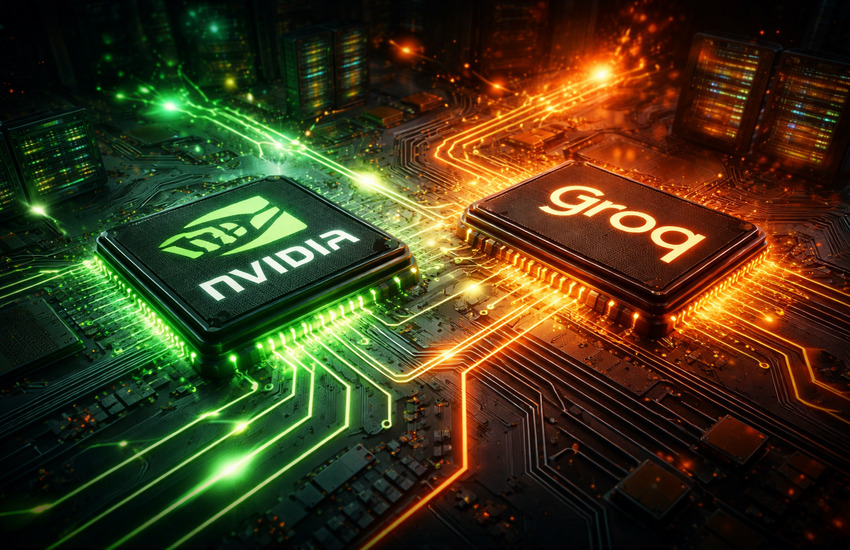
The Nvidia–Groq deal transforms the AI chip market and marks a major strategic shift for Nvidia. Nvidia dominated AI GPUs for years, powering generative AI and enterprise applications.
However, rising competition and demand for AI infrastructure push Nvidia to expand beyond hardware dominance. The company now focuses on building a broader ecosystem.
The AI Chip War So Far
Currently, Nvidia still leads in AI training GPUs, but rivals steadily challenge its dominance. For example, AMD and Intel launch stronger AI offerings, while Google rolls out improved TPUs and Amazon develops Trainium chips. As competition grows, the AI chip market becomes increasingly dynamic.
At the same time, rising demand for both training and inference workloads pushes companies to focus on specialized chips and strategic partnerships. Consequently, raw GPU performance alone no longer guarantees leadership in the AI chip war.
What the Nvidia–Groq Deal Means
Nvidia finalized the deal with Groq in late 2025. This agreement gives Nvidia access to Groq’s advanced inference chip technology. Reuters reports that Nvidia will deliver 1 million chips, including Groq units, to Amazon Web Services through 2027.
Ian Buck, Nvidia’s VP of Accelerated Computing, explained the company’s approach: “Inference is hard. It’s wickedly hard. To be the best at inference, it is not a one chip pony. We actually use all seven chips.”
Moreover, Nvidia integrates Groq’s technology across its infrastructure. As a result, the company accelerates AI deployment and improves performance across multiple workloads. In addition, the deal demonstrates that Nvidia shifts from a hardware-focused approach to an ecosystem-driven strategy.
Why the Nvidia–Groq Deal Signals a Strategic Shift
This deal highlights Nvidia’s strategic evolution. Partnerships with startups like Groq allow Nvidia to fill gaps in specialized inference chips. At the same time, Nvidia retains leadership in training hardware.
Therefore, the AI chip war shifts from a winner-takes-all hardware battle to a platform-based competition. Collaboration and integration now matter as much as raw performance.
Additionally, Nvidia combines Groq’s chips with its own lineup to provide cloud providers like Amazon a complete AI solution. This approach positions Nvidia as more than a GPU vendor and turns it into a central hub for AI infrastructure.
Ultimately, the deal demonstrates that ecosystem influence now rivals raw processing power.
The Future of AI Chips
Looking ahead, the Nvidia–Groq deal shows key trends. Small companies with special skills, especially in inference, get influence by working with bigger companies.
Companies that build ecosystems instead of just products get long-term advantages. These partnerships also help AI roll out faster and spark new ideas in chip design. They can also reduce costs as competition grows.
Because of this, Nvidia’s focus on ecosystem growth keeps it ahead in the AI chip market. The Nvidia–Groq deal shows the AI chip war now depends on ecosystems, partnerships, and strategy, not just hardware.


