


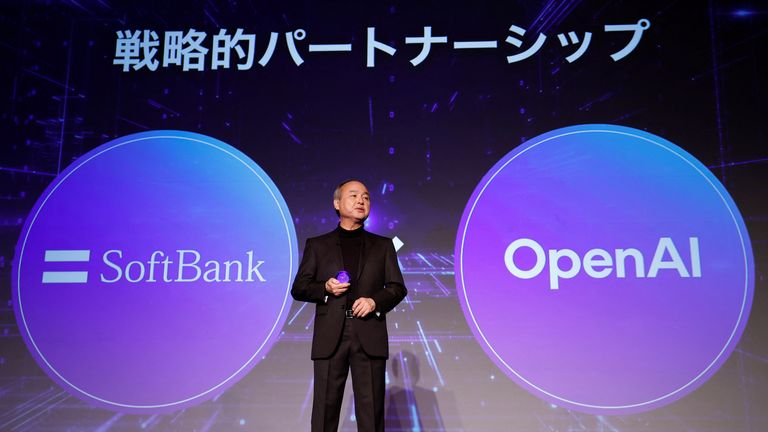
SoftBank Group completed its $22.5 billion payment to OpenAI on December 26, 2025, fulfilling the second and final tranche of its historic $41 billion investment commitment that was announced back in April 2025.
This deal completion represents one of the largest private technology funding efforts in history, as it highlights CEO Masayoshi Son’s all-in pivot toward achieving artificial superintelligence (ASI) as the central strategy for SoftBank’s future.
The tumultuous race to complete the final payment by year-end deadline required SoftBank to go through severing multiple simultaneous funding. The Japanese multinational investment holding company had originally agreed to invest up to $40 billion at a $300 billion OpenAI valuation, contingent on OpenAI completing its transition to a for-profit structure, which was a milestone the AI giant achieved in October 2025.
To assemble this $22.5 billion, SoftBank had to execute a coordinated liquidation strategy that involved a number of process:
- Asset Liquidation: SoftBank divested its entire $5.8 billion Nvidia stake in November 2025, which was a significant decision given Nvidia’s central role in GPU supply for AI infrastructure. The company also reduced its T-mobile U.S. position by $4.8 billion, allowing SoftBank to generate over $10 billion in combined liquid proceeds.
- Leverage and Margin Loans: SoftBank expanded its undrawn margin loan capacity against Arm Holdings, which it owns, with potential to access $6.5 billion of additional capacity. The strategy allowed the company to avoid selling core long-term holdings while maintaining liquidity.
- Operational Tightening: CEO Son implemented strict internal controls, one of which requires his direct approval for any Vision Fund transaction that exceeds $50 million, as well as slowing most deal-making activity to a near-halt. There were also staff reductions with the aim of preserving cash.
- Deferred Liquidity Events: SoftBank also accelerated plans for the subsidiary IPO of its payment app PayPay, which was originally scheduled for Q4 2025 but delayed due to the 43-day U.S. government shutdown. Now expected for its IPO launch in Q1 2026, the payment app is projected to raise more than $20 billion.
How this OpenAI commitment helps SoftBank
The financial urgency of SoftBank’s payment is also met with significant opportunities. For instance, SoftBank negotiated its investment at a $300 billion post-money valuation in April 2025, but OpenAI’s valuation has appreciated dramatically since then.
Secondary stock sales in October valued OpenAI at approximately $500 billion, and ongoing discussions with Amazon and other potential investors suggest valuations already approaching $900 billion. This three-fold appreciation across the span of seven months creates substantial gains for SoftBank.
Additionally, OpenAI’s rapid valuation increases is a highlight of the ongoing intensifying competition for the securing and control of frontier AI infrastructure and compute capacities. For example, Amazon is in early discussions to invest $10 billion in OpenAI at valuations that exceed $500 billion in a deal that would deepen OpenAI’s adoption of Amazon’s Inferentia and Trainium chips as well as its AWS infrastructure in general.
What this means is that almost every company wants to take part in the currently ongoing AI arms race.
The Stargate Project as an imperative to this collaboration
SoftBank’s commitment to OpenAI also exists within the broader context of the existence of the Stargate Project, a $500 billion joint initiative between OpenAI, SoftBank, and Oracle, with participation from other leading tech companies.
The Stargate Project, with data centers already established in the U.S., Germany, Norway, and UAE, aims to scale up to 10 gigawatts of compute capacity, which is equivalent to 10,000 times the electricity consumption of a typical data center.
Overall, SoftBank’s commitment or investment in OpenAI represents the centerpiece of the company’s strategy that’d pave the way for the control over the full value chain of artificial superintelligence (ASI), both in the U.S. and in Japan.
