






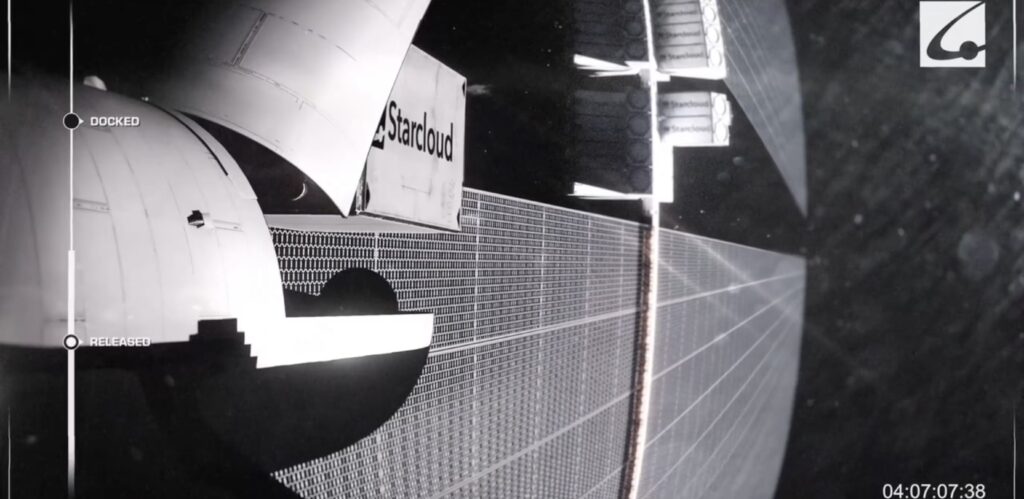
Nvidia-backed Starcloud is betting that the future of AI will be powered by something above and better than power grids. As data centers on Earth run into increasing electricity demand, grid problems, and local protests, the Redmond, Washington-based startup wants to build orbital data centers that run on uninterrupted solar power in space.
Starcloud Space Data Center Ambition
Starcloud wants to move a meaningful slice of AI computing off the planet by turning satellites into high‑performance data centers. The company recently filed with the U.S. Federal Communications Commission (FCC) for permission to launch a constellation of up to 88,000 satellites into low Earth orbit to host AI workloads.
The startup is also part of Nvidia’s Inception program and uses Nvidia’s latest GPUs as the core of its orbital computing platform. Founded in 2024 by Philip Johnston, Ezra Feilden, and Adi Oltean, Starcloud is a member of the Nvidia Inception program and a graduate from Y Combinator and the Google for Startups Cloud AI Accelerator.
And now, Starcloud has raised $170 million in a Series A round at a $1.1 billion valuation, making them the fastest company in Y Combinator’s history to reach unicorn status, just 17 months after its demo day presentation.
The round was led by Benchmark and EQT Ventures and brings Starcloud’s total capital raised to $200 million. The company will be using this capital to build data centers in space, an approach it says can solve a problem that ground-based infrastructure is no longer equipped to handle.
How Space Solves the Energy and Cooling Problem
Instead of relying on fresh water for cooling through evaporation towers, as many Earth-based data centers do, Starcloud’s space-based data centers can use the vacuum of deep space as an infinite heat sink by emitting waste heat through infrared radiation. This removes the need for water entirely.
“Anything you can do in a terrestrial data center, I’m expecting to be able to be done in space. And the reason we would do it is purely because of the constraints we’re facing on energy terrestrially,” Starcloud CEO Philip Johnston had said last year in an interview.
Constant exposure to the sun in orbit also means continuous solar power, with no need for batteries or backup power. Starcloud projects the energy costs in space to be 10 times cheaper than terrestrial-based options, even including launch expenses.
The company’s long-term goal is a 5-gigawatt orbital data center with super-large solar and cooling panels approximately 4 kilometers in width and length. For context, a compute cluster of that size would produce more power than the largest power plant in the United States.
What Comes Next From Starcloud
Starcloud 2, scheduled to launch later in 2026, will feature the largest commercial deployable radiator ever sent to space and generate 100 times the power of Starcloud-1. This comes after Starcloud 1 that was launched last year.
Starcloud 2 will carry Nvidia’s Blackwell B200 chip, an AWS server blade, as well as a bitcoin mining computer. It will be the first Starcloud satellite to run commercial workloads for paying customers.
Beyond that, Starcloud 3 is also being designed as a 200-kilowatt, three-ton spacecraft built to launch from SpaceX’s Starship rocket.
However, real challenges remain. An Nvidia A6000 GPU failed during the Starcloud 1 launch, and technical hurdles around efficient power generation, chip cooling, and multi-GPU synchronization in orbit are still being worked through.
The economics of this business also depend heavily on launch costs coming down and rockets like Starship reaching a high operational pace.
A Crowded Race to Orbit
Starcloud is not alone in the pursuit to move data centers into space.
There’s Jeff Bezos’ Project Sunrise, a space-based project seeking approval from the U.S. FCC to deploy a constellation of over 50,000 satellites to host artificial intelligence (AI) computing workloads in orbit.
SpaceX has also asked the U.S. government for permission to deploy up to one million satellites into Earth’s orbit to power AI workloads, while Aetherflux, Google’s Project Suncatcher, and Aethero are also developing space-based computing businesses.
Johnston, however, draws a distinction between Starcloud’s model and what SpaceX appears to be planning. “They are mainly planning on serving Grok and Tesla workloads,” he told TechCrunch, adding that SpaceX is unlikely to position itself as an energy and infrastructure player in the way Starcloud intends to.
Now whether or not space becomes the dominant venue for the intended data centers buildout will depend on how quickly launch costs fall and how well the technology holds up in orbit. For now, Starcloud is betting it will, and investors are backing that bet with real money.
Last year, Johnston predicted that “in 10 years, nearly all new data centers will be being built in outer space.” It looks like they’re on the right track to making this prediction come true.


