


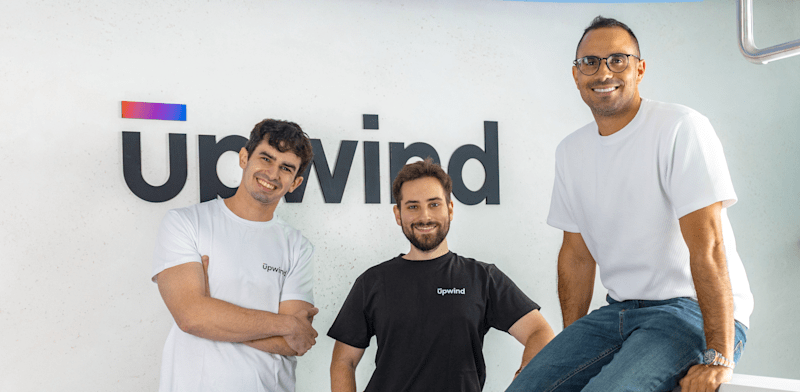
Upwind has raised $400 million after rejecting a reported $4 billion acquisition offer from Datadog. The Series C values the cloud security company at $3.8 billion, giving it resources to pursue growth independently. Consequently, the decision reflects rising demand for cloud and AI protection across industries.
Upwind Secures $400 Million Funding
Bessemer Venture Partners led the financing, with Canapi Ventures joining as a new investor. Existing backers Greylock Partners, Cyberstarts, Craft Ventures, Salesforce Ventures, and TCV also participated. The round takes Upwind’s total funding above $800 million. With this, its valuation has more than doubled since January, when investors valued the company at $1.5 billion.
The company was founded by Amiram Shachar, and they build runtime cloud security software. The platform examines applications and infrastructure while they operate, rather than relying only on pre-deployment checks. It maps networks, APIs, workloads, and data flows to expose weaknesses and suspicious activity.
Moreover, the company’s commercial performance has strengthened its position with investors. Upwind’s revenue quadrupled during 2026, while quarterly additions to annual recurring revenue reached between $20 million and $30 million. In addition, the company expects annual recurring revenue to approach $90 million by year-end.
Why the Acquisition Fell Through
Datadog approached Upwind in October with an offer worth nearly $4 billion. However, the proposal offered little premium over Upwind’s $3.8 billion private valuation. The company chose to retain control and pursue a larger opportunity as enterprise technology changes.
Currently, AI adoption is reshaping the security market. Companies increasingly connect AI agents with business applications, databases, and sensitive internal systems. These integrations create new access points that attackers could exploit. Also, they make it harder for security teams to track how automated systems interact with corporate data.
Consequently, businesses need security platforms that can monitor live activity across complex environments. They must identify exposed resources, investigate suspicious behaviour, and determine whether vulnerabilities create genuine risks. This growing need creates an opportunity for Upwind to expand beyond conventional cloud protection.
What Comes Next for Cloud Security
Going forward, Upwind plans to invest the new capital in product development and engineering. Its September acquisition of Aegis added capabilities for securing AI systems and autonomous agents. The company also launched an AI Security Lab to research agentic security, frontier models, benchmarks, and advanced AI systems.
Furthermore, its product roadmap includes three specialised agents. Blue Agent investigates security data, Red Agent tests whether vulnerabilities create exploitable exposure, and Green Agent helps teams prioritise and remediate findings. Together, these tools aim to automate parts of security operations while keeping analysts involved in consequential decisions.
In addition, Upwind plans to extend its platform across identity, data, and AI security. That expansion will test whether its runtime approach can address risks beyond conventional cloud workloads.
Ultimately, the $3.8 billion valuation has set a demanding benchmark. Sustaining revenue growth and converting its research into widely adopted products will determine whether independence delivers greater long-term value than a sale.
