


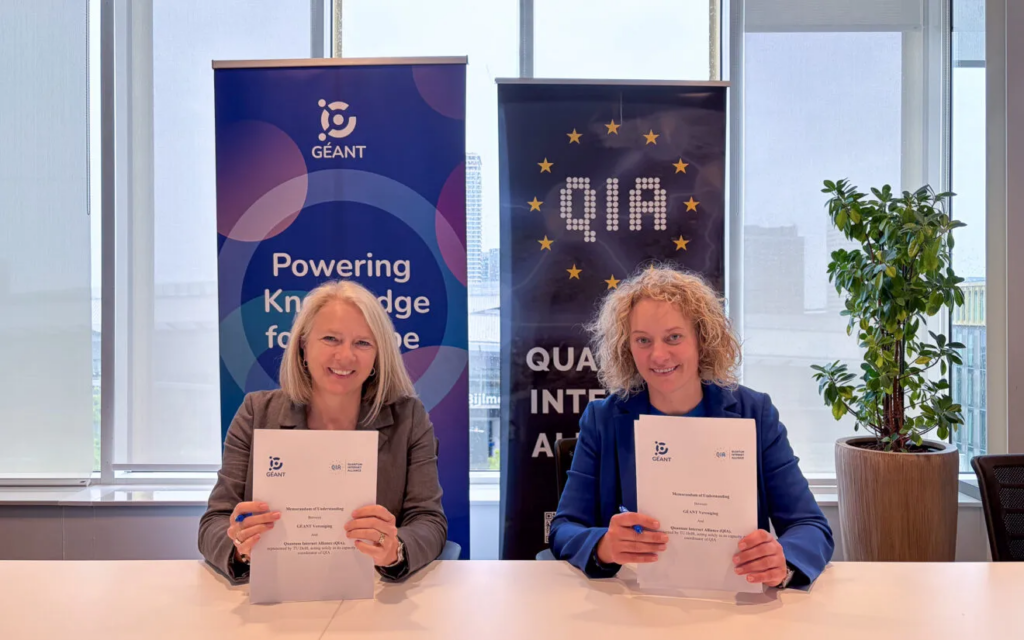
Quantum Internet Alliance (QIA) and GÉANT have signed a major agreement to build Europe’s quantum internet. GÉANT is Europe’s largest network, connecting schools and universities across the continent. Meanwhile, QIA, brings together more than 50 research institutions focused on quantum internet technology.
Together, the two groups now aim to move quantum technology out of research labs and into real-world networks. This brings Europe closer to safer, faster, and more secure digital communication.
GÉANT and QIA Formalize a New Quantum Partnership
GÉANT CEO Lise Fuhr and QIA Director Stephanie Wehner met in Amsterdam. They formalized it as a Memorandum of Understanding on September 8, 2026. The document sets shared goals rather than legal obligations. Even so, it commits both groups to share knowledge and build compatible systems.
Moreover, Fuhr explained why the step matters for Europe. “GÉANT and European NRENs have an important role to play in developing quantum networking in Europe,” she said. In other words, national research networks like GÉANT can turn lab breakthroughs into working systems. Because of the agreement, GÉANT’s existing network can now support QIA’s quantum research directly.
Bridging Lab Research and Real-World Networks
Today, quantum networking mostly exists inside university labs. To grow beyond the lab, researchers need large, real-world networks to test their equipment. GÉANT already connects 40 national research networks across Europe, giving it exactly the infrastructure QIA needs.
Also, TU Delft leads QIA, contributing deep knowledge of quantum hardware. Because neither group could build a quantum internet alone, they moved quickly toward a formal partnership.
Now, their teams plan to coordinate through two groups: GÉANT’s quantum committee and QIA’s technology forum. The setup should speed up decisions and prevent duplicated work between the two organizations.
How the Deal Strengthens Europe’s EuroQCI Strategy
The deal matters because Europe treats quantum technology as a top priority. For example, the EU runs a program called EuroQCI to protect hospitals, governments, and power grids with quantum-based security.
Specifically, the GÉANT-QIA partnership feeds directly into the EU’s larger goal. It also supports Europe’s push for digital independence, reducing reliance on quantum technology from outside the region. To put the stakes in perspective, the global quantum market could pass $155 billion by 2040.
Because of the scale involved, early infrastructure decisions carry long-term weight. In practical terms, universities, hospitals, and government agencies all stand to benefit from stronger, quantum-secure networks. Although, without strong coordination, progress could slow across the entire continent.
The Road Ahead for Europe’s Quantum Internet
Looking ahead, QIA will host a two-day event on September 28 and 29, 2026. The event will showcase progress toward a global quantum internet just weeks after the signing. Beyond the event, GÉANT and QIA plan to launch field trials across national borders.
These trials will test two key technologies: quantum key distribution and blind quantum computing. Meanwhile, the EU continues expanding EuroQCI’s networks on the ground and in space. The goal is a fully secure, quantum-based network by 2030.
If the trials succeed, Europe moves one step closer to a fully working quantum internet. The GÉANT and Quantum Internet Alliance partnership marks an early, necessary step toward that goal. Over time, the agreement could shape how millions of people across Europe communicate safely and securely.
