






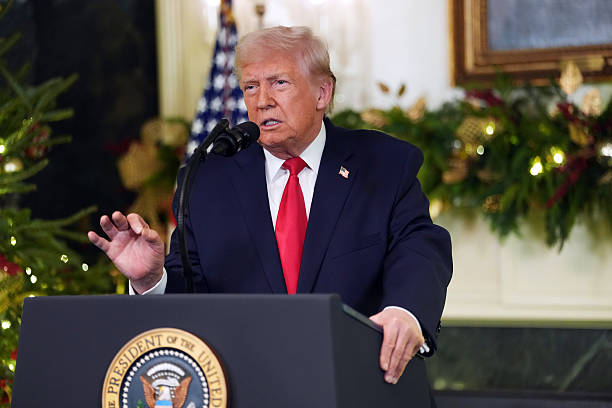
President Donald Trump recently signed an Executive Order that pushes artificial intelligence (AI) oversight firmly into federal hands and blocks states from enforcing their own rules on the technology. Titled “Ensuring a National Policy Framework for Artificial Intelligence,” the directive targets laws in states like California and Colorado that demand safety tests and bias checks for AI systems.
This move comes as AI companies face a patchwork of 50 different state regulations, creating headaches for tech developers to build the next generation of technology. This move also comes months after the U.S. Senate voted against a 10-year moratorium on State AI regulation back in July.
Trump’s AI Executive Order argues that these state measures burden interstate commerce, don’t allow for Big Techs to continue building impressive models especially when it comes to AI, and make the U.S. less competitive against global rivals like China. As such, the Executive Order instructs the Attorney General to form an AI Litigation Task Force, tasked with suing states over rules that conflict with federal policy, in the next 30 days.
Federal agencies will now lead AI regulations in the world’s biggest economy, with the Commerce Department and Federal Trade Commission identifying state laws to challenge in court. Also, governing bodies like the Special Advisor for AI and Crypto, the Assistant to the President for Science and Technology, the Assistant to the President for Economic Policy, and the Assistant to the President and Counsel will collaborate with the AI Task Force “regarding the emergence of specific State AI laws that warrant challenge,” President Trump wrote in a press release.
While the order does not outrightly cancel out state rules, it sets up precedents where federal supremacy claims could prevail. Now, developers of powerful AI systems gain an advantage against requirements for “kill switches” or bias audits that State AI laws formerly implemented as guardrails, as long as they align with federal standards.
While child safety laws stay untouched, as do rules on how state governments buy and use AI remain intact, infrastructure permitting for data centers faces lighter federal pushback. This reflects the Trump administration’s priority on expanding AI compute power without local roadblocks.
Additionally, Trump’s AI Executive Order also rescinds parts of President Biden’s 2023 AI framework, dropping mandates for safety reporting in favor of voluntary guidelines and export controls on chips.
“Pursuant to Executive Order 14179 of January 23, 2025 (Removing Barriers to American Leadership in Artificial Intelligence), I revoked my predecessor’s attempt to paralyze this industry and directed my Administration to remove barriers to United States AI leadership,” President Trump wrote, while acknowledging that the U.S. remains “in the earliest days of this technological revolution and are in a race with adversaries for supremacy within it.”
However, one U.S. state caught in the crosshairs of this pushback is California’s Transparency in Frontier AI Act. The Act requires big AI firms to share safety data and install emergency shutoffs for models that could cause harm. Colorado’s AI Act also mandates impact assessments to prevent discrimination in hiring or lending, which are rules the White House labels as forcing “ideological tweaks” to AI algorithms.
What Trump’s AI Executive Order means for Tech companies
The development of AI in today’s world is faced with rigid compliance, especially in the models, where models were often tailored to each state’s policy prior to the enforcement of Trump’s AI Executive Order.
It is why there’s the argument for how national uniformity on the production of technology promises savings, which also allows and creates space for small players to compete with giants like Google or OpenAI.
However, for everyday users in the U.S., they might have to face the ripple effect of this change in AI regulation. State bias rules aimed to catch unfair outcomes, like AI rejecting qualified minority candidates. But now, federal oversight loosens these regulations, as it prioritizes speed over safeguards, which is also a trade-off that has so far sparked debate on risk it poses at large.
But globally, the order also helps the U.S. to continue maintaining its lead in achieving technological supremacy.


