






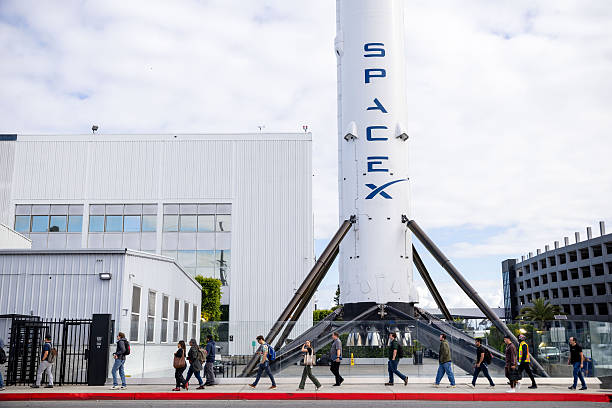
SpaceX confidentially filed for an initial public offering (IPO) with the U.S. Securities and Exchange Commission on April 1, 2026, aiming to be the largest (IPO) in history.
The company is targeting a valuation of up to $1.75 trillion and plans to raise around $75 billion through the offering, with a public listing on Nasdaq targeted for June or July 2026, depending on market conditions. For comparison, Saudi Aramco currently holds the record for the largest IPO ever, having raised $29.4 billion in 2019. SpaceX is aiming to raise more than double that.
From Rockets to Revenue Engine
SpaceX’s case for going public is grounded in one product more than any other, Starlink. According to many reports, the company generated nearly $16 billion in revenue and $7.5 billion in EBITDA in 2025, driven almost entirely by subscriber growth within the Starlink segment. By late 2025, Starlink was already serving an estimated 7 to 8 million users, with daily subscriber additions supported by extended regional availability and new direct-to-cell features.
Quilty Space, a global leader in space sector business intelligence, has projected that Starlink’s 2026 revenue could reach between $15.9 billion and $24 billion, depending on subscriber growth and the rollout of its direct-to-cell connectivity services in 2026.
The SpaceX-xAI Merger Factor
SpaceX’s February 2026 acquisition of xAI, Elon Musk’s artificial intelligence venture, changed the company’s IPO trajectory considerably. Before the merger, SpaceX’s last private valuation stood at approximately $350 billion in late 2025. The post-merger entity was immediately revalued at $1.25 trillion. The IPO filing reflects an additional $500 billion in expected market cap growth upon going public.
The move positions SpaceX not just as a launch and satellite business, but also as an orbital data center and AI infrastructure platform. Elon Musk has discussed using IPO proceeds to help finance a constellation of AI data-center satellites, which would target lower operational costs and improved sustainability compared to ground-based data centers.
Industry analysts have, however, noted that the economics of orbital computing are unproven and that near-term revenue from that segment remains speculative.
What This Means for the Broader Space Industry
The ripple effects of a SpaceX IPO extend well beyond the company itself. Since IPO plans were first reported in December 2025, investors have already bid up the valuations of publicly traded space companies including Rocket Lab and AST SpaceMobile.
Once SpaceX enters the public market, it effectively gives investors a commercial space company with scale and real cash flow to benchmark against, which raises the valuation framework for the entire sector. Additionally, companies like Planet Labs and Intuitive Machines are expected to benefit from the increased capital attention the listing will draw to space infrastructure broadly.
Legacy aerospace contractors face a different kind of pressure. Companies like Lockheed Martin and Northrop Grumman are valued primarily on EBITDA and steady dividend yields, with growth ceilings tied to federal defense budgets. SpaceX, by contrast, is being priced on total market dominance, which gives it access to capital at a scale that traditional contractors cannot match.
According to SatNews’ market assessment, what this capital gap may do is to push these legacy firms into spinning off their space divisions or pursue mergers with smaller commercial space companies to remain competitive.
SpaceX IPO Valuation Question
There’s a cloud of scrutiny hanging over SpaceX’s numbers and what it will mean after the IPO. At a $2 trillion-plus valuation, SpaceX would trade at roughly 108 times its $18.5 billion in revenue, making it nearly four times more expensive than Meta was at its IPO and significantly more expensive than Nvidia was at the height of the AI boom.
PitchBook’s analysis places SpaceX’s fair value in a range of $1.1 trillion to $1.7 trillion, describing the valuation as expensive but not irrational, provided that Starlink scales as projected and Starship commercializes on or near its proposed timeline.
And one notable structural feature of this public offering is Musk’s plan to allocate up to 30% of shares to retail investors, triple the industry standard, with a special event planned for 1,500 individual investors on June 11.
Whether the listing holds its valuation after the first day of trading remains the real question. What is already clear is that SpaceX going public will force every investor, competitor, and government space program to re-examine how they think about the economics of space.


