






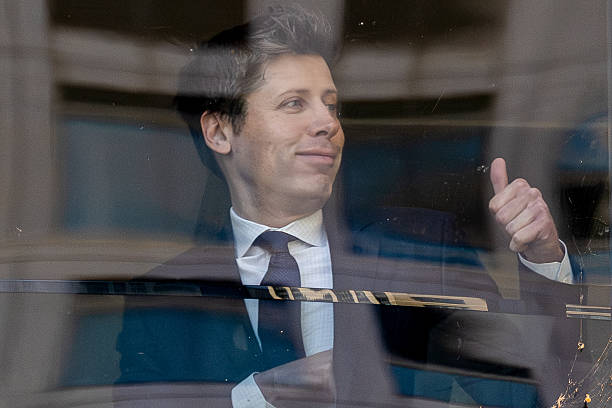
Sam Altman spent two years telling anyone who would listen that AI was coming for white-collar jobs. In June 2025, he warned that entry-level roles were at serious risk.
Then, a year later, Altman at the Commonwealth Bank of Australia conference in Sydney said something different. “I’m delighted to be wrong about this,” he told CBA chief executive Matt Comyn. “I thought there would have been more impact on entry-level white-collar jobs being eliminated by now than has actually happened.”
Speaking with Comyn, Altman acknowledged that while OpenAI’s technological predictions since launching ChatGPT in 2022 had been “roughly right,” their social and economic predictions were “pretty wrong.”
“I now think I understand more about why it hasn’t, and I’m obviously grateful but that is an area where my intuitions were just off,” he said. “People are like ‘oh you could have saved the world a lot of fear mongering and a lot of doom and gloom’ but at the time I was like ‘I see this is a real risk we should probably talk about it’ and it still may.”
He also revised his estimate of AI’s economic footprint downward, saying AI could handle “30 to 40% of tasks” in the economy eventually. That is a considerable retreat from earlier claims that AI would replace most jobs.
Altman pointed to a personal experiment as part of what changed his view. He let an AI handle his Slack responses, then switched back to replying himself after noticing that people responded more positively when they knew they were talking to him directly as opposed to an AI. His broader point was that the human component of work proved harder to replace than he expected.
What the Data Shows
On the one hand, a Yale Budget Lab study found no meaningful change in unemployment rates for workers in AI-exposed jobs since ChatGPT launched in late 2022, even as AI spread across writing, coding, customer service, research, and marketing jobs.
On the other hand, Goldman Sachs research as cited by CEO David Solomon says data center construction alone has added 200,000 jobs since 2022, which some economists cite as evidence that AI spending creates employment even as it automates tasks elsewhere.
But this is not entirely reassuring. Tech layoffs through May 2026 have passed 115,000, already approaching the full-year total of 124,000 logged in 2025, with AI cited in nearly 50,000 job cuts through April, according to outplacement firm Challenger, Gray & Christmas.
What the Reversal Means
Altman’s walk-back carries real weight because his earlier warnings have since shaped how workers, investors, and policymakers thought about AI’s economic consequences for two years. When the person who built the most widely used AI product in history says entry-level jobs are at serious risk, people listen and markets respond. His reversal now pushes that conversation in a different direction.
But the reversal does not close the debate. It reopens it in a more complicated way, because the two most prominent figures in AI are no longer saying the same thing. While Altman now says the disruption has been slower than he expected and that he is relieved to have been wrong, Anthropic’s research published in March 2026 found evidence that hiring of younger workers has slowed by roughly 14% in AI-exposed occupations.
It is also important to note that Altman’s walk-back did not happen in a vacuum. OpenAI is reportedly preparing for an IPO, with an estimated valuation of $1 trillion, and a narrative that the company’s technology is eliminating jobs is not the kind of story that attracts cautious institutional investors.


