






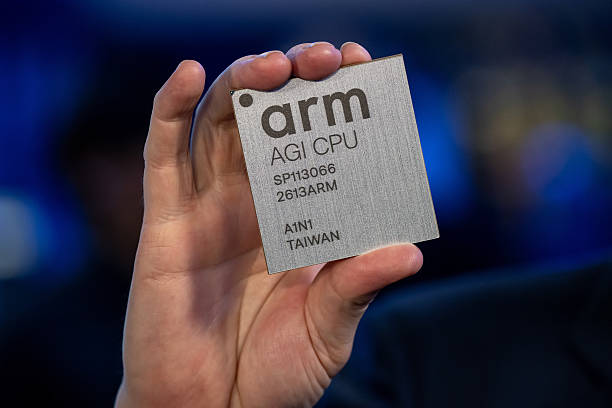
For 35 years operating in the semiconductor industry, Arm Holdings built its business by selling chip designs, not chips. That changed on March 24, 2026, when the British semiconductor company unveiled Arm AGI CPU, its first in-house production processor, at its Arm Everywhere event in San Francisco.
According to the company, the chip is designed specifically for data centers running agentic AI workloads, and it puts Arm in direct competition with Intel and AMD.
The ARM AGI CPU
Arm has introduced the AGI CPU, its first in-house data center processor, moving beyond its longstanding model of only licensing core designs to chipmakers. Built on Neoverse, the AGI CPU packs up to 136 Neoverse V3 cores into a 300-watt thermal design power (TDP) envelope, compared to the 128 cores at 500 watts required by top-end AMD EPYC and Intel Xeon processors.
The AGI CPU also supports 12 channels of DDR5‑8800 memory, delivering more than 800 GB/s of aggregate bandwidth, or around 6 GB/s per core with sub‑100 ns latency. Arm’s head of cloud AI, Mohamed Awad, told CNBC the chip delivers two times the performance per watt compared to an x86 rack, meaning twice the performance in the same footprint and the same power.
Arm will sell this as finished silicon alongside its usual IP and compute subsystems (CSS) services.
Why This Threatens x86 in AI Data Centers
Arm is positioning the AGI CPU as the “CPU foundation” for agentic AI data centers, where CPUs handle orchestration, scheduling, memory and storage coordination, networking, and service logic around GPU or specialized accelerator clusters.
In this environment, total CPU per rack and power efficiency matter as much as individual core performance, and this is where Arm is making a hard competition with Intel’s and AMD’s x86 server chips.
Arm claims the AGI CPU can deliver more than 2x performance per rack versus x86 CPUs , which translates into higher workload density and potentially up to $10 billion in Capex savings per gigawatt of AI data center capacity for hyperscale operators.
With up to 8,160 cores per air‑cooled 1U rack and about 45,000 cores per liquid‑cooled rack, operators can allocate a dedicated core per program thread while keeping optimized performance under sustained AI workloads. All of these functionalities directly pose a threat to Intel’s Xeon and AMD’s EPYC server processors.
Meta Is The Lead Partner
Arm is not entering this development alone. Meta is listed as a lead partner, and many reports indicate that other large cloud and AI customers, including OpenAI, have signed up as early clients for the company’s AGI CPU‑based systems.
Meta signed on as the launch customer and co-development partner and the partnership goes beyond a supply agreement. The AGI CPU project has been in the works since 2023, with Meta serving as a co-developer. The social media giant, with its expensive plan to build AI data centers and to spend over $100 billion on AI projects, will use the Arm AGI CPU to optimize its family of applications and custom Meta Training and Inference Accelerator (MTIA).
Meta software engineer Paul Saab, who worked on the project since 2023, told CNBC that having Arm as an option “allows a lot more flexibility in our software stack and in our supply chain.” Saab also pointed to power as a driving factor, noting that wattage is “a very scarce resource,” and that a more efficient CPU frees up capacity for other parts of the infrastructure.
Original design manufacturers (ODMs) like Lenovo and Quanta Computer and Supermicro are also making server designs around the chip, which further gives Arm credibility.
Financially, CEO Rene Hass projects that the Arm AGI CPU and related silicon products could generate roughly $15 billion in annual revenue by 2031. And market reaction has been optimistic, with Arm’s share price jumping 6.5% after the company announced its financial projections.
What Changes for Intel and AMD
For Intel and AMD, the immediate impact is not a collapse of x86 servers, but an alternative in a segment of the semiconductor market that is growing the fastest.
If Arm and its partners can prove the advantage of the Arm AGI CPU at scale in real deployments, especially for customers like Meta, AGI CPU‑based racks could start to displace x86 CPUs in new AI-focused capacity even while legacy and general-purpose AI workloads remain on Intel and AMD platforms.
That shift in new deployments alone would be enough to pressure x86 market share and margins, which would, in turn, move Arm AGI CPU from an experiment into a threat in the semiconductor industry.


