


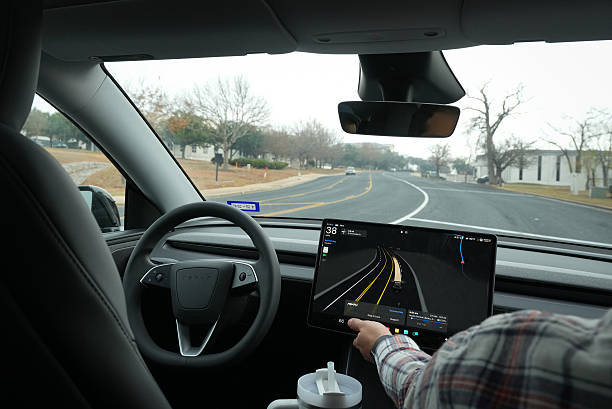
Tesla has put an artificial intelligence (AI) training center into operation in China, a move the company says is designed to adapt its Full Self-Driving (FSD) technology to local road conditions, filling a gap that has held the system back since its China debut nearly a year ago.
Tesla China Vice President Grace Tao confirmed the development in early February, telling Shanghai-based financial media outlet Cailian that the facility is now active and focused on building out local assisted-driving and AI capabilities. Tao said the center has sufficient computing power to support development of assisted-driving features, though she declined to disclose details such as its location, the size of the investment, or specific computational capacity.
Why Tesla Needed a Local Training Center
The core issue is data. Tesla’s FSD relies on a neural network trained using video clips from real driving situations, enabling vehicles to make human-like decisions. The system has been built on billions of miles of data collected from Tesla vehicles across the U.S. and other markets.
China’s strict data localization laws, however, have prevented Tesla from sending driving data collected on Chinese roads to its U.S.-based servers. That means when Tesla first launched its FSD-equivalent system in China in February 2025, the company was working around the problem rather than solving it. CEO Elon Musk acknowledged at the time that the company “just used publicly available video on the Internet of roads and signs in China and used that to train in simulation.”
However, it had real limitations such as Chinese roads coming with their own traffic patterns, road signs, and driving behaviors that a system trained on foreign internet footage could not fully account for. With a local training center now running, Tesla can collect actual driving data from its vehicles on Chinese roads, train its neural network against that data, and improve the system’s performance for those specific conditions, all while staying within Chinese data regulations.
The launch of the training center also completes what Tesla has been building toward since 2021, when it established a data center in Shanghai for local data storage. The new facility closes the loop on a full localization chain – data storage, local training, and algorithm optimization.
The Competitive Pressure Behind the Timing
Tesla’s move comes as Chinese automakers are pushing hard on autonomous driving. Companies like Huawei, Xpeng, and Li Auto have been aggressively developing their own autonomous driving systems, trained entirely on local Chinese data, and thousands of Level 3 (L3) capable vehicles are expected to hit Chinese roads in 2026 following recent regulatory approvals.
L3 autonomous driving refers to a system that can handle most driving tasks on its own but still requires a human ready to take control when required or prompted, which is a step beyond what Tesla’s current China offering provides.
“Chinese fans of autonomous driving will benefit from intensified competition between Tesla and its local rivals,” said Yin Ran, an angel investor in Shanghai. “As thousands of L3 cars are likely to hit China’s roads in 2026, a new battle will take shape as all electric-car builders try to deliver efficient and affordable self-driving systems.”
Tesla’s approach differs from most of its Chinese rivals in one key way. While competitors often rely on high-definition maps and LiDAR sensors, Tesla relies on a vision-only system that can adapt to any road without pre-mapping offers a scalability advantage that mapped solutions struggle to match.
FSD Approval in China Remains Unconfirmed
Despite the infrastructure progress, regulatory approval for FSD in China is still pending. At the World Economic Forum in Davos last month, Musk said the company was targeting approval “hopefully next month,” but sources cited by state-owned outlet China Daily said that information was “not true.” Chinese authorities did not provide additional details on whether a formal review is underway or what a potential timeline might look like.
Currently, Tesla offers “Intelligent Assisted Driving” in China, the rebranded version of its FSD system that it introduced in February 2025.
Tesla Broader AI Investment Plans
Tesla’s capital expenditure for 2026 is expected to exceed $20 billion globally, with investment priorities including AI computing power, robotics factories, mass production of the autonomous Cybercab, energy storage, charging networks, and battery plants. The China AI training center is part of that wider infrastructure push.
China is also one of Tesla’s most important production bases, as the company’s Gigafactory set a monthly record with over 97,100 deliveries in December 2025, and the company delivered 851,000 units worldwide that year, with China accounting for more than half of total global deliveries.
Getting FSD right for China is, by that measure, not a side project. It is central to how Tesla performs in its most critical market.
