






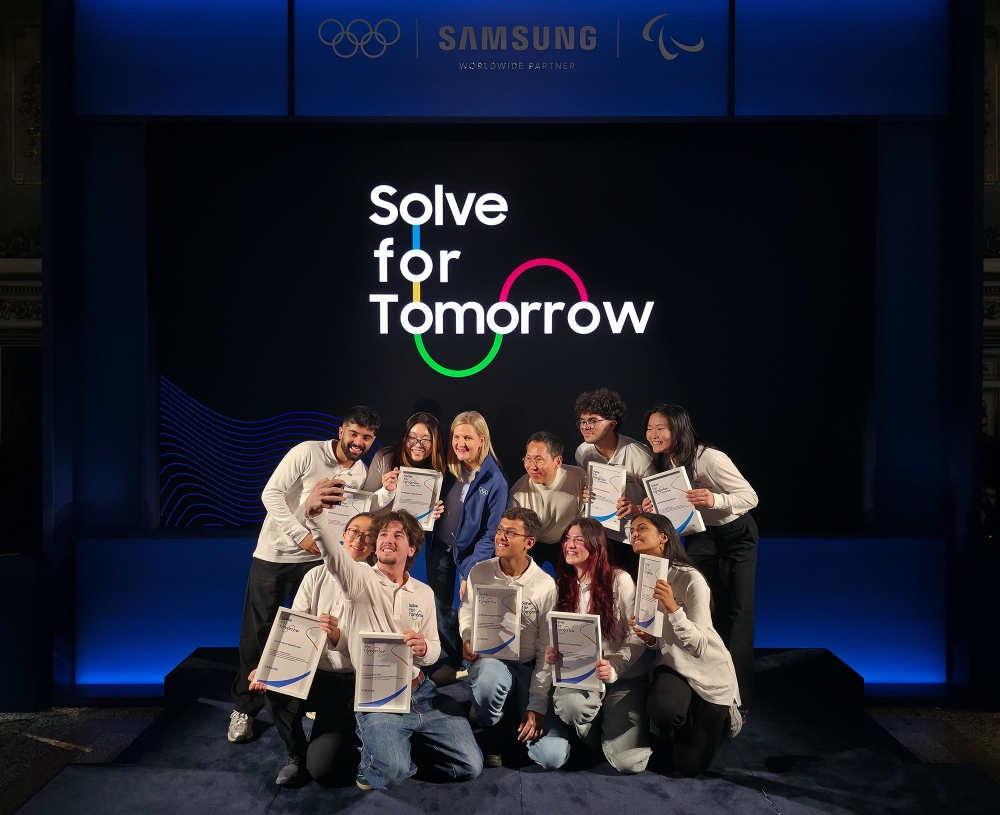
Samsung has named 10 young innovator teams as its Solve for Tomorrow global ambassadors, granting each team funding and up to two years of continued support to develop their AI-powered solutions into market-ready products.
The announcement was made during the Olympic Winter Games Milano Cortina 2026 at Samsung House in Milan, with International Olympic Committee (IOC) President Kirsty Coventry and Samsung’s Head of Global Marketing, Won-Jin Lee, in attendance.
The 10 teams, which were taken from regional Solve for Tomorrow competitions across countries including the U.S., Australia, the UK, France, Turkey, China, Indonesia, and India, were selected through a joint evaluation by Samsung and the International Olympic Committee (IOC), with judges assessing each entry on innovation, scalability, and social impact.
The teams are split into two categories: five in Sport & Tech, jointly supported by Samsung and the IOC, and five in Accessibility & Environment, supported by Samsung alone.
What the Teams Built
The 10 solutions range from wearable health tools to environmental response systems, each targeting a gap the young inventors identified in their own communities.
On the Sport & Tech side, Poseidon, developed by a team from Turkey, is an AI-powered wearable designed to guide visually impaired runners, while Storm Shield, built by a team from the U.S., is a headband that shields hearing aids from damage during physical exercise. Danielle Yang, a hearing-impaired member of the Storm Shield team, said she joined the program specifically to address challenges she faced in daily life.
“I joined Samsung Solve for Tomorrow to address the challenges I experienced in my daily life,” Yang, who has a hearing disability, told attendees according to Samsung’s announcement. “With the support of Samsung Electronics and the IOC, I’m truly honored to have the opportunity to share my idea with the world, even on the Olympic stage.”
Another Sport & Tech entry is Run Sight, developed by an Indonesian team, is a wearable AI solution that helps people with visual impairments safely participate in running and other physical activities by detecting lanes and obstacles.
There’s also Australia’s Ahan Khiani, an AI-based platform that was built to connect individuals with local sports teams and communities to increase participation in recreational sports, and Great Britain’s Raye Woon, a team that designed and built smart sneakers equipped with sensors to detect early signs of blister formation in people with diabetes and encourage safe physical activity.
The Accessibility & Environment category features equally practical inventions. AKQUA-Gel, created by a U.S. team of five students, Arya Anilkumar, Anna Huang, Aishwarya Reddy,
Subiksha Srinivasan Vidya, and Elaine Zuo, is an AI-enabled smart bandage that monitors wound healing in real time and flags early signs of infection through sensor data.
China’s Furen Makers created a brainwave-controlled wheelchair aimed to support people with ALS and physical disabilities in mobility, rehabilitation and sports participation. Paraspeak, from India, is a cloud-based AI tool built to improve speech clarity for people with speech impairments.
And from France, Liova repurposes discarded smartphone batteries into portable power banks, while Turkey’s OilSorb uses wool-based pads combined with drones to respond to marine pollution.
“It is energizing to witness the Solve for Tomorrow Ambassadors showcase their innovative solutions firsthand,” said Ollie Dudfield, Olympism365 Associate Director at the IOC. “The work of the Ambassadors reflects our shared belief across the IOC, Samsung and Milano Cortina 2026, in youth engagement and in the impact sport and technology can have as catalysts for positive social change.”
The Programme Behind the Samsung Announcement
Solve for Tomorrow is Samsung’s long-running global STEM education platform, which was launched in the United States in 2010 and now active in 68 countries, where it has reached over 2.9 million students in its 15-year history. The programme encourages students to design technology-based solutions to problems in their own communities.
This year, Samsung introduced two global competition themes, Sport & Tech, and Accessibility & Environment, in part of its ongoing partnership with the IOC.
Samsung’s Chief Design Officer, Mauro Porcini, who attended the Milan exhibition believes that “young people already have what it takes to build a better future, and that Samsung’s role is to “support that journey, to provide the space, the tools and the trust that allow their ideas to grow into something meaningful.”
With two years of structured support now committed to each of the 10 ambassador teams, the question of whether these student-built AI-driven solutions can clear the problems in manufacturing, regulation, distribution and accessibility of tech products.
“Through Solve for Tomorrow and our collaboration with the IOC, we are creating environments where young people can discover their strengths, express their ideas, and contribute meaningfully to society,” said Global Marketing Head Lee. “We are not only supporting innovation but also nurturing future leaders who will carry forward the values of excellence, respect, friendship – and creativity.”


