






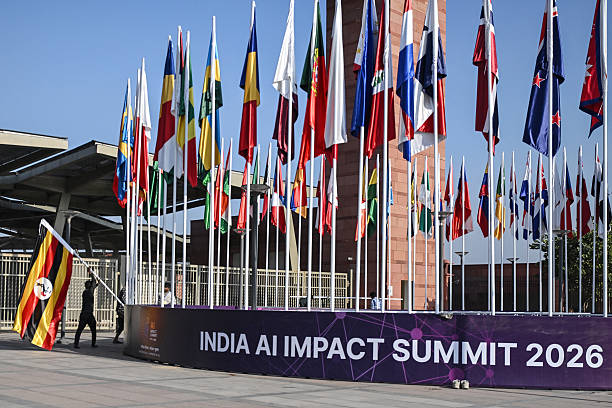
The world’s top artificial intelligence (AI) companies are heading to New Delhi, with Google CEO Sundar Pichai, OpenAI CEO Sam Altman, Nvidia CEO Jensen Huang, and Meta’s Chief AI Officer Alexandr Wang among the executives confirmed to attend the India AI Impact Summit 2026.
The summit is expected to run from February 16 to 20 at Bharat Mandapam, Pragati Maidan. The five-day event is organized by India’s Ministry of Electronics and Information Technology (MeitY) through its IndiaAI Mission, and is the first global AI summit of this scale to be held in the Global South.
The summit has recorded over 35,000 registrations from more than 100 countries, with 50 ministerial-level delegations and 15 to 20 heads of government expected to attend. French President Emmanuel Macron is scheduled to speak on February 19 alongside Prime Minister Narendra Modi, who will also chair a roundtable with CEOs of major technology firms.
Who Is Attending the India AI Impact Summit 2026
Confirmed participants include Google CEO Sundar Pichai, OpenAI CEO Sam Altman, Nvidia CEO Jensen Huang, Google DeepMind CEO Demis Hassabis, Meta Chief AI Officer Alexandr Wang, and Anthropic CEO Dario Amodei. Other notable attendees include Microsoft co-founder Bill Gates, Microsoft President Brad Smith, Amazon’s Chief Global Affairs and Legal Officer David Zapolsky, Qualcomm CEO Cristiano Amon, and Accenture Chair and CEO Julie Sweet.
On the Indian side, the summit will include Reliance Industries Chairman Mukesh Ambani, Infosys Chairman Nandan Nilekani, and Tata Group Chairperson N. Chandrasekaran, among other prominent industry leaders.
Software Technology Parks of India (STPI) Director General Arvind Kumar confirmed that Nvidia, Google, and OpenAI will be among 400 exhibitors at the India AI Impact Expo, the trade and innovation fair running alongside the summit.
What the India AI Impact Summit Addresses
The India AI Impact Summit 2026 is structured around three core pillars; People, Planet and Progress, with discussions focused on employment and skilling, sustainable and energy-efficient AI, as well as economic and social development. It has seven thematic working groups, co-chaired by representatives from the Global North and Global South, that will present concrete deliverables, including proposals for AI Commons, trusted AI tools, shared compute infrastructure, and sector-specific use cases of artificial intelligence.
The summit’s programming spans five days and includes high-level sessions, CEO roundtables, a research symposium, panel discussions, global hackathons, and addressing innovation challenges. A key result of the summit will be the Leaders’ Declaration, a jointly developed document that will reflect the policy positions and commitments agreed upon by participating governments and organizations.
Sessions will focus on AI policy, frontier research and business innovation, with a strong emphasis on social impact and alignment with national initiatives such as IndiaAI and Digital India and how AI can be applied to healthcare, agriculture, rural development, education, finance, governance, and public services.
Three global challenges are also part of the summit framework: AI for All, which is open to innovators and startups; AI by HER, which spotlights women-led AI solutions; and YUVAi, a youth innovation challenge for participants between 13 and 21 years old. Together, these three initiatives have drawn over 15,000 registrations from 135 countries.
India’s Place in the Global AI Conversation
The India AI Impact Summit 2026 follows the 2025 AI Action Summit held in Paris, the 2024 AI Seoul Summit, and the Bletchley Park AI Safety Summit in 2023. Each gathering has built on the previous one, and India’s edition is the first to be hosted outside the western world and East Asia.
Through this summit, India is specifically looking to shift the AI conversation from the Safety and Action themes of earlier summits to one focused on Impact, with an emphasis on driving implementation and measurable outcomes, particularly for deployment of the technology across the Global South and multi-sector collaboration. The summit also aligns with India’s broader national AI strategy, which prioritizes accessibility, inclusion, and the use of AI for public services at scale.


