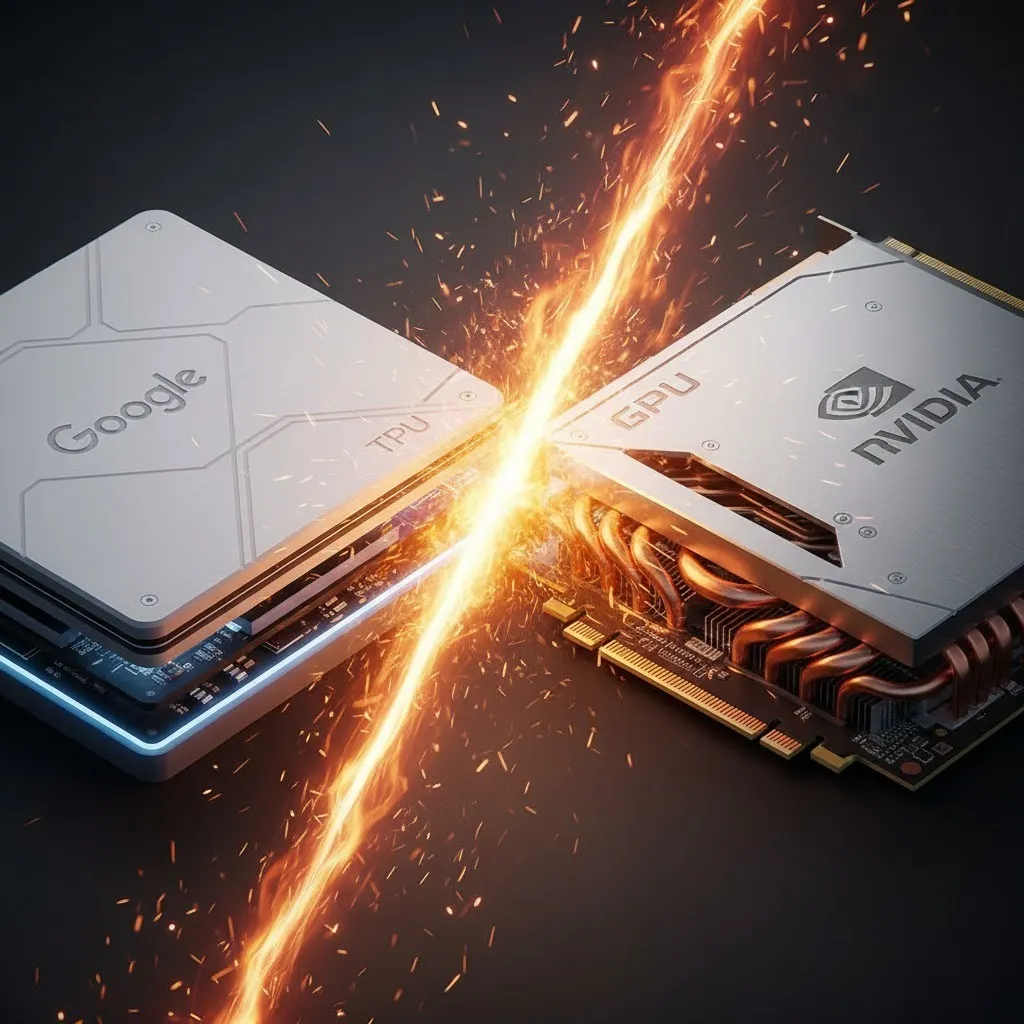
Google’s Tensor Processing Units (TPUs) pose a growing challenge to Nvidia’s dominance in AI hardware through its production of superior efficiency in large-scale workloads and massive planned deployments.
What this means is while Nvidia still maintains over 90% market share in GPUs used in data centers thanks to its CUDA ecosystem, Google’s custom-developed TPUs specifically excel in cost-optimized training and inference – something the AI industry desperately needs and is jumping at.
In other words, the shift marks an important reshaping of the AI infrastructure market, where cost efficiency and specialized performance are beginning to trump the software ecosystem advantages that have protected Nvidia’s 90% market share.
However, in response to this perceived threat, Nvidia boasts in an X post that they are “generation ahead of the industry.”
“We’re delighted by Google’s success – they’ve made great advances in AI and we continue to supply to Google,” the AI giant wrote. “Nvidia is a generation ahead of the industry – it’s the only platform that runs every AI model and does it everywhere computing is done.”
Nvidia also touts that their GPUs offer “greater performance, versatility, and fungibility than ASICs, which are designed for specific AI frameworks or functions.” While this may be true, Google’s latest custom silicon Ironwood TPU still stands as a serious competitor to Nvidia’s improvised Blackwell architecture.
While both architectures deliver great performance, Ironwood specifically gains distance in economics and scale, and this vantage point gives Google the ability to build AI systems with massive compute power.
Ironwood TPU also executes inference workloads at roughly four times the cost-performance of Nvidia’s H100 GPU. This helps Google’s stance as a strong competitor seeing as inference workloads are predictably the thing that will consume 75% of all AI compute by the end of the decade but yet receives a fraction of optimization focus in the AI hardware industry.
There is also a recent decentralization shift in the industry as many tech companies are not participating and remaining in singular partnerships with Nvidia to serve their AI needs. For instance, Meta announced back in December 2025 they were in advanced talks to spend billions of dollars on Google’s AI chips in a bid to avoid the company’s over-reliance on Nvidia’s hardware.
This competitive timeline matters for the industry at large – for both investors and the companies. Nvidia may use this competition to their advantage to gain clarity and accelerate its own efficiency improvements and double down on workloads where general-purpose design remains strategically valuable.
“We are experiencing accelerating demand for both our custom TPUs and Nvidia GPUs,” was what a Google spokesperson said in a statement. “We are committed to supporting both, as we have for years.”