






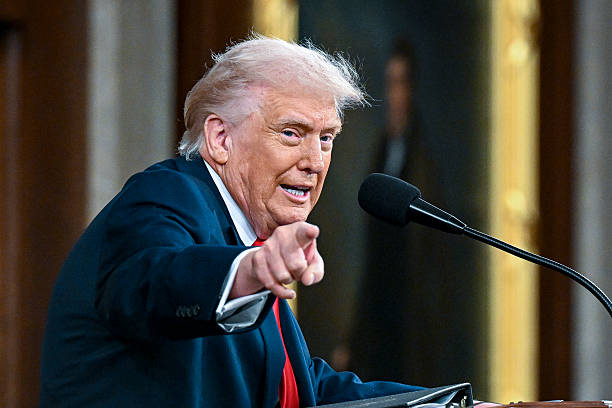
U.S. President Donald Trump used his State of the Union address to announce a new policy requiring major technology companies to generate their own electricity for their AI data centers, rather than drawing from the national grid and passing those costs on to American consumers.
“We’re telling the major tech companies that they have the obligation to provide for their own power needs,” Trump said during the address. “They can build their own power plants as part of their factory so that no one’s prices will go up, and in many cases, prices of electricity will go down for the community, and very substantially down.”
The Ratepayer Protection Pledge
Trump framed the directive around what he called a “ratepayer protection pledge,” an agreement he said he had already negotiated with the tech sector ahead of the address. While he did not explain the nitty-gritty of the pledge, Trump added that these technology companies are “going to produce their own electricity.”
The details of enforcement, however, remain unclear, as Trump did not specify which companies are bound by the pledge or even outline consequences for non-compliance.
It goes without saying that these major tech companies may include Elon Musk’s xAI, Amazon, Google, Meta, Microsoft, Oracle, and OpenAI, and they are reportedly expected to formally sign the pledge when they visit the White House in early March, according to anonymous sources who informed Reuters.
Why the Grid Can’t Keep Up
At the center of the problem is the sheer scale of electricity that AI data centers now demand and an aging national grid that was never designed to handle it.
“We have an old grid. It could never handle the kind of numbers, the amount of electricity that’s needed,” Trump said during the address.
The numbers back that up. In 2025, regulators across the country approved $11.6 billion in rate increases to accommodate AI’s electricity demands, many of which have already taken effect.
And that spike is also showing up directly in household bills as AI data centers have been linked to expected monthly residential electricity bill increases of, for example, $16 in Ohio and $18 in Western Maryland.
Tech Companies Are Already Building
The directive comes as many tech companies have already begun building independent power infrastructure. According to a February 2026 report from Cleanview, a data visualization firm that tracks clean energy and data center projects, roughly 30% of all planned data center capacity in the United States has plans to build its own power plants. Of the 30%, 90% of the planned capacity was added in 2025 alone.
Elon Musk’s xAI is among the most visible examples. The company has deployed mobile generators at AI data center sites in Tennessee and Mississippi, although the move drew scrutiny because some of those generators were installed without permits.
Several major players have also announced voluntary consumer protection measures ahead of the formal pledge signing. Microsoft launched what it called its “Community-First AI Infrastructure” initiative, committing to cover higher utility rates tied to its data centers, reduce water consumption, and support local jobs and taxes. OpenAI also announced a similar initiative tied to its Stargate data center projects.
What Comes Next
The formal signing at the White House in early March will be the clearest indication yet of how binding this arrangement is meant to be. For now, it remains a pledge, with the weight of presidential pressure behind it, but without a defined legal enforcement.
What is clear is that the cost of building and powering AI data centers is no longer being treated as a problem for utility companies and consumers to absorb. Whether through self-built power plants, purchased capacity, or third-party agreements, Big Tech is now expected to foot its own energy bill.


