






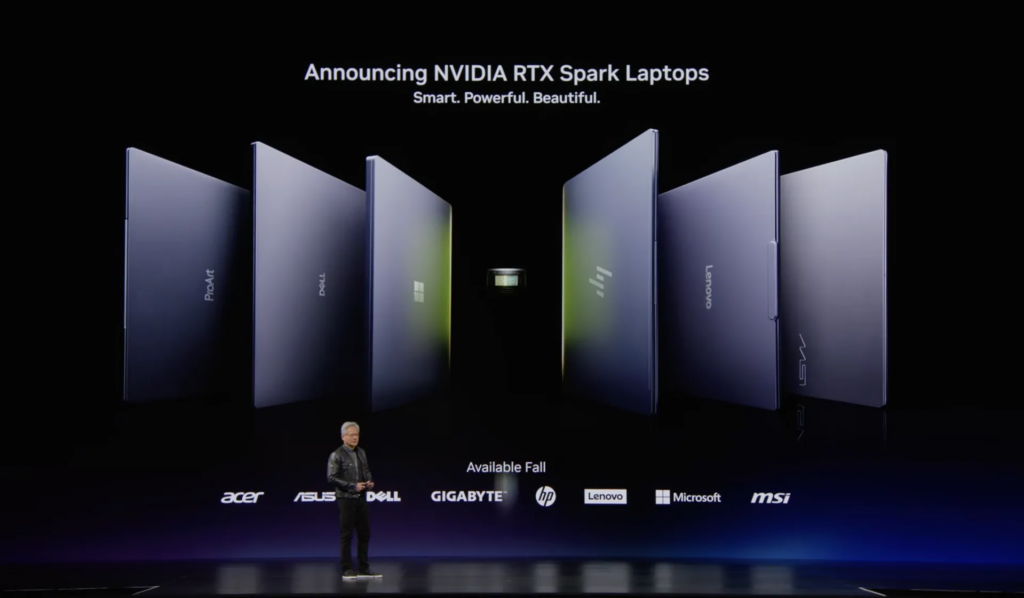
On the 1st of June 2026, Nvidia unveiled RTX spark and shook up the entire chip industry. The chip combines a 20-core Grace CPU with a Blackwell RTX GPU. In addition, it includes 128GB of shared memory and both the processor and the graphics chip can access this memory instantly.
Because of this design, the chip delivers massive computing power for AI tasks. A laptop with RTX Spark can run a very large AI model entirely on battery power and without an internet connection.
RTX Spark: The Superchip That Shook Computex 2026
On the stage in Taipei, Nvidia CEO Jensen Huang said “This is the reinvention of the computer. Every single application that Windows has ever run, this computer literally runs everything the world has ever created.”
As a result of this promise, more than 30 laptop brands have signed up. Dell, Lenovo, HP, Asus, MSI, and Microsoft Surface will all ship RTX Spark laptops this fall. Desktop versions will also arrive from these companies.
Furthermore, the stock market reacted within hours of the announcement. Nvidia shares rose 4%. In contrast, Intel shares fell 6% and AMD shares dropped 5%. This shows investors clearly see RTX Spark as a genuine threat.
Why the RTX Spark ARM Architecture Breaks the x86 Monopoly
To understand why investors reacted this way, let’s look at the chip’s design. Traditional PCs use Intel or AMD x86 chips. Those chips have dominated the chip industry for forty years.
However, RTX Spark instead uses an ARM CPU that Nvidia designed itself. This design tightly connects the processor to Nvidia’s graphics chips. Consequently, the machine runs AI assistants directly on the device with no need for a server. This local execution eliminates lag and improves privacy.
For example, Adobe is now rebuilding Photoshop and Premiere Pro as native ARM apps. Qualcomm tried for two years to get this support but failed and Nvidia succeeded in months.
For this reason, Nvidia’s CFO Colette Kress, projects a $20 billion in CPU revenue this fiscal year. These ARM-based chips are Nvidia’s biggest bet yet.
Intel‘s Nervous Welcome: “A Healthy Dose of Paranoia”
Nevertheless, Intel is not surrendering. Intel’s senior director Nish Neelalojanan admitted his team feels uneasy. “We always take everything with a healthy dose of paranoia,” he said. He also warned about “tons of compatibility, DRM issues, backwards compatibility” when ARM enters the PC market.
Meanwhile, Intel will keep partnering with Nvidia in data centers. But in laptops and desktops, Intel will fight Nvidia fiercely. Intel’s strategy leans on its decades-old software ecosystem.
As a rebuttal, the company points to RTX Spark’s high price. Early RTX Spark PCs will cost well above $1,500. In contrast, Intel plans to offer $599 Wildcat Lake processors for people on a budget. However, analysts believe Intel is far more worried than its public statements suggest.
AMD’s Calculated Counter: “We Were the Only Game in Town for Two Years”
On the other hand, AMD’s client SVP Rahul Tikoo took a different approach. “I’m really excited that Nvidia has joined the game,” he said.
Immediately after RTX Spark’s launch, AMD unveiled its Ryzen AI Max+ processors. Those chips support up to 192GB of shared memory. Tikoo notes there is “no translation layer, no performance loss.” This statement is a direct shade at ARM’s need to emulate older software.
In addition, AMD argues that its x86 chips run everything natively. The company also points to its Strix Halo products. AMD has shipped those chips with up to 128GB of shared memory for nearly two years. In other words, AMD claims Nvidia is just trying to catch up to them.
Why Intel and AMD Now Play Defense
According to benchmarks, a standard speed test called Clang compilation shows RTX Spark scoring 43,149. This score beats the 10-core Apple M5 by 54%. However, it trails the 15-core M5 Pro by just 7%.
Still, Windows-on-ARM software compatibility remains a real hurdle. Legacy x86 apps still need emulation, which slows them down but Nvidia promises full coverage over time.
Another barrier is price. RTX Spark systems will not appeal to shoppers on a budget at launch. Despite these challenges, the direction is clear. ARM is coming for the PC.
Ultimately, Nvidia brings AI firepower that its competitors never had. This has put Intel and AMD on the defense side. The silicon war has now entered a new era.


