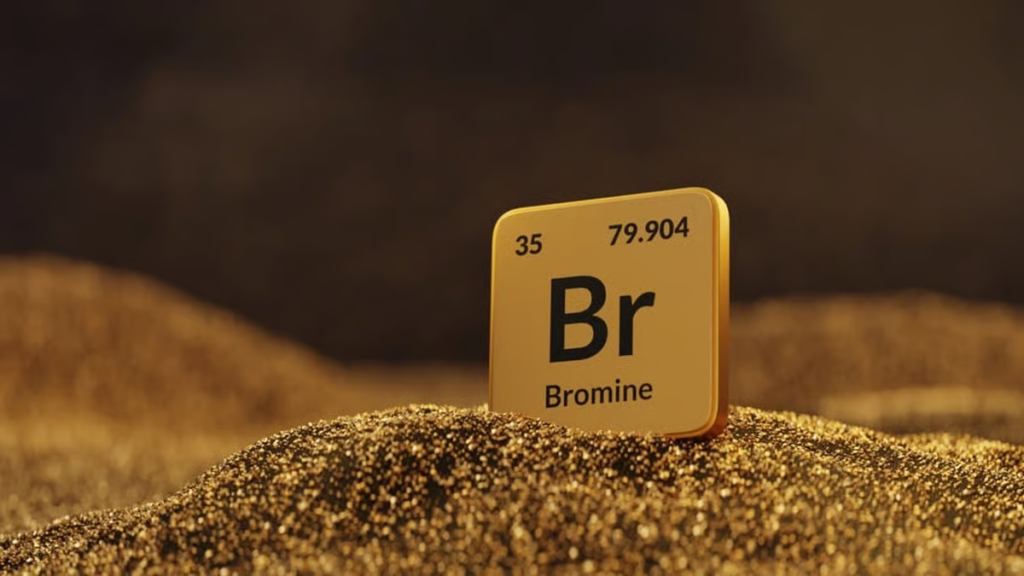
The chemical used in manufacturing RAM, Bromine, comes from the Dead Sea in Israel. In early 2026, Iranian missiles landed within 35 kilometers of the country’s main bromine production complex.
As a result, War risk insurance for Israeli ports jumped from 0.2% to 1.0% of each vessel’s value so the Middle East conflict became a tech crisis.
Israel’s Bromine Monopoly
In Israel, the Dead Sea region supplies about two thirds of the world’s bromine. A company called ICL Group controls roughly 40 percent of global production from the Israeli side.
In addition, South Korea depends on this arrangement almost completely. Recent trade data shows that South Korea imports 97.5% of its bromine from Israel. Samsung and SK Hynix, both companies from South Korea, manufacture the vast majority of the world’s RAM. Therefore, a lack of bromine means no RAM production or supply.
Why RAM Needs Bromine
For RAM production to run smoothly, a specific gas called hydrogen bromide (HBr) makes everything possible. Chip factories use HBr for a process called plasma etching and carve microscopic transistor patterns onto silicon wafers.
Furthermore, HBr is the perfect gas for this job. No other common gas comes close. Chlorine based alternatives fail at today’s tiny transistor sizes. A recent semiconductor materials report confirms that no drop in replacement exists for the most advanced chips.
Even if scientists found one tomorrow, qualification would take two to five years.
Conflict Hits the Supply Chain
However, the missile strikes did not hit the bromine complex directly but it was a very close call.
At the same time, shipping routes now face new dangers as well. The increase in war risk insurance ripples through every container of bromine leaving the country.
As a result, supply lines have become fragile. A single escalation near the Dead Sea could block exports for weeks.
From Bromine Shortage to RAM Crisis
Currently, the semiconductor factories operate on just-in-time inventories. A recent supply chain alert shows that fabrication plants hold only two to three weeks worth of HBr at any given time.
Hence, a thirty day disruption would halt memory production completely. Prices already show the strain. Smartphone prices in several emerging markets rose 10 to 25% in April. The reason is memory cost increases tied directly to bromine supply fears.
In addition, PC manufacturers warn of 15 to 30% price hikes later this year.
Seeking Alternatives
Nevertheless, the industry wants to break free from this dependence but Chlorine based etchants still lag far behind. They work for older chips but not for advanced nodes.
Furthermore, companies are racing to find solutions. Samsung Electronics recently announced a joint research project with TSMC. Their goal is to develop bromine recycling technology that captures and reuses the gas from fab exhaust.
However, commercial scale remains 18 to 24 months away. Until then, manufacturers should accelerate alternative research and consumers should expect higher memory prices in the near future.