






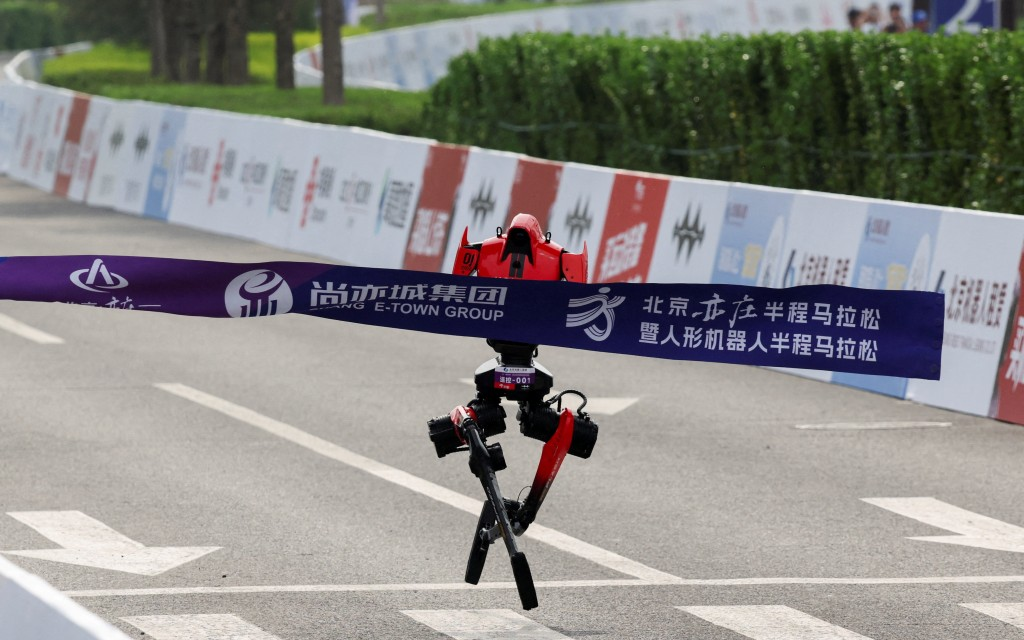
On the 19th of April 2026, China organized a half-marathon for humanoid robots in Beijing. One of the runners, a red humanoid robot named Lightning, completed the 21-kilometer course in 50 minutes and 26 seconds.
This win beat the human world record held by Ugandan runner Jacob Kiplimo by nearly seven minutes. For the people watching, it was a truly defining moment in the world of robotics.
Humanoid Robots Just Had Their Biggest Year Yet
To truly appreciate this feat, it takes understanding where things stood just a year ago. At the inaugural Beijing humanoid robot half-marathon in 2025, most robots failed to finish and the fastest completed the course in 2 hours and 40 minutes.
This year, four robots finished in under one hour. Participation also jumped from 21 teams to 102, with over 300 robots competing across 26 brands. That turnaround came down to one specific engineering fix.
Last year, motor heat buildup stopped robots from sustaining high speeds across long distances. To fix this, Honor’s engineers adapted a liquid-cooling system from smartphone manufacturing.
Then, they rebuilt Lightning with 95-centimeter legs modeled on elite human athletes. The result was a robot that ran at full speed for the entire race without stopping.
What the Race Did and Did Not Prove
However, the results have specific factors worth scrutinizing. The entire course was pre-mapped and rehearsed before race day. Support crews also followed every robot throughout and only 40% of competitors navigated autonomously. The rest relied on remote human operators.
In addition, Lightning itself crashed into a barrier after crossing the finish line and needed handlers to set it upright. MIT robotics professor Rodney Brooks called the event a publicity stunt. He argued that the controlled setup reveals little about real-world capability.
In contrast, University of Michigan professor Yanran Ding disagreed. He pointed out that efficiency across 21 kilometers without overheating is a difficult problem that needed solving.
Nevertheless, both arguments are valid. It is very important to understand that this is just a show of progress. It was not organized to demonstrate what humanoid robots can do in the real world.
China’s Humanoid Robots and the Race With the U.S.
This event was carefully planned by the Chinese government. In a 2023 policy document, China named humanoid robotics a new frontier in technological competition.
Then, they carried it out as a priority into their 2026-2030 five year plan. They funded infrastructure and subsidized domestic manufacturers.
At the moment, Chinese firms ship roughly 80% of humanoid robots globally.
Meanwhile, U.S. pension funds pulled back from Chinese robotics startups under growing regulatory pressure. Middle East sovereign funds stepped in, backing Chinese venture capital and buying locally developed machines.
In response, US robotics firms now look at Washington for a counter-strategy that includes potential tariffs on Chinese robots.
What Comes After the Finish Line
However, neither tariffs nor record breaking race times will settle who leads the next decade of robotics. Right now, engineers and investors should focus more on safety, viability and adaptability.
Honor’s engineers argued that Lightning’s cooling and structural reliability advances will transfer directly into commercial products.
Ultimately, that transfer is where the real contest is and the government on both sides know it. The half-marathon might have broken a record but the real contest has no end in sight.


