
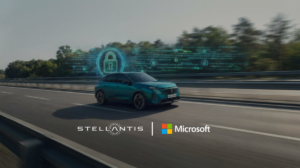






Car manufacturing and software development have long operated like two separate lanes on a highway. Stellantis and Microsoft are now merging them.
The two companies recently announced a five-year strategic collaboration that is focused on co-developing advanced AI, cybersecurity, and engineering capabilities. The deal builds on an existing relationship and covers a wide range of the automaker’s operations. It also includes a plan to cut Stellantis’ datacenter footprint by 60% by 2029 as the automaker shifts more of its digital backbone to Microsoft Azure.
Why Cybersecurity Matters Here
Think of a modern-connected car the way you think of a smartphone. It sends and receives data constantly, connects to apps, and stores personal information, and that makes it a target. The case is so for a modern-connected car.
To make its cars less of a target, Stellantis will deploy and operate an AI-driven global cyber defence centre that will power its IT systems, connected vehicles, manufacturing sites, and digital products.
This is designed to detect cyberthreats faster, protect customer data, and strengthen resilience across the company’s global operations. And this matters because modern vehicles are increasingly software-heavy, with mobile apps, in-vehicle services, and cloud-linked systems that all create more entry-points for attacks.
Over 100 AI Initiatives Across the Business
If cybersecurity is the defensive line, then the AI initiatives are the offensive strategy for Stellantis. Both Microsoft and Stellantis will co-develop more than 100 initiatives related to AI and cybersecurity, covering areas such as sales, customer care, product development, and operations.
The AI initiatives being prioritised include product validation, warranty reduction, and predictive maintenance. These are less about building something new and more about fixing what is already broken.
Stellantis is also rolling out Microsoft’s enterprise AI tools company-wide. Every Stellantis employee now has access to Microsoft’s Copilot Chat assistant, with 20,000 Microsoft 365 Copilot licences rolled out to support specific roles across the company.
Stellantis is also cleaning house on the infrastructure side. The company will migrate to Microsoft Azure, with a target to reduce its data centre footprint by 60% by 2029. Moving to Azure is similar to a company switching from maintaining its own server room which may be expensive, aging, and hard to scale, to renting storage and computing power in a modern facility built for exactly that purpose.
The Business Angle and What to Watch
For Stellantis, the partnership sits within a broader move to embed software deeper into its vehicle and business platforms. And for Microsoft, it adds another major industrial partner in a sector where AI, cloud, and cybersecurity means more.
Both companies said the goal is to deliver practical benefits for drivers, including more responsive services, stronger connectivity, and better protection of data and digital features.
Also, the scale of this agreement stands out because it is tied to execution milestones. More than 100 AI projects, a dedicated cyber defense center, Azure migration, workforce deployment of Copilot tools give the collaboration visible checkpoints over the next few years, etc.
The key question now is how quickly these plans translate into shipped features, safer connected services, and smoother operations across Stellantis’ global business.


