






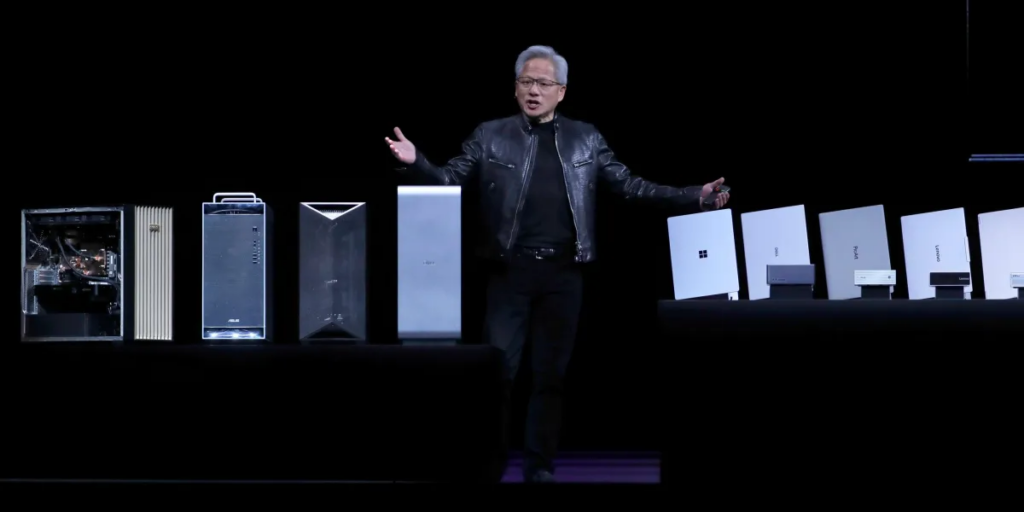
Nvidia’s consumer AI now sits at the center of the company’s next growth strategy. For years, Nvidia powered the AI boom through data centers. Now, the company wants to change things up.
At Computex 2026, CEO Jensen Huang introduced a broader vision for personal AI. Instead of sending every AI task to the cloud, users could run more workloads locally on their personal computers.
Why Nvidia’s Consumer AI Signals the End of Cloud-Only AI
Until recently, most advanced AI systems depended on cloud infrastructure. Companies built large data centers and processed requests remotely so users relied on distant servers for AI responses.
However, that approach creates new challenges. AI inference costs continue to rise. Every response requires computing resources. As usage grows, those expenses also increase.
In addition, many organizations want greater control over sensitive data, faster responses and fewer cloud dependencies. Because of these concerns, Nvidia noticed an opportunity.
Instead of routing every request through remote servers, users could process more AI tasks locally. As a result, they could reduce delays and keep more data on their devices.
RTX Spark Is the Foundation of Nvidia’s New Strategy
To support this strategy, Nvidia introduced RTX Spark. The platform combines an Arm-based CPU with a Blackwell GPU. It also includes unified memory designed for AI workloads.
Unlike traditional consumer PCs, RTX Spark focuses heavily on AI processing. It aims to support more advanced AI applications.
At the same time, Nvidia wants to support agentic computing. These systems can perform tasks with less user direction so they require greater computing power. This positions the platform as a foundation for personal AI systems.
Nvidia’s Consumer AI Creates a New Growth Market
Nvidia already dominates the AI data center market. However, the company sees another opportunity in personal computing.
The AI PC market has become very competitive. Intel, AMD, Apple, and Qualcomm all want a larger role in that category. Hence, Nvidia has expanded partnerships across the PC ecosystem.
Additionally, the company’s consumer strategy reflects a broader goal. Nvidia wants its technology to power AI workloads wherever they run. That includes both large data centers and future AI computers.
As a result, consumer AI gives Nvidia another avenue for expansion beyond its traditional roles.
What a Personal AI Future Means For Users and the Industry
Ultimately, Nvidia’s strategy reflects a broader industry shift. For years, companies concentrated computing power in large facilities while personal devices consumed those services.
If Nvidia’s strategy succeeds, users could run more advanced AI applications locally, while businesses could deploy AI agents closer to their operations.
However, data centers will still play a critical role in training large AI models but personal computers may take on a larger role in everyday AI use. Nvidia’s consumer strategy positions the company for that possibility as the industry continues to evolve.


