


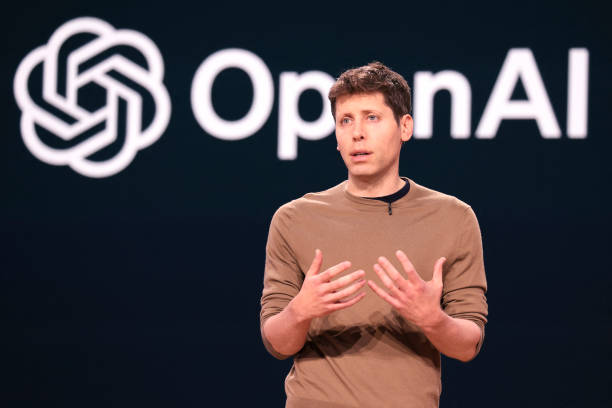
OpenAI CEO Sam Altman recently told employees in an internal Slack message, viewed by CNBC, that ChatGPT is “back to exceeding 10% monthly growth.” The announcement comes as the company is in active discussions to close what could be the largest private funding round in tech history, and as pressure from rivals intensifies on multiple fronts.
The AI startup currently counts more than 800 million weekly active users on ChatGPT, according to the same internal communication. While that figure alone is striking, late 2025 saw a slowdown in ChatGPT downloads, with Altman declaring a “Code Red” to prioritize improvements on the famous chatbot.
This immediately fueled concerns that the market had reached saturation, especially going by the fact that there are other companies offering comparable reasoning capabilities at significantly lower cost.
Altman’s latest message to staff appears to put those concerns to rest, at least for now.
And beyond user growth numbers, the update also covered OpenAI’s coding tools. Altman said Codex, OpenAI’s coding product, grew about 50% week-over-week and directly competes with Anthropic’s Claude Code. The surge in Codex usage coincides with the launch of o3-mini, a model built specifically for STEM and coding tasks rather than general creative work.
A $100 Billion Funding Round Taking Shape for OpenAI
Altman and CFO Sarah Friar have been meeting with investors to make the case for OpenAI’s continued growth, as the company works toward closing a funding round that could reach $100 billion. The negotiations are expected to heat up in the coming weeks, according to anonymous sources who spoke with CNBC.
The round has attracted some of the biggest names in global technology. Amazon is reportedly in talks to contribute at least $50 billion, with Amazon CEO Andy Jassy personally leading the negotiations with Altman. SoftBank, which already contributed $30 billion to OpenAI’s previous $41 billion round completed in March 2025, is considering adding another $22.5 billion to its total commitment. Amazon, Microsoft, and Nvidia are all in active discussions to participate, according to CNBC.
A successful close would value OpenAI at up to $830 billion, which, to emphasize how massive it is, is more than the GDP of Argentina. Much of that capital is expected to fund infrastructure in the name of building data centers. OpenAI already holds roughly $40 billion in cash on its balance sheet, meaning the $100 billion target is less about keeping the lights on and more about securing long-term computing resources for its next generation of AI infrastructural development.
Revenue Push and OpenAI’s Advertising Gamble
Despite its enormous user base, OpenAI ended 2025 with $20 billion in annualized revenue but is projected to lose approximately $14 billion in 2026, which is roughly three times its 2025 losses.
To close the losses gap, OpenAI has moved into advertising. An Ad service that started in early February saw adult users in the United States on the free tier and the $8-per-month ChatGPT Go subscription experience clearly labeled ads at the bottom of ChatGPT responses. However, the company has stated that ads will not influence ChatGPT’s answers and that advertiser data will be kept separate from individual conversations.
The decision drew a response from Anthropic. During Super Bowl LX, Anthropic ran a campaign with the tagline “Ads are coming to AI. But not to Claude.” Altman called the ads “clearly dishonest” in a lengthy post on X, arguing that OpenAI’s approach to advertising would look nothing like what Anthropic depicted.
A Competitive Landscape That Isn’t Letting Up
OpenAI is preparing for an initial public offering (IPO) later in Q4 2026 as competition from Google’s Gemini and Anthropic’s Claude intensifies. For example, Google’s Gemini exceeded 750 million monthly active users last December, while Anthropic gained significant ground with enterprise customers, particularly through Claude Code and Claude Co-work, a desktop tool developed for white-collar workers.
For OpenAI, the next few weeks will matter considerably. A closed funding round at the reported scale would give the company the resources to sustain its infrastructure buildout and keep its models competitive. Altman’s claim of a 10% growth gives investors something concrete to point to, although whether that pace can hold against an increasingly well-funded and competitive field remains the real question.
