






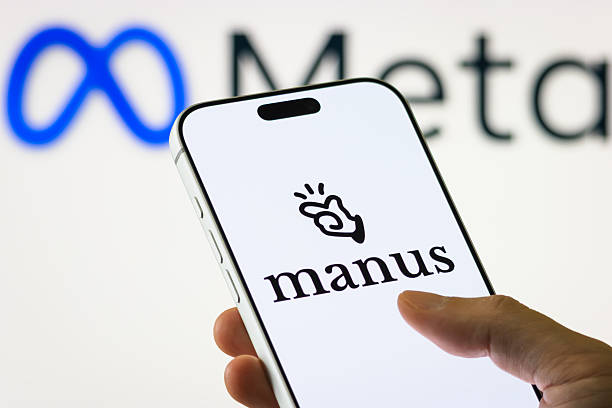
Meta has acquired Manus, a fast-rising AI startup based in Singapore with Chinese founders, in a deal valued at more than $2 billion.
Finalized in late December 2025, the deal will bring Manus’ advanced AI agent technology under Meta’s AI umbrella to supercharge its push into developing Agentic AI, which are systems that act autonomously on complex tasks.
Manus’ CEO Xiao Hong will report directly to Meta’s COO Javier Olivan, while the startup’s operations will continue from Singapore.
What Manus Brings to the Meta’s Table
Manus has built a reputation for creating AI agents that can navigate multiple software platforms simultaneously while maintaining context across different tasks. The Singaporean-based company’s Agent Mode was designed to take on complex tasks from handling data analysis to customer service interactions and to building a website.
Manus’ technology differs from traditional chatbots in a crucial way as the startup’s agents can actually complete multi-step tasks and workflows without necessarily needing human contribution or supervision.
In other words, while most AI assistants today require users to break down tasks into specific commands, Manus’ agents can interpret high-level tasks and figure out the necessary steps themselves.
Why Agentic AI Drives the Deal For Meta
Agentic AI represents the next frontier beyond chatbots, moving beyond software that just answers questions to executing mutli-step plans independently. Meta, with its over 3.3 billion daily users across Facebook, Instagram, and Whatsapp, sees this as key to embedding AI companions everywhere. And Manus fits perfectly as it offers production-ready tech that integrates with Meta AI.
Industry analysts have noted that this bolsters Meta’s position against OpenAI’s GPT series as well as Google’s agents, especially as the AI arms race continues to heat up in building autonomous systems. It also reflects the broader industry momentum toward building Agentic AI, which many analysts consider the next major phase of artificial intelligence development.
As companies are racing to move beyond conversational AI tools toward systems that can take meaningful action on behalf of users, Meta plans to roll Manus tech into enterprise tools and consumer apps, potentially monetizing via premium features.
More importantly, for Meta’s business model, Agentic AI could transform how advertisers create and manage campaigns, how creators produce content, and how users interact with Facebook, Instagram, and Whatsapp.
The social media giant envisions AI agents that can help small businesses optimize their advertising spend, assist influencers with content scheduling and audience engagement, and even facilitate more natural commerce experiences.
As such, the Manus acquisition gives Meta immediate access to proven technology to make it happen and experienced talent in a field where expertise remains scarce.
Competitive Landscape and What Happens Next
Meta isn’t alone in pursuing this technology aggressively as Google recently expanded its AI agent capabilities through its release of Project Mariner, an experimental AI agent that uses Google’s Gemini model to understand and automate tasks within users’ Chrome browser, like searching, shopping, or planning trips, by controlling the cursor, clicking, and filling forms on their behalf.
Also Microsoft has integrated autonomous features into its Copilot platform, and Salesforce launched Agentforce last year with a specific focus on enterprise applications. The competition has intensified and promises to look that way for a long time as many companies have realized that Agentic AI could fundamentally reshape how people work and interact with this technology, and how the technology works for them too.
The bigger question now is how quickly Meta can deploy Agentic AI features to consumers and fully enter the competitive race, as well as whether the company’s massive spend so far on the development and integration of AI can be justifiable.


