






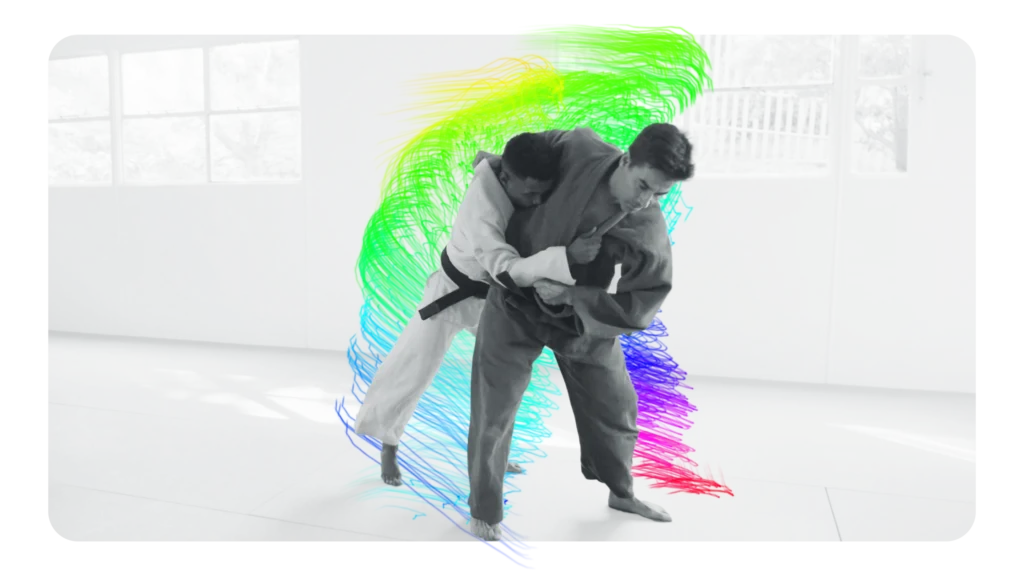
Google DeepMind has released D4RT (Dynamic 4D Reconstruction and Tracking), a unified AI model that reconstructs dynamic scenes from video at speeds 18 to 300 times faster than previous methods. The model processes a one-minute video in roughly five seconds on a single TPU chip, while earlier approaches required up to ten minutes for the same task.
The model addresses a fundamental challenge in computer vision which is taking flat 2D video sequences and recovering the full 3D world in motion. Unlike traditional systems that rely on multiple specialized models for different tasks like depth estimation, motion tracking, and camera positioning, D4RT uses a single unified framework.
Key Capabilities of D4RT and Performance Results
D4RT utilizes a unified transformer architecture to jointly infer depth, spatio-temporal correspondence, and full camera parameters from a single video. The model’s flexible querying mechanism enables several distinct capabilities through the same interface.
For point tracking, the model predicts the 3D trajectory of pixels across different time steps. It can track objects even when they move out of frame or behind obstacles. For 3D reconstruction, D4RT generates complete point clouds and depth maps of scenes without requiring iterative optimization processes that previous methods relied on.
The model also estimates camera poses by aligning snapshots from different viewpoints and accurately reconstructing the camera’s movement path through the scene. This handles both static environments and dynamic scenes with moving objects.
On the MPI Sintel benchmark, which features complex synthetic scenes with fast motion blur and non-rigid deformation, D4RT demonstrates superior fidelity compared to recent strong baselines.
The model achieves state-of-the-art accuracy across dynamic scene benchmarks while demonstrating up to 300 times faster inference compared to previous approaches. On camera pose estimation tasks, D4RT achieved over 200 frames per second processing speed on an A100 GPU.
Previous reconstruction methods often duplicated moving objects in their outputs or failed to reconstruct dynamic elements entirely. D4RT maintains continuous understanding of the moving world, tracking all dynamic pixels in a unified reference frame.
Practical Applications
The speed improvements position D4RT for real-time applications that were previously impractical, with the model’s efficiency making on-device deployment realistic for robotics and augmented reality applications that require real-time processing without cloud dependence.
For robotics, D4RT provides the spatial awareness necessary for navigation and object manipulation in environments where objects move or lighting conditions change. The ability to predict object positions even when they’re not visible addresses collision scenarios where vision systems are not aware and lose track of obstacles.
In augmented reality, placing virtual objects convincingly into real scenes requires accurate 3D understanding. D4RT’s processing speed brings this capability closer to running directly on devices like AR glasses or smartphones without requiring external servers.
The model also advances Google DeepMind’s broader world models initiative, which focuses on building systems that can simulate and predict real-world environments rather than processing text and images in isolation.


