






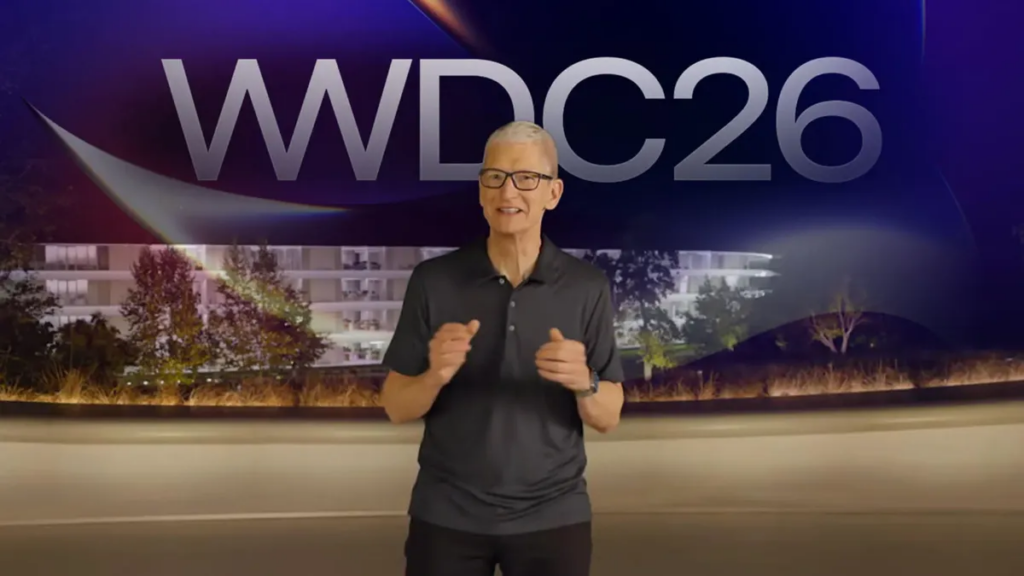
Apple WWDC 2026 has shifted attention from software updates to something even bigger. During the keynote speech at the conference, the company announced a major AI upgrade to Siri and everyone is talking about it.
On the 8th of June 2026, Apple kickstarted the WWDC 2026. The conference drew developers from 65 countries to Apple’s Silicon Valley headquarters.
From Feature Drops to Foundational Intelligence at Apple WWDC
Currently, Apple no longer treats AI as an add-on feature. Instead, intelligence has become a foundational layer across every platform. The company weaves AI into iOS 27, iPadOS 27, macOS 27 “Golden Gate,” watchOS 27, visionOS 27, and tvOS 27.
Consequently, this represents Apple’s most ambitious software overhaul in years. The company is moving from adding isolated AI features to building an ecosystem where intelligence sits at the centre of the user experience.
Siri AI Tears Down the Old to Build a Systemwide Agent
Beyond the platform-wide overhaul, the software centers Siri above all others. Apple rebuilt the assistant completely from the ground up. From a simple voice command tool, Siri AI has become a fully conversational, systemwide agent.
Furthermore, the assistant can draw on personal context to search across messages, emails, and photos. It answers questions about on-screen content and retrieves up-to-date information from the web.
In addition, a dedicated Siri app syncs conversation history across all devices via iCloud. Users can start a request on one device and finish on another.
Deep Integration Across Every Device Creates a Universal Interaction Layer
This new Siri does not live only on the iPhone. It works identically across iPad, Mac, Apple Watch, and Apple Vision Pro. For example, on the MacOS 27, Siri appears in Spotlight transforming search into an AI-powered Q&A hub.
On the iPhone, a new Siri Mode in the Camera app lets users point at objects and get real-time information. Also, Apple Watch users can now initiate conversations from their wrist. Siri also expands to CarPlay and AirPods.
As a result, this universal experience gives Apple an advantage competitors will find difficult to replicate.
The Hybrid Architecture Blends Apple’s Models with Google’s Infrastructure
To make Siri work everywhere, Apple had to rebuild the underlying architecture. Siri AI runs on Apple’s own third-generation Apple Foundation Models. These models are custom-built for Apple Silicon and use none of Google’s deployed assistant stack.
Instead, Apple’s models are refined using outputs from Gemini frontier models. Gemini teaches and Apple’s smaller models learn.
For its most demanding model, Apple extended Private Cloud Compute onto Nvidia GPUs inside Google’s cloud. A new on-device model packs 20 billion parameters but activates only one to four billion per request.
Apple’s software engineering chief stated: “We believe privacy in AI is non-negotiable”. He added that “requests are never stored” and “never accessible to anyone”. This privacy-first framing allows Apple to contrast its approach with rivals that require opt-in for personal data access.
Strategic Implications Shape the Regulatory Front at Apple WWDC
Taking all this together, Apple WWDC 2026 answered critics who said Apple lagged in the AI race. Yet, the repositioning comes with trade-offs. Siri AI will not launch initially in the European Union due to regulatory concerns.
In addition, device compatibility is also narrowing. Siri AI requires iPhone 16 and later, iPhone 15 Pro, M1-and-later iPads and Macs, and Apple Vision Pro.
Ultimately, the key takeaway is clear. Apple is no longer playing catch-up on AI. iOS 27 looks like Apple’s most consequential software release in years. The future is intelligent but not without tradeoffs.


