






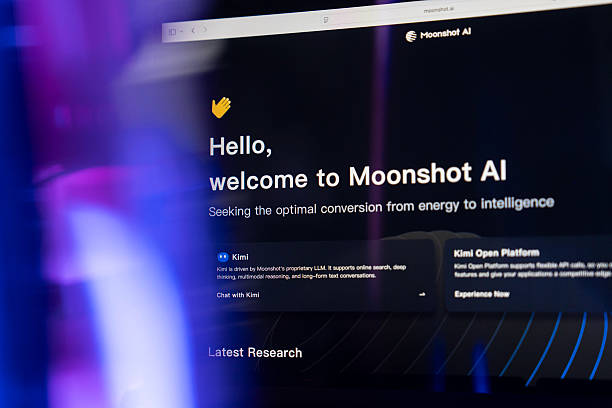
Moonshot AI, the Beijing-based lab behind the Kimi series of open-weight large language models, has raised roughly $2 billion at a valuation of $20 billion.
The round was led by Long-Z Investments, the venture capital arm of Chinese food delivery giant Meituan, with additional participation from Tsinghua Capital, China Mobile, and CPE Yuanfeng. The raise is the largest single funding event in China’s large language model sector, making Moonshot the best-funded AI lab in the country.
The company has now raised $3.9 billion over the past six months. For context on how fast things have moved, Moonshot was valued at $4.3 billion at the end of 2025, more than doubled to $10 billion by early 2026 following a $700 million raise, and has now climbed to $20 billion.
Who Is Behind Moonshot AI?
Moonshot AI was founded in 2023 by Yang Zhilin, a former Tsinghua University professor who previously worked at Meta and Google. The company focuses on large language models, AI agents, and enterprise AI infrastructure.
Its Kimi chatbot platform has become one of China’s highest-profile AI consumer products, while Moonshot AI has increasingly expanded into coding models, agentic AI systems, and enterprise AI services.
The Model That Changed the Conversation
Much of Moonshot’s current momentum comes from the performance of its Kimi models. Kimi K2.6 is a 1-trillion-parameter Mixture-of-Experts model with 32 billion parameters active per token, meaning inference runs at the cost of a 32B model while the full capacity of a trillion-parameter architecture remains available for routing.
On SWE-Bench Pro, K2.6 edges past GPT-5.4 by 0.9 points and clears Claude Opus 4.6 by five points. The hallucination rate on AA-Omniscience also dropped from 65 percent on K2.5 to 39 percent on K2.6, a calibration improvement that matters more for real production deployment than most top-line benchmark gains.
Kimi K2.6 is now the second most-used large language model on OpenRouter globally. Its models also compete directly with ChatGPT, Gemini, and Claude.
The company’s revenue is growing too. Moonshot’s annual recurring revenue (ARR) topped $200 million in April, driven by rapid growth in paid subscriptions and API usage. That revenue figure gives the valuation firmer grounding and signals that the company is building a real commercial business alongside its research output.
A Broader Shift in China’s AI Landscape
Moonshot’s raise reflects a wider trend across China’s AI sector. Zhipu AI, which trades in Hong Kong as Knowledge Atlas Technology, ended last Thursday with a market cap of roughly $55.9 billion, while MiniMax closed at about $33 billion, after both stocks rallied on new model releases. DeepSeek, perhaps the most well-known Chinese AI lab internationally, is reportedly in talks to raise outside capital for the first time, at a valuation of about $45 billion.
The picture that emerges is of an entire ecosystem gaining commercial scale and investor confidence at speed. Chinese AI labs are shipping competitive models, attracting serious capital, and generating real revenue, all at the same time.
Moonshot AI’s fresh capital is expected to go toward scaling model development, expanding enterprise sales, and strengthening infrastructure as competition intensifies across China’s AI sector. With Kimi K2.6 already ranking among the top open-weight models in the world, what Moonshot does with $2 billion and a $20 billion valuation will be worth watching closely.


